We use cookies to ensure you get the best browsing experience. By continued use, you agree to our privacy policy and accept our use of such cookies. For further information, click FIND OUT MORE.
Make this your preferred source to get more updates from this publisher on Google.
As the internationally-acclaimed director behind modern classics such as “Kinatay” and “Serbis”, Brillante ‘Dante’ Mendoza is renowned the world over for his ability to tell often-intimate, sometimes-disturbing, stories. With his latest release, “Thy Womb”, bagging top honors and critical acclaim at the 2012 Venice International Film Festival, it seemed the perfect time to showcase this Cannes winner’s work in his home country with a mainstream push via the 2012 Metro Manila Film Festival. However, despite the presence of star power from Nora Aunor, Bembol Roco, Mercedes Cabral and Lovi Poe, the film failed to find a local following.
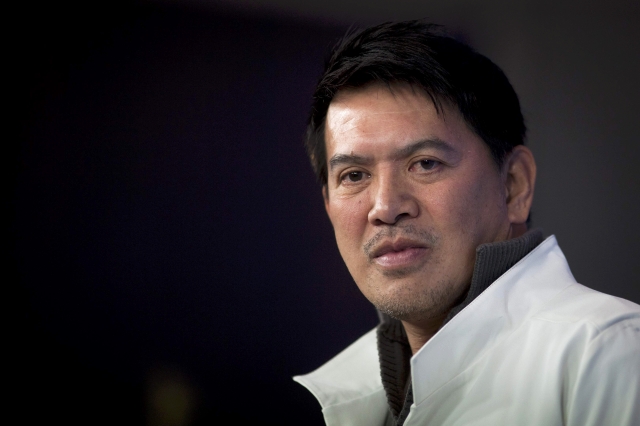
"I've never tried to compete in the mainstream because I'm not mainstream," said Brillante Mendoza. REUTERS/Thomas Peter
GMA News Online: How would you compare “Thy Womb” to your previous films?MENDOZA: People have asked me why “Thy Womb” is very subtle, very mellow, unlike “Kinatay”, which was very in-your-face. What I want to tell them is that the story is very different from “Kinatay”, what I wanted to say was different. The story dictated that I say what I wanted to say in that way. Everything comes from what you’re trying to say with your film, from the production design to the cinematography… everything, even the editing. “Thy Womb” didn’t call for (in-your-face) treatment…it’s more poetic, more subtle; it’s about going with the flow, like waves on the water we were shooting on. Sometimes, there are big waves, and we represented those too, but otherwise, it was the film we wanted to make. Q: In your opinion, why did “Thy Womb” fail to strike a cord with local audiences, leading some theaters to try pulling it from their screening schedules?MENDOZA: I don’t know why they reacted that way (laughs) because, on my part, I’m just here to make films. I’ve never tried to compete in the mainstream because I’m not mainstream. Even if it was a mainstream festival, I was just happy to be there, I wasn’t there to compete with anyone. I knew from the very start that I was going to fail. [Questions like] why don’t they understand it? Why don’t they appreciate it? Why wasn’t “Thy Womb” a hit in the Philippines? Well of course they won’t appreciate it, they don’t have a taste for it yet! So you have to do it slowly. Of course, I’m not saying that even if you do it slowly, it will become the next mainstream – that will never happen. My mistake was trying to do [the promotions] in the mainstream way. Now, I’m trying to do it the independent way. The approach has to be underground, like, for instance, all the MMFF entries are done with their screenings. Thanks to social networks and schools, I have “Thy Womb” screenings up until next year!
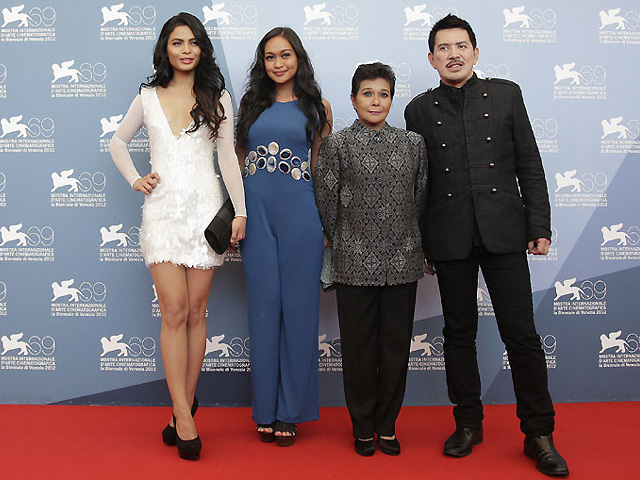
Brillante Mendoza (right) poses with Kapuso actress Lovi Poe (left), Mercedes Cabral (2nd left) and Nora Aunor during the photocall of the movie 'Thy Womb' at the 69th Venice Film Festival. Reuters/Tony Gentile
Q: So you get your satisfaction from these smaller screenings?MENDOZA: Exactly! And I feel more fulfilled because I would never be allowed to speak at regular screenings, never be able to directly address viewer’s concerns or questions. Here, a student can just ask, “why did the film end that way?” and I can answer. It’s honest, and it fulfils your objectives as a filmmaker, as an advocate. Q: Aren’t there instances of independent films becoming box office successes?MENDOZA: I think there’s misconception about that. Nowhere is it written that just because you’re independent, your film can’t do well, nor does it mean that just because you’re independent, your film has to be small or extremely raw. You have to know your audience and what you’re trying to say with your film. Don’t hope or dream that your indie will become mainstream. Take (Marlon Rivera’s) “Babae Sa Septic Tank”, which was done by alternative filmmakers out of an independent outfit. But how many films have succeeded the way that one did, among all of those that have been made? We can’t use “Septic Tank” as a basis because it made money. The thing is, it didn’t make a lot of money, but it was able to make a profit because it was a small production with low overhead. If you make the same film in the mainstream, you’d need to spend P30 million, and then you’d need to gross P90 million. You can’t hope to spend P3 million or P4 million and hope to make P90 million, it doesn’t happen. Now, there are those that are hits, but it doesn’t mean that just because “Septic Tank” made it, all the independent films will make it. You can have your Robin Padillas or your Kris Aquinos, but even they have flops – and that’s the mainstream! There’s never any guarantee that just because you have a film, you’re going to make money at the box office. Q: What if a major studio decided to remake your film with the same cast, locations and themes?MENDOZA: There’s always a way to tell a good story, but you cannot have the same message. Any story, produced differently, would always have a different message. Q: You told us before that one of your favorite moments in (the classic) “Himala” was when Nora Aunor’s character is catatonic following her rape, and that it broke your heart to learn her onscreen silence was the result of miscommunication between her and director Ishmael Bernal than any actual instructions. Do you have any such unexpected moments on your sets?MENDOZA: All the time! And more often than not, it works! I come from advertising, so I like to make sure that everything is planned to the smallest detail. But then when we come to the day of the shoot, I tend to follow what the situation gives me. A lot of times, what you see, what happens on the set is perfect, not what you plan. Q: How about when something doesn’t work?MENDOZA: I know when to stop. I listen to my people, I listen to my actors. As a filmmaker, as a director, you should know how to be a team player while also serving as team leader. Never get into that mind set that you’re always right just because you’re the director and no one else has any good ideas. It’s all about collaboration, and that’s why I respect so much the artists around me. In fact, they work hard because they know I listen to their suggestions, so they can’t help but be as passionate as I am. – KDM, GMA News


 GMA Brandtalk
 Tracking
 Archives