

 GMA Brandtalk
 Tracking
 Archives

ADVERTISEMENT
Filtered By: Lifestyle
Lifestyle
Movie review: Revisiting Jurassic Park, this time in 3D
+
Make this your preferred source to get more updates from this publisher on Google.
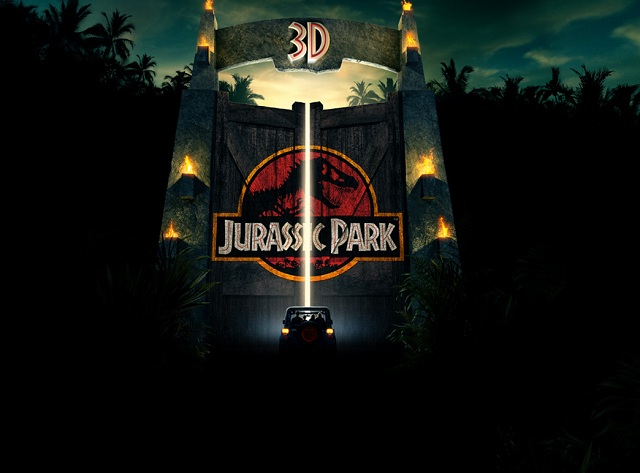
Jurassic Park stomps back into theaters, this time in 3D.
Twenty years after its first release, box office juggernaut “Jurassic Park” returns to cinema screens with a post-converted 3D makeover. Supervised by director Steven Spielberg, the original story, characters and groundbreaking-for-their-time visual effects remain intact and untouched – no George Lucas-type tinkering or rewriting of history here!
Based on the novel of the same name by Michael Crichton (who also co-wrote the screenplay), the story centers around a biological preserve constructed by billionaire John Hammond (the legendary Richard Attenborough) on a remote island off the coast of Costa Rica. The main attraction of the park (and the film) is the presence of real flesh and blood dinosaurs, resurrected via the power of genetic engineering.
Invited to sign off on the viability of the park are paleontologist Alan Grant (Sam Neill), paleobotanist Ellie Sattler (Laura Dern), and cynical chaotician Ian Malcolm (a rarely-more sardonic Jeff Goldblum). Along for the ride are Hammond’s grandchildren, Lex (Ariana Richards) and Tim (Joseph Mazzello).
Going into this assignment, I must admit to having experienced a measure of trepidation; in addition to the apprehension that comes with revisiting classic films that may have aged less than gracefully. Seeing “Jurassic Park” in SM Megamall 20 years ago was a formative experience for me, fostering an appreciation for the craft, skill and passion that go into creating a major motion picture that continues to this day. Simply put, this movie rocked my 10-year-old brain and, based on the film’s box office, I know mine wasn’t the only one.
Based on the novel of the same name by Michael Crichton (who also co-wrote the screenplay), the story centers around a biological preserve constructed by billionaire John Hammond (the legendary Richard Attenborough) on a remote island off the coast of Costa Rica. The main attraction of the park (and the film) is the presence of real flesh and blood dinosaurs, resurrected via the power of genetic engineering.
Invited to sign off on the viability of the park are paleontologist Alan Grant (Sam Neill), paleobotanist Ellie Sattler (Laura Dern), and cynical chaotician Ian Malcolm (a rarely-more sardonic Jeff Goldblum). Along for the ride are Hammond’s grandchildren, Lex (Ariana Richards) and Tim (Joseph Mazzello).
Going into this assignment, I must admit to having experienced a measure of trepidation; in addition to the apprehension that comes with revisiting classic films that may have aged less than gracefully. Seeing “Jurassic Park” in SM Megamall 20 years ago was a formative experience for me, fostering an appreciation for the craft, skill and passion that go into creating a major motion picture that continues to this day. Simply put, this movie rocked my 10-year-old brain and, based on the film’s box office, I know mine wasn’t the only one.
The human actors are solid, but the real stars of the show are the dinosaurs, and they are spectacular.
Back to 2013.
Stepping out of the theater with a giant smile on my face, it was undeniable: Aside from the computers, slide projectors and some questionable fashion choices, “Jurassic Park” could have been shot yesterday, with the Man vs. God parable of hubris gone awry coming through clearer than ever.
This is not to say that the film is perfect; the problems that plagued the original narrative are all here, but they’re just as inconsequential as they were in 1993. For better or worse, after taking his time in the first act, the breakneck manner that Spielberg hurtles his characters through the remainder of the film will keep you from wondering why anyone would think it would be a good idea to run a theme park with four people (one of whom is a senior citizen on a cane) over the weekend of an important inspection.
Don’t even get me started on why Dr. Grant neglects to ask what Hammond even has on his island before getting on that helicopter.
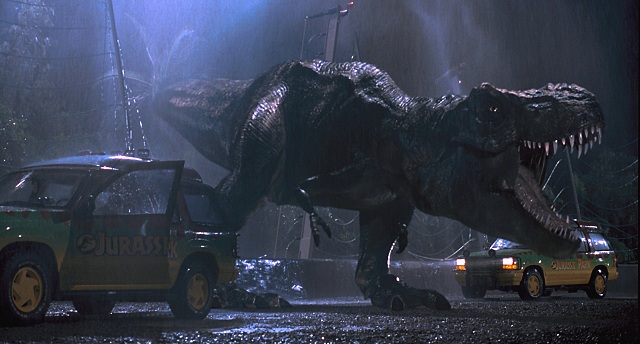
Plot holes notwithstanding, in the hands of a lesser director, “Jurassic Park” could have been a mere retooling of Crichton’s previous theme park-gone-wrong tale, “Westworld”, albeit with dinosaurs filling in for Yul Brynner’s homicidal animatronic cowboy. Spielberg was at the height of his blockbuster powers at this point, atoning for the excesses of his previous film “Hook” while on the cusp of the critical and awards-based credibility his next film, “Schindler’s List”, would bring. Concepts that shouldn’t work, do, as do sequences that no other director – then or now – would attempt. The tyrannosaurus attack remains one of the best sequences of sustained action and suspense ever filmed.
Of course, then, as now, while Attenborough, Neill, et al, are all solid in their respective roles, expressing awe and abject terror at appropriate moments, the real stars of the show are the dinosaurs, and it is not hyperbolic in the least to say that they are spectacular.
Ushering in the age of computer-generated trickery that modern moviegoers have become accustomed to, it is somewhat ironic that the road to the future was paved by recreations of extinct species. Even more ironic is that, while “Jurassic Park” is best remembered for visual effects house Industrial Light and Magic’s groundbreaking expansion of what could be done with a computer – experimented with in “Star Trek II” (1982), “Young Sherlock Holmes” (1985) and “The Abyss” (1989), before being put to memorable use in “Terminator 2” (1992) – the majority of effects here were accomplished with intricate animatronic and puppet work, courtesy of practical character effects maestro Stan Winston and his team.

Stepping out of the theater with a giant smile on my face, it was undeniable: Aside from the computers, slide projectors and some questionable fashion choices, “Jurassic Park” could have been shot yesterday, with the Man vs. God parable of hubris gone awry coming through clearer than ever.
This is not to say that the film is perfect; the problems that plagued the original narrative are all here, but they’re just as inconsequential as they were in 1993. For better or worse, after taking his time in the first act, the breakneck manner that Spielberg hurtles his characters through the remainder of the film will keep you from wondering why anyone would think it would be a good idea to run a theme park with four people (one of whom is a senior citizen on a cane) over the weekend of an important inspection.
Don’t even get me started on why Dr. Grant neglects to ask what Hammond even has on his island before getting on that helicopter.
Plot holes notwithstanding, in the hands of a lesser director, “Jurassic Park” could have been a mere retooling of Crichton’s previous theme park-gone-wrong tale, “Westworld”, albeit with dinosaurs filling in for Yul Brynner’s homicidal animatronic cowboy. Spielberg was at the height of his blockbuster powers at this point, atoning for the excesses of his previous film “Hook” while on the cusp of the critical and awards-based credibility his next film, “Schindler’s List”, would bring. Concepts that shouldn’t work, do, as do sequences that no other director – then or now – would attempt. The tyrannosaurus attack remains one of the best sequences of sustained action and suspense ever filmed.
Of course, then, as now, while Attenborough, Neill, et al, are all solid in their respective roles, expressing awe and abject terror at appropriate moments, the real stars of the show are the dinosaurs, and it is not hyperbolic in the least to say that they are spectacular.
Ushering in the age of computer-generated trickery that modern moviegoers have become accustomed to, it is somewhat ironic that the road to the future was paved by recreations of extinct species. Even more ironic is that, while “Jurassic Park” is best remembered for visual effects house Industrial Light and Magic’s groundbreaking expansion of what could be done with a computer – experimented with in “Star Trek II” (1982), “Young Sherlock Holmes” (1985) and “The Abyss” (1989), before being put to memorable use in “Terminator 2” (1992) – the majority of effects here were accomplished with intricate animatronic and puppet work, courtesy of practical character effects maestro Stan Winston and his team.
The T.rex attack remains one of the best sequences of sustained action and suspense ever filmed.
Like magicians who learn multiple ways to do the same card trick, using the CGI to complement the practical effects enabled the filmmakers to maximize the strengths of each to sell the illusion of dinosaurs gone wild.
Where today, for the most part, one would just accept that everything they were seeing was generated in a computer, 20 years on one is still hard-pressed to point out where they’re looking at a fully-CGI dinosaur or Winston’s seven-ton robot. The result is movie magic that has only gotten better with age, resistant to upgrades in software and hardware, retaining the ability to startle and terrify. Two decades on, “Jurassic Park” still puts several, more recent releases to shame.
And what of the much-ballyhooed 3D? Well, just as “Jurassic Park” reset the standard for blockbusters in 1993 (originally set by Spielberg’s own “Jaws” in the first place), its rerelease raises the bar for 3D post-conversion, and not just for classic films; this is how any film that wasn’t shot in the format should be converted to 3D, period. The depth of field on display is astonishing, almost making one think that cinematographer Dean Cundey (“The Thing”, “Apollo 13”) had always meant for his shots to end up being converted. Australia actually went and upgraded their rating for the film from the original “PG” on the grounds that it was scarier with the added dimension. Take from that what you will.
Today, “Jurassic Park” looks and sounds better than ever, standing proudly as one of the great cinematic experiences of our time. And while you don’t need to be a 10-year-old to enjoy the film, it’s certainly more than enough to make you feel like one. — BM, GMA News
Mikhail Lecaros is a professional magazine editor and freelance writer. The views expressed in this article are solely his own.
Where today, for the most part, one would just accept that everything they were seeing was generated in a computer, 20 years on one is still hard-pressed to point out where they’re looking at a fully-CGI dinosaur or Winston’s seven-ton robot. The result is movie magic that has only gotten better with age, resistant to upgrades in software and hardware, retaining the ability to startle and terrify. Two decades on, “Jurassic Park” still puts several, more recent releases to shame.
And what of the much-ballyhooed 3D? Well, just as “Jurassic Park” reset the standard for blockbusters in 1993 (originally set by Spielberg’s own “Jaws” in the first place), its rerelease raises the bar for 3D post-conversion, and not just for classic films; this is how any film that wasn’t shot in the format should be converted to 3D, period. The depth of field on display is astonishing, almost making one think that cinematographer Dean Cundey (“The Thing”, “Apollo 13”) had always meant for his shots to end up being converted. Australia actually went and upgraded their rating for the film from the original “PG” on the grounds that it was scarier with the added dimension. Take from that what you will.
Today, “Jurassic Park” looks and sounds better than ever, standing proudly as one of the great cinematic experiences of our time. And while you don’t need to be a 10-year-old to enjoy the film, it’s certainly more than enough to make you feel like one. — BM, GMA News
Mikhail Lecaros is a professional magazine editor and freelance writer. The views expressed in this article are solely his own.

