

 GMA Brandtalk
 Tracking
 Archives

Movie review: 'Side Effects' and the perils of pills for psychic self-defense
“Love and Other Drugs” already expostulated with definitive, exhaustive authority on the small-scale effects of maintenance pills on long-time Parkinson’s sufferers and its potential for comedy, relationship drama, and the medical rep trade. Good thing director Steven Soderbergh takes a completely different, serious tack with “Side Effects.”
Revealing any of the twists (at least the two major ones) would completely ruin the experience of this whodunit of a thriller for you, so we’ll keep this review to the bare bones.
So what happens when you mix prescription pills for psychic self-defense?
This movie gleefully dives into the ramifications of pharmaceutical treatment for psychological ills, specifically on anti-depressant drugs.
We begin with Emily Taylor (Rooney Mara), who is one truly depressed woman. Her husband, Martin (Channing Tatum), has just been released from prison after serving four years for insider trading. He would have gotten away clean but, like many financial guys on the up and up, he got greedy and he got sloppy. So, he got caught.
While Emily and Martin’s mom are amped that he’s out of the big house, the family is still at ground zero when it comes to money. While she claims there’s no connection to their financial woes, Emily shortly afterwards drives her car right smack into the concrete wall of an underground parking lot. Apparent suicide attempt? Everybody seems to think so.

From there on she’s prescribed a number of anti-depressant medications. Thing is, none of them work.
The crime aspect of this movie can actually be traced to that session when Dr Banks prescribes Emily a drug that she’s never been on. This switch, and the resulting cocktail of the other stuff she’s on, has the alleged, unintentional “side effects” of the title.
Soderbergh has outdone himself here. This time he takes on the minutiae of the day-to-day grind of a depressive’s life. He shows how it is to have a growing dependence on a pharmacy in your bathroom cabinet as opposed to the macro scale of the illegal drug trade’s explosive casualties in “Traffic.”
In fact, there are so many layers of commentary here that turn on the dime of the narrative twists that it’s sometimes hard to keep track of them all. They blend and blur and eventually fuse into one another like the effects of a mood-altering pill. . .and a pill to take the edge off that, and another to counteract the effects thereof.
To appreciate what happens in this narrative it’s useful to have a basic understanding of what’s called “synergism” or the “synergistic effect.”
Medically, it’s defined as a joint action of two drugs in such a way that one supplements or enhances the action of the other to produce an effect greater than that of either drug alone. It can be the capacity of two or more drugs acting together so the total effect is greater than if taken separately. Translated, it just means that some grey, unknown symptoms can arise if you take this drug with that drug.
This also relates to “speedballing” or “powerballing.” Usually applied to the hazardous and intravenous (that’s needles) use of cocaine with heroin or morphine in the same syringe. What’s called "pharmaceutical speedballing” (mixing pills with hard drugs) has now become the rush du jour for many sufferers of mental pain with access to prescriptions.
Not surprisingly, death can arise from too much of this. Legend has it that comedian John Belushi died from speedballing crack and heroin with pills. Also, it’ll happen if you mix drugs with alcohol.
America, with its culture of drugs to treat psychological illness, has been experiencing a widespread abuse of prescription stuff at a whole new level. According to a report from the Centers for Disease Control and Prevention, nearly 60 percent of drug-related deaths in 2010 involved prescription drugs, and three-fourths of those deaths involved oxycodone and morphine.
So what happens when synergistic effects are exploited for criminal gain? The result is a noir thriller that has Soderbergh back in top form, kicking ass and taking names like he was on crack himself.
It’s when Dr Banks contacts Dr Siebert (Emily's previous psychiatrist) and suggests that Emily be put on a new, experimental drug called Ablixa that stuff starts to thicken. At first Dr Siebert is cautious and outright reluctant, until Emily tries to jump onto a subway track.
Taking Ablixa, fortunately, seems to work and it enables Emily to function. Though she does start to sleepwalk and cook while she’s asleep. Dr Banks shrugs it off as just a minor side effect of the drug. Until the unthinkable happens.
They include:
America’s dependence on, and subsequent weakness to, prescription psychological, and legal, mood-altering drugs.
The business of psychiatric therapy which is revealed as all too human and flawed.
The susceptibility of both the previous items to be exploited by criminals looking to take advantage of the legal loopholes afforded to those dubbed “depressive.”
The politics of power between psychologist and patient, which is also a heady, erotic cocktail for either party.
The gargantuan industry of big pharma and its impersonality, its bottom line of profit – not patient health.
One of the most appalling scenes is when an R&D rep from a pharma company takes three psychiatrists (including Dr Banks) to a swank dinner to convince all or one of them to participate in the applied patient trials of a new drug they’re pushing for a huge retainer.
The revelation of how money, drugs, and medicine come to a head in such an open fashion made me recall moments in the HBO TV movie “Conspiracy”; the one where Nazi officials discuss the best way to dispose of their Jewish prisoners en masse to wine, in laid back, collegial tones.
Sounds like a stretch comparing the Holocaust to a pharma rep and psychiatrists having a business dinner? Maybe, but this is how your mind drugs are brought to mainstream use, and it’s a little known aspect of the psychiatrist’s lore that rarely gets shown.
Rooney Mara continues to portray fringe characters with aplomb and skill. Her streak, though, may backfire and typecast her in this mold. I mean, could you ever see the girl who played Lisbeth Salander as an American sweetheart?
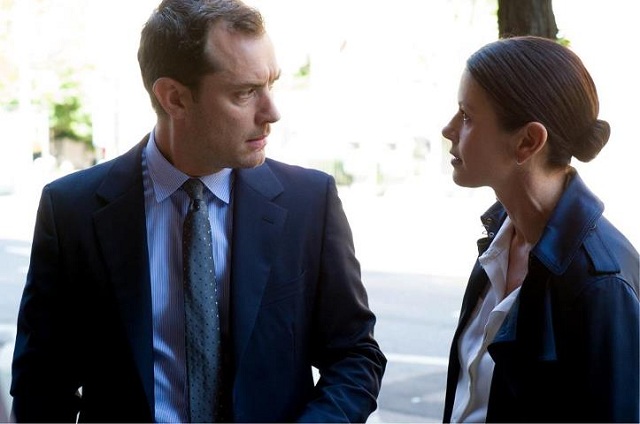
Jude Law as the put upon and well-meaning Dr Banks meanwhile hands in a great performance. He comes off as completely relatable, especially in contrast to Catherine Zeta-Jones’s Dr. Victoria Siebert – who seems as vanilla as psychiatrists come, especially at the start.
This is a smart and opinionated crime thriller that deserves your attention and money. It will screw with your mind. It will make you think twice about swallowing that Prozac.
Side effects of watching “Side Effects” may include: shock, outrage, empathic schadenfreude, and a deep respect for pill-popping noir. Oh, and watch out for a bit of girl on girl gratuity.
“Side Effects” is currently screening exclusively in SM Cinemas. — BM, GMA News
All photos courtesy of Endgame Entertainment

