

 GMA Brandtalk
 Tracking
 Archives

ADVERTISEMENT
Filtered By: Lifestyle
Lifestyle
Voices from the village
+
Make this your preferred source to get more updates from this publisher on Google.
"Voices from the Village" is an essay composed of vignettes exploring the author's relationship with sound, silence, and space. It picks apart the stories that ripple through the place that she inhabits, including those of the peculiar people within it. It won 3rd prize in the Essay category of the 2013 Carlos Palanca Memorial Awards for Literature.
1
This village I live in is a catwalk, a long and narrow stretch of asphalt that branches only into two. One is a dead end. The other leads to a path reserved only for the elite, those whose cars don a special sticker we know not where to get.
Flanking this concrete lane are houses, which stand so close to one another that the voices of their inhabitants echo through neighboring walls and are mistaken for ghosts. Daily intrusions come in the form of horns honking on the street outside or the neighbor's radio playing Pinoy rap from the '80s. Most afternoons, there are squeals of delight from middle-aged single women trapped in a game of badminton. At night, crickets.
This is music meant for a busy corner of the city. These are tunes that proclaim, loudly, Character. But there are those of us who prefer a personality cool and quiet, one of libraries and evenings draped in soft blankets. We choose to speak through the everyday hush, but are rarely heard in a place where sound merits space. Here, a small old lady in pink sweatpants marks each step she takes, counting down to one as she completes her morning jog. Stray cats cry so the lucky ones are picked up and fed. A vendor takes his position at dawn, yells “Taho!” to rent the attention of early-risers.
This village, just one of many along NAIA Road, was once named for its proximity to the afternoon sun. It is bright enough, and lined with windswept trees. Its entrance is automatic only because one clever security guard had tied a rope to the creaking gate, a rope he is known to pull from the safety of his tiny guardhouse. The home I occupy is found just behind this tiny guardhouse. This means my family is closest to the cacophony of cars in transit and a man licensed to have a gun.
2
Opening scene for a mystery: It is the middle of the night. A girl lies in the dark, waiting for overdue sleep. Just as it comes, a bang is heard. Someone bellows. Another responds. The voices: unfamiliar. The girl looks out the window, finds no one.
But a woman is shrieking. Heavy footfalls follow, and for a while, silence. A dimming lamppost stands witness to the streetscape outside. There are shadows, too, silhouettes, and only the assumption of death, which is enough.
The girl goes back to bed. She clutches the edges of her blanket, refuses to shut her eyes.
3
Nobody believes me when I say we live next to a cult. It's a slight exaggeration, sure, but essentially it's true. In our part of the village, “Good morning!” comes translated in the language of various church songs. We are roused by “Alleluia” and “Shine, Jesus, Shine,” music preceded by piercing beats from a sound check. Sometimes, I am forced to listen to a man preaching the word of his god, his already booming voice intensified by the use of a microphone. When the sun sets, more hallelujahs from his loyal believers slice through my less-than-profound thoughts.
As much as I hope they aren't slaughtering goats, I continue to be suspect of what lies behind those gray walls. We have been informed that their activities could be considered illegal. A residential community is not supposed to have religious groups imposing their faith upon others, we were told. That still didn't stop our neighbors from erecting a banner over their gate, proclaiming what they wanted us to think lay within.
All this began when the world started thinking that 2012 marked the end of days.
One time, my father decided that enough was enough. He had been through a long night and needed rest, but the neighbors were stubborn in their singing. So he tried subtlety at first, called up the guard to kindly ask the cult next door to lower the volume of their speakers. When that didn't work, he went downstairs and out our gate to tell them off. I cheered him on, but was expecting him to come home doused in holy water, wishing that was the worst they could do. The minute he returned, I anxiously asked him what he saw. Were our neighbors cloaked in ebony? Were there virgins being sacrificed on an altar? Were the people speaking in tongues?
My father, obviously not in the mood for games, dismissed my farfetched theories and told me the truth. He met a tall man wearing a white shirt and black slacks. This man, acting as the shepherd of their flock, promised that they would tone down their praise music. We were relieved.
The change was noticeable until they substituted their songs with the voices of children chanting. By then, my dad had already fallen asleep. I, on the other hand, was stuck reading with my hands over my ears.
4
Defense Mechanism Number One: Shutting the Auditory Canal. Employed every time the neighbors are heard sweeping their leaf-stricken roof.
This is a regular vision from my bedroom window, one I try my best to ignore. Once, however, I dared to look longer than usual. I saw two of them on that roof, a man and a woman, both wearing sandos and shorts, brooms and garbage bags in hand. Afraid they would see me watching them like a paranoid elderly, I decided to step back and just listen in on their conversation. I was curious, after all, and had nothing better to do.
“Woohoo!” the woman said, as though cleaning the roof was one of life's greatest pleasures.
They kept talking and I heard them clearly, from their phrases of complaint to the mockery they performed on one another. The female followed this up with a whine, similar to that of a wounded animal. She had, apparently, dropped her slipper on the ground below. There was much giggling between the two, even a bit of flirting here and there, until a scream changed the tone of the scenario. “Had she fallen off?” I asked myself, fighting the urge to take a peek.
The scream was succeeded by mangled lyrics from an old love song. The lady, apparently, was just singing, but singing badly. My ears took cover again, until I noticed that the neighbors had crossed over to our garage roof, found directly adjacent to my room and a single leap away from theirs. They obviously had more nerve than I did, because I panicked, pulled down the blinds, and rushed out my door. I didn't want to be seen, didn't even want to see how far they would trespass. Instead I went looking for a place to hide in until they were gone.
Defense Mechanism Number Two.
5
Inventory of Weapons Destroyed by the Enemy:
Earplugs
The confines of a pillow over one's head
Angry rock music
Speakers
Conversations for the inarticulate
A door, shut tight
Pauses, each one a test of patience, each one containing a decision to be made
The gate flung open
Outdoor reprieves, brief but pricey
6
QUESTION: What do you remember about this village, anyway?
FATHER, 49 y/o: It used to be an airstrip, I think. A reclaimed area. Or no, no, I'm not sure. Don't write that in. But it's near the shoreline, so as kids we would find shells – seashells, yes – when we dug holes in the ground. We had rich expats for neighbors too, some of them Spanish and Chinese. Mostly Chinese.We played basketball with some of their children. We had a court here. Not the kind you hang on a wall at home. A real one. The ground was flat and smooth. It was at the end of the village. We'd stay there until our parents called us back in time for dinner.
MOTHER, 49 y/o: The only thing I know is that my cousin had townhouses built here and I found out about it late. We even visited, do you remember? You said you wanted to stay in their attic. Then I told my friend to rent one of the townhouses. She did, but then she moved. What else? Well, this was where Gloria Diaz lived! And that senator, Pimentel. The old one, not his son. I used to see them around here. Go look it up on the Internet, you'll see! And I heard from someone that Gloria Diaz's children are still around, but maybe that's just a rumor.
SISTER, 10 y/o: I was biking here before. Beside a small mountain. I said “Yaaaay!” It was fun!
SELF, 23 y/o: I used to spend my summers wandering the village on a borrowed scooter. Even took my cousins with me sometimes. We would pick santan blossoms to chain together or steal bougainvillea to press between the pages of a book. We would yell “Car!” every time a vehicle came near. I also yelled “Car!” even when the vehicles were parked. Then I'd watch my cousins rush out of the way. There was nothing there. I guess I just preferred jokes to warnings.
7
Today, an anomaly. I hear only the chirping of birds outside, when once, a maya lost its way and found our house. It split the air across kitchen, dining room, and living room, weaving through the folds of curtains and the gaps between decorative plates. It rested on our range hood for a time, then flew in and out of an open cupboard.
I ran after it. “This is not the place for you,” I thought, leading it to the door.
Instead it traversed the stairs, looking to escape by knocking on each of the second-floor windows with its beak. Headfirst it made its mistakes, shaping all sight of sunlight into the thought of flight.
8
There is music in this neighborhood, but these melodies don't always cater to everyone's tastes and hardly ever surrender to time.
The guard, up all night, keeps himself awake with a cheap plastic radio atop a chair. He stands beside it, his foot tapping, his mind caught in a dance he cannot portray in uniform. He roams our stretch of asphalt every day, sometimes takes a bicycle. His eyes remain vigilant but the rest of his body loosens up, laughing at crude jokes from DJs and singing along to poorly written pop songs. In the morning he is gone, his shift over. Someone else arrives to take his place and leaves the radio untouched.
9
Voices from the Village: The Playlist, Part I
1. “Wasp Nest” – The National 03:21
2. “Paper Thin Walls” – Modest Mouse 03:03
3. “Don't Speak” – No Doubt 05:03
4. “You Talk Way Too Much” – The Strokes 03:04
5. “Barricade” – Interpol 04:10
6. “Everything They Say” – Eraserheads 03:54
7. “Window Bird” – Stars 04:44
8. “Midnight Radio” – Hedwig and the Angry Inch 05:38
9. “Anysound” – The Vines 01:55
10. “Firecracker” – Voxtrot 03:53
2. “Paper Thin Walls” – Modest Mouse 03:03
3. “Don't Speak” – No Doubt 05:03
4. “You Talk Way Too Much” – The Strokes 03:04
5. “Barricade” – Interpol 04:10
6. “Everything They Say” – Eraserheads 03:54
7. “Window Bird” – Stars 04:44
8. “Midnight Radio” – Hedwig and the Angry Inch 05:38
9. “Anysound” – The Vines 01:55
10. “Firecracker” – Voxtrot 03:53
10
Midway into our village, there is a family that thinks practically every week is New Year's Eve. Fireworks go off even during lunchtime, when you can barely appreciate the spectacle in the sky. I hear them at night too, and look out the window for a glimpse of those bursts of color. I hardly ever see any.
I had once asked my parents if this was normal, if other villages dealt with unsettling pyrotechnic displays while the sun was out. They didn't think it was bothering anyone despite my persistent objection to it. See, I wasn't at ease with the upsurge of smoke in the air and the possibility of people losing limbs from the explosions. They told me to mind my own business, but I never could with this attention span. Sometimes the sudden sound of leaves rustling is all it takes for me to lose my concentration. Sometimes even doors left ajar bother me.
I let it pass on actual New Year's celebrations. It is then that this firework-happy family steps onto the village runway to launch the riot they've been practicing all year. They lay out one Judas Belt, followed by what sounds like a Super Lolo. Accompanying these are blasts of watusi thrown towards the asphalt by their unsupervised children.
All three of these firecrackers are prohibited in the country. But this is one of the few times I don't mind such a racket, because we join in, banging our fists on our green gate and begging already bright heavens for better days ahead.
11
Interlude in the dark: The power went out one summer evening. Everyone slept but I was awakened by the heat. I wiped the sweat off my forehead and sat up on my bed. I tried to see my hands, but couldn't. I opened my palm then closed it, moved my fingers in a wave to no one. I felt like a child growing invisible without wanting to turn back.
I heard my little sister crying. This was followed by the first few moments of stating the obvious.
“Brownout? Brownout!”
It was my mother's voice, but it was my father who opened the door of my room to check on me. He saw my silhouette, upright in the shadows, and, puzzled, asked if I was okay. I nodded. I was, I told him, perfectly fine.
My father closed the door gently and left me to fall asleep under the peep of the moon. Instead I watched its glow through the blinds, eager for another calm spell like this one.
12
They Live Among Us: A Case Study
House #1 is the home of a man I have long been suspicious of. He is, I admit, a little odd. My father often refers to him as “Weird Boy.” My boyfriend and I have taken to calling him “Crazy Dave” after that character in the Plants vs. Zombies game. This is a character who wears a saucepan on his head as a hat, which gives you a hint at his (and our neighbor's) level of sanity.
Weird Boy/Crazy Dave once created an online group for the residents of the village to join. He said it would alert us of important news and updates, get everyone talking so we're better acquainted with the people we're stuck with. When I visited the website a while back, I saw only videos of cats.
Perhaps he thought they were this planet's most intelligent life forms.
But I wouldn't be too worried about this man if it wasn't for his car. That vehicle has been a threat to our family more than once, and who knows who else has suffered under its wheel. I only know of the transgressions it has committed against us, on both man and metalkind.
Exhibit A: It is 10 PM and Weird Boy/Crazy Dave is coming home from somewhere, possibly an hour of errands but definitely not a night of partying. He honks his horn thrice for someone to open the gate, but no one comes out to do so. The dogs start barking. The man advances towards the rusty barrier as though he's raring to use the car as a battering ram. The horn-honking continues. The dogs protest in growls and howls, yet the gate remains shut.
I wonder why he doesn't just call up whoever is inside, or ring the doorbell to let them know he's arrived. Wouldn't that be simpler and less invasive of the night? But he insists on honking his horn, hungry for attention that no one can give. I stop myself from charging outside and climbing the gate just to open it for the guy. Both of us grow impatient, and yet I cannot express this as vehemently as he does.
I'm sure someone's waiting for him. He lives with his mother and has a bunch of employees in that house, men set on doing his bidding. What that is, however, is known only through a brief exchange he had with my father. He told us the man ships things, cargo, products that our family can never be sure about. I worry that it's human DNA, or narcotics.
When at last the gate opens, I see his shoulder-haired helper panting and sweaty. He drives his car into their garage. One last honk while in there and he descends the vehicle without a word. His gaze is on the floor and his fists, unseen.
Exhibit B: In a village like this, parking is scarce. Almost all vehicles are in danger of being scratched by other vehicles worrying about the same thing. Pedestrians who do not have a death wish, meanwhile, try to avoid these cars as much as possible.
My dad was carrying my sister, then barely a year old, outside our home after a stroll around the neighborhood. The gates of House #1 opened. My dad moved away at the sight of a car in reverse. He even stood closer to our side of the street to avert any trouble.
But the universe is faithful to Murphy's Law. The car from House #1 backed right into the two of them. My father was hit, but he did everything to protect my sister from the blow, wrapped his arms around her, curled into a fetal position to keep her safe. Before anything worse happened, the car stopped. The driver emerged to see what he had bumped into. By then my dad had gotten up from the ground, ready to raise his voice, his tone caught between reason and rage.
Ignoring the scratches on his elbows and legs, he made sure my sister was alright and handed her over to my mother. He then turned to face the culprit. It was an old man. He was Weird Boy/Crazy Dave's chauffeur. He had backed out of their driveway, neglecting to check if the road was clear of people and other obstructions. He offered his apologies but arguments were exchanged instead, loud enough for the next few houses to eavesdrop on. No one else intervened though, and from what I heard, the driver was, in the end, fired.
Exhibit C: One night, my boyfriend drove me home and parked in front of our gate. We were retrieving takeout food from the backseat when the garage doors of House #1, once again, opened. I was convinced that the occurrence would go by without a hitch, but that was a mistake. I shouldn't have clung to the little faith I still had in humanity.
Then again, Weird Boy/Crazy Dave might not even be one of us. As he backed into the village runway, we yelled at him to stop because he was dangerously close to my boyfriend's car. The guard yelled too, even ran forward to tap the trunk of the man's auto with his hand. Still, he didn’t hear. The rear of his vehicle crashed into the door of the passenger seat, leaving a couple of scratches and a dent that looked more like a wound.
I went inside to get my parents, knowing that adults had a better handle on these things. When they arrived at the scene of the crime, their sense of logic seemed lost to Weird Boy/Crazy Dave. He just stood there, entranced, staring at the damage like he didn't know where he was or what was happening.
Remembering his expression then, I'd say he was probably left behind by his spaceship for reasons we were only then discovering.
My parents continued to berate him because he denied seeing my boyfriend's car parked there. It didn't make sense. It wasn't that dark after all. Three people even shouted for him to stop his vehicle. Weird Boy/Crazy Dave insisted that he didn't notice our presence, and I got worried seeing that the man showed no signs of regret. His expression was closer to glee than to remorse.
The guard had the sense to call the barangay tanod to help clear up the mess. My boyfriend and I stood paralyzed as everything transpired – the accusations, the defense, the phone call. Both of us were introverts, and were stunned silent at the unfolding of that night's events. But we were sure that we would be talking about it for months to come.
Weird Boy/Crazy Dave, cornered by my family, had no choice but to go with my dad and my boyfriend to the police station. They returned after a few hours, having managed to file the reports. Nothing truly out of the ordinary happened, except, well, the guilty party dragged my dad into a conversation about potted plants.
The reason for this still escapes me, but I am left wondering what Weird Boy/Crazy Dave does every day. Maybe he's just waiting to strike his next victim. I pray it isn't one of us again.
13
dec·i·bel
noun. a unit used to measure the intensity of sound.
60 of which measures the intensity of normal conversations
130 being marked as the threshold of pain
Somewhere in between lies the loudness of the television set when my partially deaf grandmother watches noontime teleseryes and late-night Koreanovelas with her door open.
90, I suppose, is gained when my mother attempts to overpower the television's volume in the hopes of conversing with her mother, who still can't hear her.
Also 90, for the average door slam
95 when both mothers shout at one another, plus murmurs from the rest of us who think they're having a fight when they're not, when they're simply talking about what to eat for dinner
98-100, for when they actually have fights above the din of TV's scripted melodrama
70-80, for fights with the television switched off
85 is the level that carries caution: constant exposure to sounds above it can cause a gradual loss of hearing, which I'll probably develop, often being told to join my grandmother for dinner in her room while the news is on.
So 67 or 70, roughly, is how loudly I talk back to my mother when I am displeased or moody, defiant and insensitive to her commands.
But add another 90 to that, for when I slam the door, turning away from my parents' bedroom to lock myself in my own, muttering curses amounting to decibels 25-35.
10 dB is my grandmother breathing, watching this and unable to stop it.
10 also for the whirr of the electric fan, standing a few inches away from me as I cool my head and calm down
15 for when the argument ends with regret or a whimper, 45-50 for the muffled apology, and 20, I guess, for the rustle of our clothes upon contact in a forgiving embrace.
60, again, for the snide remark rehashing these incidents when provoked.
14
There are situations you just have to be ready for. Theft, betrayal, the zombie apocalypse. I was told it was best to spring into action once tapped on the shoulder, or go wherever I'm wanted at the sound of the alarm. Often, this alarm is the one wedged in the larynx of my sister, 13 years younger than I am.
This fact always comes as a surprise to most people. It's true that I was adept in baby talk as I entered my first year of high school. I learned how to make stuffed monkeys move and speak. I mashed plenty of vegetables and shook dozens of milk bottles. But I was also trained to curb many of my internal uproars, having to tiptoe around her crib during the hours she slept.
I do not enjoy that last privilege from her now, however. My sister has the personality of someone being shot out of a cannon. Every time she enters the room there is a bang. She jumps right out of bed on weekend mornings. Her questions do not wait for answers. She does not know what it means to pause.
When we remind her of her energy's limits, she reminds us that she was born during the Year of the Horse. She will gallop as much as she wants to and the only person who can stop her is herself.
But these are forgotten the minute her muscles ache and she becomes host to an orchestra of tears. I hear her crying and everything else is put on hold. It is me entering their room with a bang, jumping out of bed, racing to her side with no stops for breath. My parents have done the same, our hands stretched over her body in search of the spots that hurt the most. We reach for the bottle of medicinal oil, wondering why such pain erupts constantly in someone so young.
There are days when my mother tries to stop her wailing by sheer will. “You don't want to be heard by the neighbors, do you?” she asks. My sister bites her bottom lip but I tell her to let it all out, the neighbors and those radios of theirs be damned. My mother shoots me a look, but we both bow our heads and fulfill our duty, soothing my sister's inflamed joints.
Some time ago, my father started wondering if the muscle pains were caused by evil spirits living among us. This was because an old woman, a few years back, claimed we weren't “alone” in the house. I scoffed and said, “Well, of course. That's because we're what they call an extended family.” But I guess, after that bout of doubt, we were cursed.
Father decided that the best way to deal with these nasty phantoms was to scare them away. This meant he would shout at my sister's pain until her aching spell had left her. Then he would exit the room out of guilt, but would come back and repeat the process. We never told her why he did this though. We didn't want to give the child nightmares.
I was certainly cynical of his method, but didn't try to stop my father for fear of his conviction. I was only glad we didn't have to beat the spirits out of her with palm leaves, like most albularyos would.
I was doing my homework the other night and was taken aback by noises you would normally hear in sessions of army training. Hut! Hut! Hut! Hut! I looked around, and though I knew it was coming from the other room I couldn't believe it. It was when I heard my sister's cries that I left to decipher the sound. It was my mother, attempting to drive away the pain with my father's bizarre approach. I could almost imagine her holding sticks of incense up into the air and chanting even more loudly than the cult next door. She didn't. We had no incense anyway.
I sat beside my sister and told her the truth, “It's not you she's yelling at.” Confused, she curled into my arms, still crying and clutching her knee.
We were never sure if this condition ran in the family. As a child, my hours of sleep were often cut short by leg cramps and I, too, would wake up breaking the silence of the night. I cried little as a baby and less as a child, so these tears frightened my parents. It would take years for me to learn how to subdue the burning pain in my lower extremities. I have tried teaching my sister this, the technique involving stretching the legs and pinching the philtrum, that groove between one's lips and nose. But she has yet to develop the discipline for it, so we wait until she can, until the pain disappears and she is ready to be the wild-eyed girl we know, that girl strong as a horse and bursting out of a cannon.
15
The Discovery of Fire:
Firetrucks race past the village and their sirens strike us fast. The sound cuts through the heart, sends signals of panic to the brain. Everyone leaves their home to see where these trucks are headed. Everyone stands on the street outside, wondering if danger's nearby. But I remain where I am and from our house's second floor I see black clouds hovering over one part of the district. These clouds reach the sky and move far from us.
The thought running through everyone's minds is this: “We are safe for now.”
This is how you spell one moment's sense of community.
Relieved, we no longer feel the need to grab valuables and go. We do not have to weigh the importance of possessions we can pocket. No one is forcing us to recreate our lives from leftovers. We are given another chance to stay put.
Once we feel secure, we turn our backs from the fire and close our doors behind us.
I am sure it is warmer somewhere else.
16
A Lexicon for Lulls in Speech and Other Silences
Preface to the First and Only Edition:
In discourses concerning desire there is talk of a language invented between one and the other. Words whispered over the telephone in bed on cold nights, phrases coy and clever, true and meant to impress. But this boy and I once learned to speak between words, too. We sought ways to cross those dips in an ongoing dialogue, distances that took the form of pauses long and short. These distances came when the last sentence said felt too far from the next, when subjects lost their segues, when neither of us had much left to say but longed to keep our conversations going, going, going.
We developed a communications system using onomatopoeia.
It began with me, back when it was just me, when I associated silences with discomfort at the presence of someone else. I believed that people needed to talk to show that they were at ease with each other. But I didn’t really talk. I would only blurt out whatever noise came to mind, be it a beep or a buzz.
I thought time was lost if it passed without anything being said, so I filled each pause with sounds that held no place in any dictionary. Instead I wrote the draft for my own, a copy given to this boy that I too, was beginning to learn.
Excerpts from the As Yet Incomplete Manuscript:
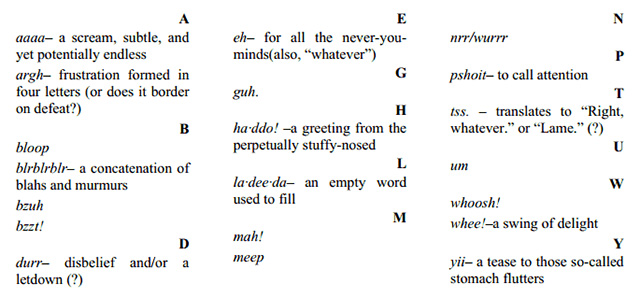
Notes on Future Editions, or the Lack Thereof:
1. Despite this, repetition was tricky and I was growing tired. The system lacked the seed of a secret, how something matters more when it is rarely used. I heard us skipping and skipping, going forward far too fast and remembering less of what was really said. Our conversations brimmed with these sounds, and words that should have weighed more began to disappear from our vocabulary.
2. I thought to unlearn this lettered routine soon, replace it with the gaps and spaces I once avoided. I coveted the surprise of something steady, the pace of respites from the noise.
3. We taught each other silences, again, and found them new. We stopped to study its temperature, how it varied from cold to warm, how it stung or how it soothed. Over the phone before falling asleep, the dips between words grew wider, but the distance felt between bodies grew thin. The soft intervals in our speech became gentle and familiar and safe as hands held, or as heads taking turns resting on each other's shoulders.
4. The Lexicon, or what exists of it, has since been used sparingly. I have only picked out its pertinent few for those times we crave conversational chaos, consulting this list on hours our silences grow cold, which isn't often.
17
I live in a numberless lot full of things to be counted. No digit on the door, only two houses in a compound, one towering over the other. The house with a single floor was my grandfather's, where my father and his siblings grew up in. The house with multiple floors was his too, but built for my father and his siblings now that they're all grown-up. This is where we are now: a white three-story box that once contained three families. The fourth family stayed with Lolo and Lola, are still there even after my grandparents' deaths. The fifth found somewhere else to inhabit.
We moved in with everyone in 1995. I was in kindergarten and it took a while to get used to sharing. Uncles and nieces shared a thousand footsteps up and down a winding staircase, so did brothers, cousins, mothers and dads. Dozens of visitors were entertained in a shared living room. Three stoves and three refrigerators shared spots in one kitchen. But meals could never be shared in one dining table. There were more of us than there were chairs.
Each family was given three rooms – a master bedroom, one other room for their children, and a bathroom. Our family occupied half of the second floor. Across us was the family of my father's older brother. I spent days playing on their side of the house, my cousin being a year younger than me. We were the only kids then.
We would often come home from school at four o'clock in the afternoon and use their pillows for playtime. We would sit beside each other on the bed, one pillow to his left and one pillow to my right. In front of us, a couple more for a control panel covered with dozens of buttons in the form of lumps. This was how we flew. Three, two, one, liftoff.
He died of leukemia at the age of seven.
That night I was jumping on my parents' bed, my feet landing on places where their bodies would have slept. I cared little for anything else. The world to me was nothing more than that one elusive fluorescent bulb on the ceiling. I wanted to reach it, cup it in my palms until they, too, burned as brightly. I wanted to stay until I got scolded for making a mess of the comforter. As my mother opened the door to do so, we caught the solitary sound of my aunt's cry.
She said my cousin's name twice, but he heard neither call.
One, two, three, four pumps, the thud of palms on a dying chest until three, two, one, zero.
18
Voices from the Village: The Playlist, Part II
11. “The Sound of Silence” – Simon and Garfunkel 03:08
12. “Let's Talk About Spaceships” – Say Hi 01:54
13. “Consequence of Sounds” – Regina Spektor 05:08
14. “She's Hearing Voices” – Bloc Party 03:28
15. “Sirens” – Angels and Airwaves 04:19
16. “The Quiet Things That No One Ever Knows” – Brand New 04:01
17. “Calling Out Your Name” – The Epstein 03:53
18. “Soundtrack for Our Movie” – Mae 03:11
19. “Ambulance for the Ambience” – Broken Social Scene 05:18
20. “Soft Shock” – Yeah YeahYeahs 03:53
21. “The Sound of Settling” – Death Cab for Cutie 02:12
Bonus Track: “Endless, A Silent Whisper” – Urbandub 03:59
19
I remember the month of fish. Steamed fish, grilled fish, broiled fish, fried fish, fish fillet or fish fingers, sizzling on pans for lunches and dinners. They told us it would pave the way for a healthier lifestyle. They made it clear that our hearts would thank us. There simply couldn't be any meat in the house, no, because meat was as red as the letters spelling “AMBULANCE” on the face of a hospital vehicle that came at 3 AM, waking the guard and the neighbors and the dogs and the cats and the crickets. Meat was as red as the siren that said go instead of stop, that said listen up someone's leaving for good.
My paternal grandmother had her second stroke in 2008. We had been watching her closely since the first attack, trying to control her diet and keep her fit so she could stay with us longer. Her right side had been paralyzed and her memory was skewed. She called everyone by her youngest daughter's name. Her speech was reduced to half-groans. We took her on walks and occasionally she smiled at us, but we were never sure about those smiles. Then we thought she was slowly regaining her strength. She wasn’t, not really. She had lived past my grandfather's death, but perhaps she didn't have much left to keep her going.
The night she was rushed to the hospital for the last time, everyone tried to pitch in. My parents helped my aunt carry Lola's body to the ambulance. They couldn't move her from the bed, so they took the mattress too. It was heavy, like a magic carpet that had lost its sense of flight.
I was told to stay in the house, and, being the eldest, became responsible for watching over my sleeping sister and cousins. We were left alone to wait, watching the sirens speed off into silence. It is a noise lodged in memory now; even the village knows it well.
She spent five days in the hospital, comatose. We visited often, touching her toes and talking to her, hoping she could understand the little we had to say. When we were sure she wouldn't make it, we gave her whispered messages to bring like she was a bottle out to sea. She never came home. She found it elsewhere.
When they said our hearts would thank us, they meant only for the fish.
20
The Memory I Still Don’t Know How to Write About but Keep Trying To Anyway
Attempt #1: Some children come home with blue and gold ribbons pinned to their chests, but when I was five, I came home with a white one sewn on the right side of my head. I guess it was a prize for being brave, for being a good little girl, for not crying when I flew off a treadmill and hurt myself.
Attempt #2: I don’t remember what we were doing at Lolo’s house that day. I don’t remember if it was early morning or late afternoon. I don’t remember what I was wearing. I don’t remember what made me headstraight for my grandfather’s study. I don’t remember why there was a treadmill there. I don’t remember whyI decided to run on it, or why, halfway through, I ran without gripping the handrails. I remember going faster and faster though. I don’t remember sweat or pain, not really. I don’t remember how long it took for my relatives to find me on the floor. I don’t remember which of them were there. I don’t remember what they said to calm me down, but I knowthey asked me what happened and I remember not saying anything, even though I could.
Attempt #3: “Shh,” saida voice that I felt seeping through the gash in my head. “No one will find out you broke the treadmill if you don’t tell them.”
Attempt #4: A weekday. A rusty treadmill in my grandfather’s study, three steps away from a big brown table of papers and dates. Me, five years old, on the treadmill, running then laughing, running while laughing, running and letting go of the handrails. Me, five years old and flying through the distance between treadmill and table, and falling, landing on the floor. Body thrown back by force, spine straight on the table’s edge. Part of my head sliced open by one of the table’s four corners. Time slowing down, turning dull. An image of the room and its beige floor. The too-bright fluorescent light. Fast-forward to my father running towards me. Image of my hands red and sticky. A thought: will the blood change my hair color? Image of my father’s face, sound of his voice. Damp, white towels over my eyes. Muffled noises.The light again.Image of the room shifting as my father’s arms scoop me up. Father’s heart beating fast under his shirt.The door creaking as he dashes outside with me. The sun. The gate. The village we were about to live in, calm but not after this.
21
Today, even the leaves are quiet. I turn towards the window and the neighbors are nowhere to be heard. The village squirrel runs across telephone wires, scurries about with but a few waves of sound. Dogs are asleep, cats tired. The buses and trucks on the street outside have settled comfortably into low rhythms. There are no footsteps in the house other than mine. I am in my room at last, writing this and listening for the voice of discord abandoned, synchronicity in its place.
Again, a moment's chirping of birds.
Neobie Gonzalez is a student at De La Salle University–Manila, taking up her Master of Fine Arts degree in Creative Writing. Her works have appeared in the "Malate Literary Folio," as well as in the anthology “A Treat of 100 Short Stories.” She is also co-editor of Plural, an upcoming online prose journal.
Posted with permission from the Palanca Foundation
Neobie Gonzalez is a student at De La Salle University–Manila, taking up her Master of Fine Arts degree in Creative Writing. Her works have appeared in the "Malate Literary Folio," as well as in the anthology “A Treat of 100 Short Stories.” She is also co-editor of Plural, an upcoming online prose journal.
Posted with permission from the Palanca Foundation

