

 GMA Brandtalk
 Tracking
 Archives

ADVERTISEMENT
Filtered By: Lifestyle
Lifestyle
Movie review: Raise your katanas versus evil in ‘47 Ronin’
+
Make this your preferred source to get more updates from this publisher on Google.
The tale of the 47 ronin is the Japanese equivalent of the 300 Spartans against the Persian invaders, or Lapu Lapu’s last stand against the Spanish (maybe even Tirad Pass, if we stretch it); it’s a historical account of a courageously small band of fighters soldiering on outgunned and vastly outnumbered.
Imagine if you will how purists must feel when a folk tale is appropriated by Disney or Hollywood for its own purposes, adding or abridging some core facts for dramatic purposes. This movie is much the same beast. Also, it’s not to be confused with the 1941 all-Japanese, black and white feature directed by Kenji Mizoguchi, from which, by the slick look of this one, director Carl Rinsch drew little encouragement from as he did with animé and a few Miike movies.
Like many such stories set so long ago that they become legendary and folkloric, they are representational of fighting on despite overwhelming odds. In lieu of this, the spirit of the thing —and its function as rallying cry for morale—is more important than actual facts. Which just means "based on a true story" is like saying “From Hell” happened just like that.
Likely why magical beasts, witchcraft, and demons made sense for this movie set in 18th century Japan.
Keanu Reeves plays the half-Caucasian, half-Jap Kai, taken in by the family of Lord Asano (Min Tanaka), ruler of the provincial fief of Akô, when he was found near death and trying to escape from his demon-infested home. He’s since been raised in the protection of the Asano fief, albeit shunned and outcast by the other men, even with his amazing ability to wield a sword. His only friend is the Princess Mika (Ko Shibasaki), who is almost of age with him.
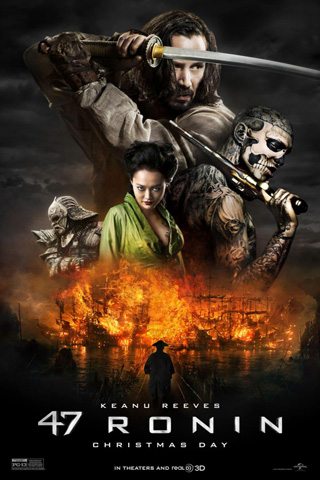
The official poster. Universal Pictures via HollywoodMetal.com
One of the most visually-inspired action sequences in this movie is when Kai returns to his demon guardian’s home (to get to the place you need to walk through a bamboo forest haunted by a fog of ghosts) for his ronin to acquire some swords. The demonic monk leader asks for a test of will and Kai is forced to oblige, showing his old guardian he hasn’t forgotten those demonic tricks of celerity he was taught as a kid.
The plot thickens when Lord Asano is duped into attacking rival Lord Kira (Tadanobu Asano), who is aided by the dark illusionist magic of a Witch (Rinko Kikuchi). Rivalry and infighting by feudal lords isn’t a secret, but all this happened during the state visit of the ruling Shogun. Japanese feudal politics thrives on appearances and “honorable” warfare. Being seen attempting to assassinate a rival while the Shogun is housed in your castle is a horrible faux pas, if not total bad form.
Not surprisingly, Lord Asano is ordered to commit suicide by the Shogun to preserve his clan’s honor. In the wake of the Lord’s seppuku his samurai are then adrift, becoming shamed ronin or masterless soldiers. Meantime, Kai is sold into slavery.
A year later, head samurai and Asano’s vassal Oishi (Hiroyuki Sanada) is released from prison. He proceeds to gather Asano’s loyal samurai in a bid for revenge. He searches for Kai to prevent the evil Lord Kira from marrying Princess Mika (thereby cementing his hold on the land) and to avenge their master from the treachery of Lord Kira and his Witch.
It is Oishi and Kai who are the focus of a movie that ostensibly is supposed to be an ensemble of 47. We see the old school attitudes Oishi tested and finally relent as it gives way to acceptance of Kai’s skill, knowledge, and place in their bid for revenge; meanwhile, Kai learns a lot as he travels with the surly old samurai. Eventually, the rest of the ronin learn to respect Kai and let go of their racial derision. How touching.
It’s pretty much a visually enjoyable movie if you get past the fact that Reeves’s proclivity for a thousand-yard-dead-eye-stare style of acting can be pretty odious in the wrong context. But his physicality and aura of Zen in this one fits the ronin glove aptly. Even curbing his fighting skills for honor’s sake resonates with barely restrained rage and not an imbecilic abyss.
Miles better are the set pieces, costumes, and cinematographic integration of the CGI into real scenes. The court scenes overflow with bold and lush prints, the kabuki sequences are a showcase of how opulent Japanese culture can be, the manifestation of the Witch’s powers as flowing, floating silk that runs like water illustrates both the level of her pact with evil and its strength. Some of the monsters (even Kai’s demonic monk foster parents) are pretty much an original blend of East colliding with West and coming out on top.
My main problem with “47 Ronin” is that the tale aspires to the epic, but twists the gravitas of the original folk tale into a phantasmagoric Hollywood parody of itself—a pitfall with many of the original Japanese horror adaptations as well. Those became brusque and leached of subtlety.
On top of it all, it also mixes in the tale of angst of a half-breed Caucasian pariah which, for all its “13th Warrior” sense on paper, isn’t anywhere in the original folk story. C’mon, aren’t the ins and outs of Japanese politics, ritual combat, and honor complicated enough?
While the Japanese actors all try to make the story flow as smoothly as possible, there are two stumbling blocks here: the fact that it’s a CGI-heavy movie and that it’s in English. You can hear some of the actors wrestling with the glottal stops of the latter (even “Pacific Rim’s” Rinko Kikuchi struggles with some of the clunkier speaking parts), though most acquit themselves just fine with the former. Some gave emotional credence to the death of a magical, chimeric bull plaguing the land of Akô, but mostly, it was evident that a few of them were unused to acting opposite a cardboard head on a pole against green screen.
Add to that the loaded and complex terms that need to be explained WITHIN the dialogue to make sense to global audiences. They’re often glaring enough to interrupt the syntax of the lines (e.g. Shogun: “You are now ronin, masterless samurai.”)
Despite all that, the adventures of the ronin seeking revenge is compelling enough to drive the action forward and take us along with it. It’s a credit to the strength of the source material.
Sure there’s initial awkwardness with the fantasy elements gelling together, but it is exactly because of the stylish, visual thrills—having dragons, demon-forged swords, brawling giants, Nosferatu-looking monks, samurai blood baths, some much needed levity from a token plump, jolly samurai, and one very sexy, shape-shifting witch—that saves this one from being consigned to the bin of other trying-hard samurai epics.
My only gripe is there are NO ninjas in this movie. Aren’t shadow warriors (at least a squad of them) a requisite in any Japanese feudal lord’s private army? So yeah, lovers of ninjas will be disappointed.
There are worse ways to spend a weekend than with some popcorn watching Neo teach puny samurai how to handle a sword or dueling with magical creatures. Word to the wise, too: you’ll have a great viewing of this if you try not to count the ronin—especially before the attack on Asano’s fortress. Rikai suru? — VC, GMA News

