

 GMA Brandtalk
 Tracking
 Archives

ADVERTISEMENT
Filtered By: Lifestyle
Lifestyle
Movie review: A WWII tale of Death and the Maiden in ‘The Book Thief’
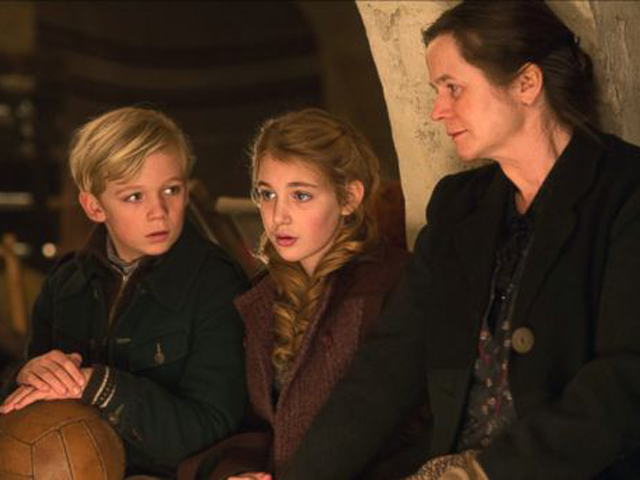
The Book Thief succeeds at giving a human face to the ordinary men and women hidden by Hitler's Nazi propaganda machine. All photos courtesy of 20th Century Fox
Our introduction to Liesel sees the wide-eyed waif and her younger brother on their way to meet their foster parents. As narrated to the audience by no less than Death himself (“The Queen’s” Roger Allam, sounding uncannily like “Harry Potter’s” Michael Gambon), Liesel suffers a decidedly Dickensian tragedy in the form of her brother passing away en route. A quick burial and one purloined book later, Leisel arrives on Heaven St., where she meets the Hubermans, comprised of kindly sign painter Hans (Academy Award winner Geoffrey Rush) and the stern Rosa (Emily Block, TV’s “Downton Abbey”).
While Leisel takes a while to warm to the couple, she makes fast friends with the flaxen-haired neighborhood ragamuffin, Rudy (Nico Liersch). As the country around them falls ever deeper under the boot heel of Nazism, will see Leisel, Rudy and the Hubermans experience life, love, tragedy and triumph as they try to exist peacefully in a nation at war.
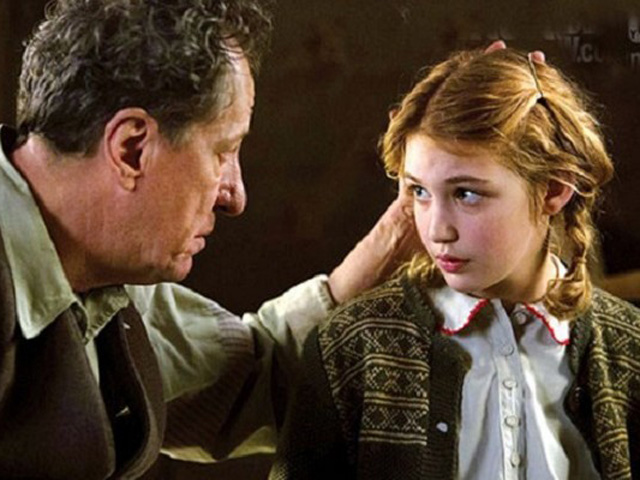
Geoffrey Rush and newcomer Sophie Nélisse provide the emotional center of the film.
While some reviewers have accused the “The Book Thief” of downplaying (or, worse, glorifying) the Nazi party’s role in the Holocaust that claimed millions of Jewish lives, this reviewer found the converse to be true.
Take, for instance, a sequence that sees Leisel, Rudy, and their classmates singing a Nazi tribute song in full Hitler Youth regalia: the overall effect of seeing ostensibly innocent children paying tribute to one of history’s most despised figures paints a far more chilling picture of Hitler and his followers than any number of explicit scenes. Another scene that drives home the seriousness of the situation is the Hubermans’ insistence to Leisel to remain silent about the Jewish fugitive hiding in their basement.

As she learns to read, Leisel is able to escape the confines of her wartime existence.
Make no mistake, while “The Book Thief” may not be anywhere near as affecting as, say, Spielberg’s seminal “Schindler’s List” (1993), it never actually crosses the line into sugarcoating or self-parody. Indeed, areas the film actually excels in are sentiment and emotion, earning much mileage from the relationships between its main characters. Whatever faults Brian Percival’s (TV’s “Downton Abbey) matter-of-fact storytelling may have in depicting the bigger picture, these shortcomings do not detract from the narrative’s human component. As a story designed to represent a child’s-eye view of one of the most barbaric periods in human history, at the very least, the film can lay claim to accomplishing most of what it set out to do.
Seeing as the filmmakers trusted the audience to connect the historical dots as they occurred around Leisel, it’s a pity they couldn’t do the same for when it came time to show her character’s eventual direction. — VC, GMA News
"The Book Thief" opened at local cinemas on Feb. 19 and is now showing.
Mikhail Lecaros is a professional magazine editor and freelance writer. The views expressed in this article are solely his own.

