

 GMA Brandtalk
 Tracking
 Archives

ADVERTISEMENT
Filtered By: Lifestyle
Lifestyle
Movie review: The high notes and lowlifes of ‘Jersey Boys’
+
Make this your preferred source to get more updates from this publisher on Google.
Directed by Clint Eastwood and based on the hit Broadway show of the same name, “Jersey Boys” arrives in theaters with the big-budgeted sheen of a freshly applied Hollywood paint job. A jukebox musical (a lá “Mamma Mia!”) by way of straightforward biopic, “Jersey Boys” chronicles the meteoric rise (and fall, and rise) of musical icons Frankie Valli and The Four Seasons from the fifties through to their 1990 induction into the Rock and Roll Hall of Fame.
The film opens in 1951 and follows teen Frankie Castelluccio (John Lloyd Young, who originated the role on Broadway) and his experiences growing up in blue-collar New Jersey—musically gifted, but yet to assume his stage surname of Valli.
We are introduced to the friends and bandmates who will shape Frankie’s future, including fast-talking neighborhood ne’er-do-well Tommy DeVito (“Boardwalk Empire’s” Vincent Piazza, looking for all the world like a young Dermot Mulroney) and Nick Massi (Michael Lomenda, who has played the role on tour). An introduction by Tommy’s friend Joe Pesci (who, in real life, would grow up to portray fiery-tempered thugs in “Goodfellas”, “Casino” and “Home Alone”) brings talented songwriter Bob Gaudio (Erich Bergen, who played the role in the Las Vegas production) into the fold.
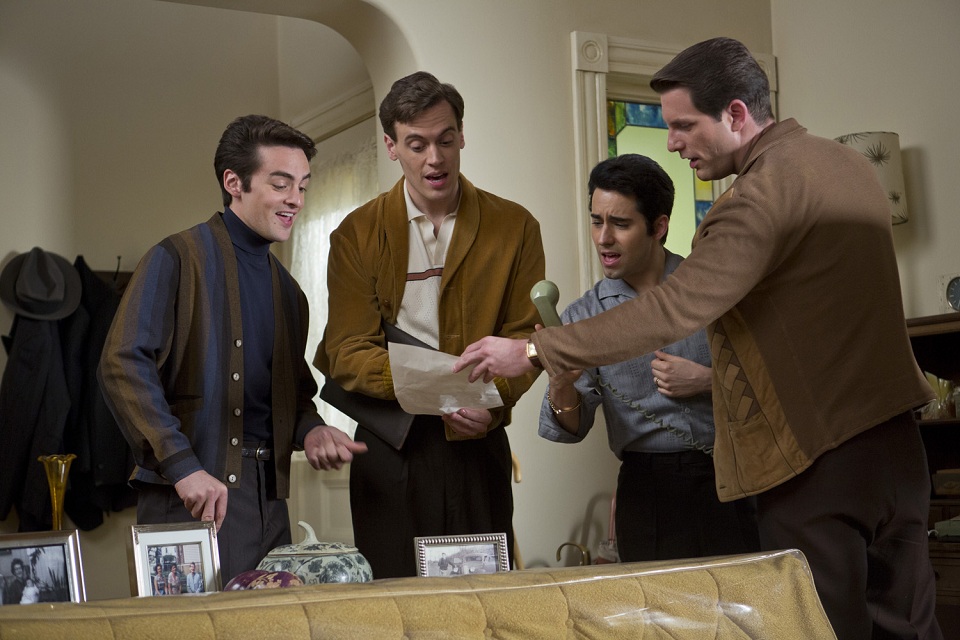
'Jersey Boys' tracks how the The Four Seasons come together as a group. Photos from Warner Bros
As TV appearances and tour obligations begin occupying more and more of the boys’ time, the band’s interpersonal relationships begin to fracture under the strain of their fame. The situation is exacerbated when DeVito’s financial debts come to light, forcing the group to turn to Valli’s longtime patron, mob boss Gyp DeCarlo (Christopher Walken, playing the sentimental underworld figure to the often-hammy hilt), for help.
Given The Four Seasons’ rags to riches (to rags) appeal and the nostalgic, crowd-pleasing charm of their repertoire (many of which were used in the play), the story of the boys from the wrong side of the tracks who hit the big time was ripe for a big-screen treatment. However, Eastwood’s announcement as director caused even some of the play’s most diehard fans to call shenanigans. His status as a music aficionado and occasional composer notwithstanding, there was precious little in the cinematic-tough-guy-turned-A-list-director’s filmography to suggest that he was up to the challenge of bringing the musical to life.
For the most part, the songs do their jobs, and the reenactments of vintage Four Seasons performances provide some of the film’s most enjoyable moments. From their humble beginnings performing in smoky lounges and state fairs to their primetime heyday appearing on “American Bandstand” and “The Ed Sullivan Show,” the sequences are toe-tappingly charming in their attention to mood and period detail.
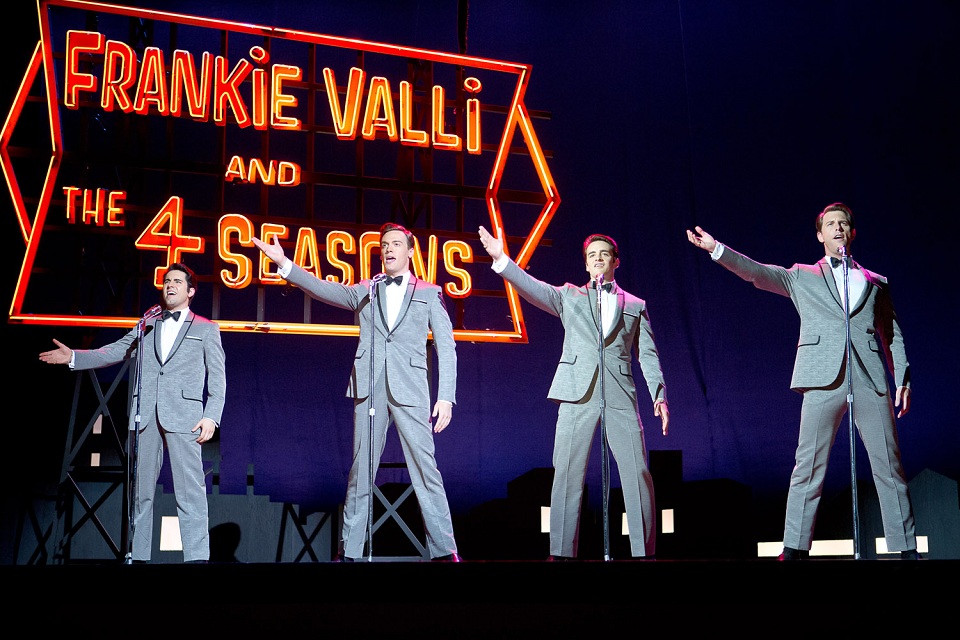
On top of the world, the boys from Jersey quickly learn that fame has many pitfalls.
To wit, we have the down-to-earth lead singer (Valli), the musical genius (Gaudio), the wild card (DeVito) and—by the character’s own admission—the “Ringo” (Massi). Throw in the pre-fame love interest (Renée Marino) a post-fame mistress (Erica Piccininni, of the OBC), and a neglected child looking to follow in her father’s footsteps (Freya Tingley, aka Wendy on “Once Upon a Time”), and we’ve covered pretty much all the personalities you expect to see in a film of this type.
Stereotypical characterizations aside, another narrative blemish is the film’s lack of a well-defined passage of time, with only hairstyles, grooming (or lack thereof) and the width of the characters’ lapels (helloooo, 1970’s!) letting us know what year we’re in. Between those and the occasional vague dialogue reference, some storylines get ridiculously short shrift, with those featuring Valli’s (apparently) musically gifted daughter and Massi’s out-of-nowhere inner conflict being prime examples.
Adding to the fragmented feel is the awkward reworking of the play’s multiple perspective narration (wherein each band member narrates one act from his point of view before aligning for a multi-part monologue at the end), presented here as random characters speaking straight into the camera with little concession to rhyme, reason or continuity. It’s a shame, too; In the right hands, the band’s hitherto unknown criminal pasts could have made for fascinating cinematic material, rather than the rather dull, disjointed (if well-intended) jumble we are given here.
The film rounds off with a riff on the traditional curtain call, with all the characters assembling for a fourth wall-shattering performance of “December, 1963 (Oh What a Night)” before the end credits roll. Eschewing the (relatively) “real-world” setting depicted thus far, the distinctly theatrical flourish perfectly encapsulates the adaptation’s identity crisis. Indeed, when the cast freezes into an awkward, sweaty, pose at the end, it has the unfortunate overall effect of beating out “Edge of Tomorrow” for this season’s most annoying closing image, while serving as the (mercifully) final nail in the coffin for this half-baked adaptation of one of Broadway’s most beloved productions. — BM, GMA News
“Jersey Boys” opens exclusively at Ayala Cinemas on July 16.

