

 GMA Brandtalk
 Tracking
 Archives

ADVERTISEMENT
Filtered By: Lifestyle
Lifestyle
Independence Day: When love is gone
+
Make this your preferred source to get more updates from this publisher on Google.
In my previous article (“To wed or not: How to avoid an annulment”) I shared my experiences as a lawyer handling cases for annulment and for judicial declaration of absolute nullity of marriage. I discussed my observations regarding litigant-spouses and the various factors that may contribute to the success or failure of a marriage.
Many of you emailed me asking about your particular situation, whether you can successfully file a petition to dissolve your marriage, given your particular set of circumstances.
I was overwhelmed by the email inquiries I received (more than 200), and also because the article itself (the Tagalog version) was shared more than 100,000 times. I was shocked by the immense number of shares, which tells me that so many of you are desperately trying to get out of an abusive or unhappy marriage.
To help you assess your own situation, this piece will try to answer all the questions you sent through email.
You’ve tolerated his infidelities for too long, you’ve even endured some physical and verbal abuse… and you’ve had enough of her excessive nagging and her spendthrift ways. You’ve called it quits and you both want to move on with other partners. Can you mutually agree to dissolve your marriage and jointly file a petition in court for the annulment or declaration of absolute nullity of your marriage?
No, you cannot. Marriage in the Philippines is protected by the State and its dissolution cannot be the subject of any compromise or agreement between the spouses. In fact, after a petition is filed by either of you asking for the annulment or judicial declaration of absolute nullity of your marriage, the public prosecutor will step in and investigate whether there is collusion between you and your spouse to dissolve your marriage.
Collusion means complicity, consent, agreement, or approval---there must be none between the spouses in order for the petition to move to the next phase of the proceedings.
Our laws seem to suggest that every petition for dissolution of marriage must be vigorously contested; a marriage cannot be nullified so easily.
Even if the respondent-spouse does not appear in the annulment or nullity proceedings, someone will oppose the petitioner-spouse: the Solicitor General (who will deputize the public prosecutor) will enter his appearance on behalf of the State and will act to protect the marriage.
Even if the respondent-spouse does not appear in the annulment or nullity proceedings, someone will oppose the petitioner-spouse: the Solicitor General (who will deputize the public prosecutor) will enter his appearance on behalf of the State and will act to protect the marriage.
In the course of the trial, the public prosecutor will cross-examine witnesses presented by the petitioner-spouse. Aside from his/her own testimony, the petitioner-spouse is expected to present at least one other witness. There are no short cuts; it is full-blown litigation, and it usually takes two years in most cases.
The entire process will cost anywhere from around P250,000 to P500,000, depending on the lawyer whose services you engage. Aside from attorney's fees, the cost also includes filing fee (from P4,000 and up, depending on the value of your community property as spouses), notarization fees, transcripts of stenographic notes, photocopies, mailing costs, and other incidental expenses.
If the only ground available to you is psychological incapacity, you also pay for the psychological evaluation, which can be anywhere from around P25,000 to P50,000, depending on the professional reputation and court experience of the psychologist.
While your petition is being litigated in court, can you in the meantime marry your new beloved?
NO. In the foggy intoxication of your hot passion, you probably think your starry-eyed haste to marry your current lover is an incredibly romantic gesture, propelled by a great love that cannot wait.
In reality, it is called bigamy. A hot prison cell may soon await you if you commit this crime.
In reality, it is called bigamy. A hot prison cell may soon await you if you commit this crime.
You must wait for the court’s decision annulling or declaring the absolute nullity of your first marriage before you jump into another marriage, otherwise you may find yourself charged with bigamy.
What about if you and your spouse have not lived together for more than five years, is your marriage then automatically invalidated?
NO. Even if you and your spouse have not lived together or spoken to each other for 100 years, you are still tied together as husband and wife, until death parts you.
The only way to dissolve your marriage is to file a petition in court for either annulment or judicial declaration of absolute nullity of your marriage, depending on what grounds may be available to you.
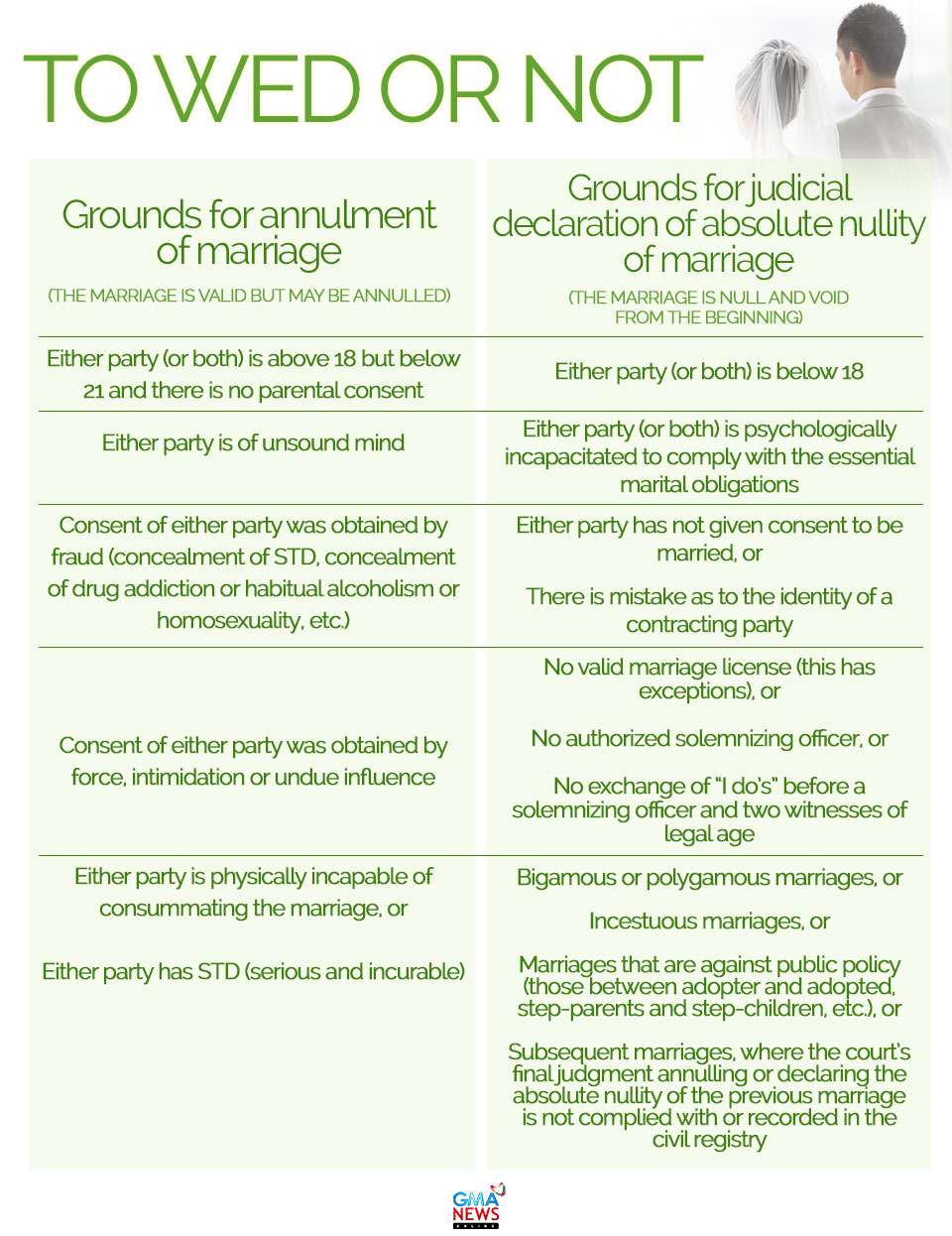
Once again, below is the chart that we published in the previous article (“To wed or not: How to avoid an annulment”) listing the grounds for annulment and for judicial declaration of absolute nullity of marriage.
These grounds are exclusive. Before filing any petition to dissolve your marriage, you must check first if your situation falls under any of these grounds. Then you must consult a lawyer, bringing with you your certificate of marriage. Your lawyer will ask you questions about your background and that of your spouse. He/she will also ask you questions about your marriage and your family life. After that, your lawyer will be able to assist you with your petition and advise you how to proceed.
These grounds are exclusive. Before filing any petition to dissolve your marriage, you must check first if your situation falls under any of these grounds. Then you must consult a lawyer, bringing with you your certificate of marriage. Your lawyer will ask you questions about your background and that of your spouse. He/she will also ask you questions about your marriage and your family life. After that, your lawyer will be able to assist you with your petition and advise you how to proceed.
If dissolution of marriage is what you want, filing a petition for legal separation is not the answer. Legal separation only allows you to live apart and split your properties, but you will still be married to each other. You cannot remarry another person (it would be bigamy) and you cannot “live-in” with another person because you may be held liable for concubinage (if you are male) or adultery (if you are female).
What about if your spouse is a foreigner and he/she obtained a divorce abroad capacitating him/her to remarry, will you automatically be able to remarry also or will you still have to file a petition here to nullify your first marriage?
No, you cannot automatically remarry. There is no more need to file a petition for annulment or judicial declaration of absolute nullity of your first marriage, but you must first file a petition for judicial recognition of your foreign divorce. This is filed in court and is litigated just like any other case. You must present as evidence your authenticated foreign divorce decree and an authenticated copy of the marriage and divorce laws of the country that issued the divorce.
If you live and work abroad and you file for divorce, will it be valid in the Philippines?
It depends. If you are still a Filipino citizen, the foreign divorce that you obtained is invalid. Divorce is not allowed in the Philippines, and the marriage laws of your nationality as a Filipino will follow you wherever you go in the world. Only a foreigner spouse may file for divorce abroad.
On the other hand, if you already acquired foreign citizenship you may obtain a divorce abroad even if you were still a Filipino when you married.
Atty. Reeza Singzon is a trial lawyer specializing in family law and civil law. For questions and comments, she may be reached at reeza.singzon@gmail.com

