

 GMA Brandtalk
 Tracking
 Archives

Meet the three female ICC judges who signed the warrant of arrest for Duterte
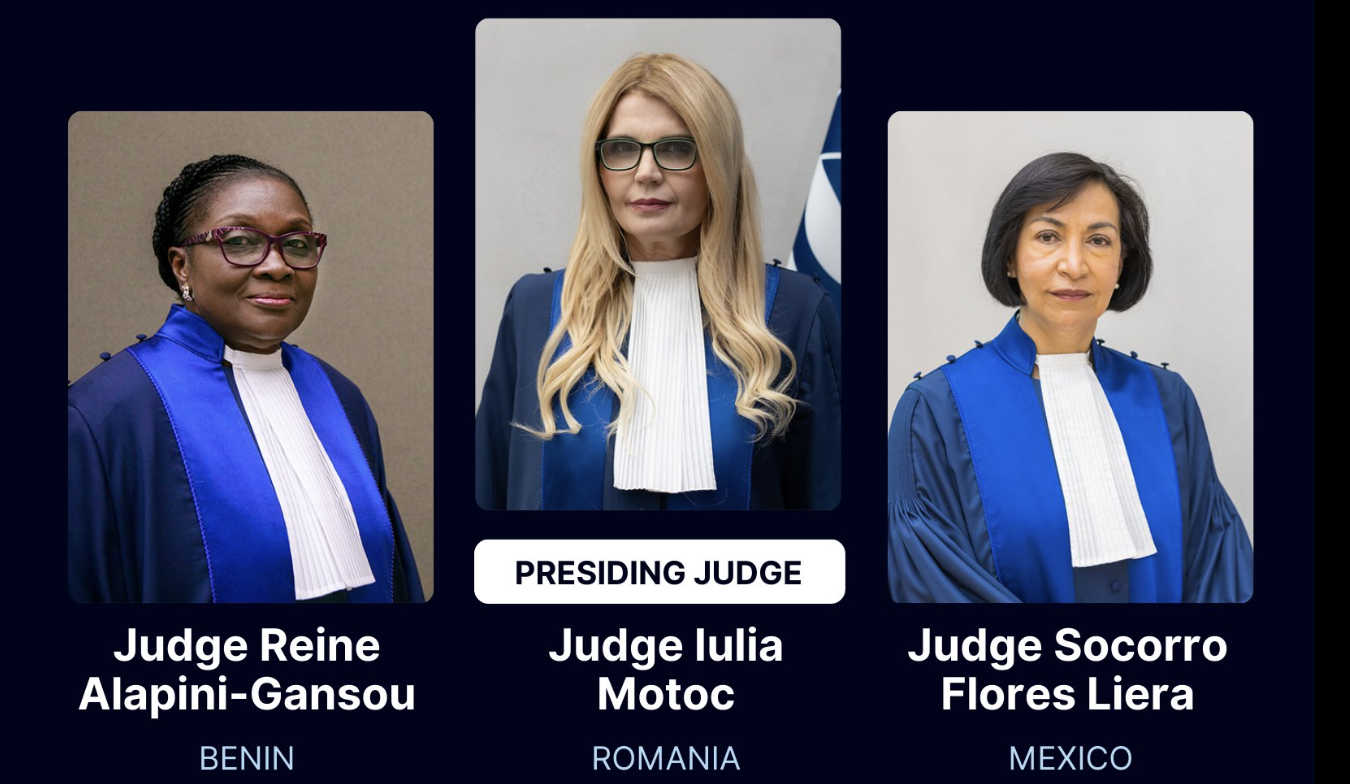
Three female judges of the International Criminal Court (ICC) have signed the warrant of arrest for former President Rodrigo Duterte for crimes against humanity.
Police served the warrant of arrest to Duterte on Tuesday morning, after landing at the Ninoy Aquino International Airport Terminal 3 from Hong Kong.
The ICC has been investigating Duterte for his bloody drug war during his time as mayor of Davao City and as president of the Philippines.
Shortly after the arrest, Duterte was brought to the Villamor Airbase, Pasay City and by 11:03 p.m. on March 11, he started his journey to the Hague in the Netherlands, where he will be tried before the Pre-Trial chamber.
The warrant of arrest was signed by Judge Iulia Motoc, presiding judge, Judge Reine Alapini-Gansou, and Judge Maria del Socorro Flores Liera.
They are the Pre-Trial judges who will hold a hearing to confirm the identity of the suspect, ensure that the suspect understands the charges, and set a date to begin the confirmation of charges hearing.
Get to know them below.
Judge Iulia Motoc
The presiding judge of the pre-trial chamber of the ICC, the Romania-born Motoc earned her Bachelor of Laws degree from the University of Bucharest in 1989.
She also obtained her Master’s degree as well as her PhD in International Law from the University Paul Cezanne, Aix-Marseille III in 1991 and 1996, respectively.
The Romanian judge also has a habilitation in law degree from Paris-Sud University (Paris X1) and a PhD in Philosophy from the University of Bucharest.
Apart from that, Montoc was a Senior Fellow at the New York University School of Law (2003-2004) and Yale University School of Law (2004-2007).
Before joining the ICC, Motoc served as a judge at the Constitutional Court of Romania from 2010 to 2013 and at the European Court of Human Rights (ECHR) from 2013 to 2023, where she dealt with complex cases including. corruption and sexual violence, genocide, crimes against humanity, and war crimes.
Motoc also worked with the United Nations, where she served as the vice president of the UN Human Rights Committee as well as president of the UN Sub-Commission on Promotion and Protection of Human Rights.
She also served as a UN Special Rapporteur for the Democratic of Congo reporting crimes against humanity and war crimes. She is also a member of the Institut de Droit International.
She also co-drafted the UN Report on free, prior and informed consent of indigenous people and the UN Guidelines on Extreme Poverty and was a UN Special Rapporteur on Genetics and Human Rights.
Her expertise in human rights doesn’t end there as she was also a member of the Advisory Committee on the Framework Convention for the Protection of National Minorities and European Union Agency for Fundamental Rights and a Member of the Management Board.
Reine Alapini-Gansou
Reine Alapini-Gansou is a Beninese judge of the ICC since 2018.
Alapini-Gansou holds a joint post-graduate degree (DEA) from Maastricht, Lomé, and Bhutan universities, as well as a degree in Common Law from the University of Lyon 3.
Additionally, she has a Master's in Business Law and Judicial Careers from the National University of Benin in West Africa. She has also earned multiple diplomas in international human rights law from institutions such as the African Institute of Human Rights, the René Cassin Institute, and the International Development Law Organization (IDLO).
Before joining the ICC in 2018, Alapini-Gansou dedicated 12 years to the African Commission on Human and Peoples' Rights (ACHPR), serving as its Chair from 2009 to 2012 and as the Special Rapporteur on the situation of human rights defenders in Africa from 2005 to 2009 and again from 2012 to 2017.
She has contributed to several United Nations commissions of inquiry into human rights violations and chaired the joint working group on special procedures between the UN and the African Commission on Human and Peoples' Rights. In 2011, she was appointed as a judge at the Permanent Court of Arbitration.
Alapini-Gansou was admitted to the Benin Bar in 1986 and later worked with the Association Avocats Sans Frontières (ASF) Belgium on the "Justice for All in Rwanda" project in 2001. She is also a member of the International Criminal Bar.
While at ICC, the Beninese served as the ICC Pre-Trial Division President from 2019 to 2020.
Aside from being a judge, she has been a professor at the University of Abomey - Calavi, in Benin.
Maria del Socorro Flores Liera
Flores Liera has been an ICC judge since 2021.
The Mexican judge obtained her law degree from the Universidad Iberoamericana and the Faculty of Law of the Universidad Nacional Autónoma de México, specializing in public international law.
Before joining the ICC in 2021, she had a distinguished career in Mexico's Foreign Service, including serving as the Permanent Representative of Mexico to the UN and other international organizations in Geneva from 2017 to 2021. She was also Vice-President of the Human Rights Council in 2020 and is a member of the Mexican Branch of the International Law Association.
As a member of the Mexican delegation, Flores Liera played a key role in the creation of the International Criminal Court (ICC) from 1995, including negotiating the Rome Statute and the adoption of the Elements of Crimes and Rules of Procedure. She also served as Chairperson of the Drafting Committee at the 33rd International Conference of the Red Cross and Red Crescent.
Move by Duterte camp
Duterte’s camp has since moved to have two of the three—Alapini-Gansou and Flores Liera—removed from the case, citing alleged bias.
But the ICC has repeatedly rejected these efforts.
On May 6, 2025, the ICC Pre-Trial Chamber denied Duterte’s request to excuse the two judges from ruling on jurisdiction. In its decision, the chamber stressed that only judges themselves may seek to be excused, and that defense parties cannot preemptively request such disqualification.
The matter was later elevated to the full plenary of ICC judges. On July 3, 2025, the plenary ruled unanimously that there was no bias or appearance of partiality on the part of Alapini-Gansou and Flores Liera, affirming that they had fulfilled their duties in accordance with the Rome Statute.
Alongside these rulings, the ICC has been preparing for the participation of victims in the proceedings. In April 2025, the Registry recommended the adoption of an “A-B-C Approach” to streamline applications while ensuring protection and dignity for victims.
Prosecutor Karim Khan has also submitted 139 pieces of evidence in support of the case, covering categories such as murder during Duterte’s term and his potential modes of liability.
The case now moves closer to trial, with judges Motoc, Alapini-Gansou, and Flores Liera remain assigned to the proceedings. — Jade Veronique Yap and Sherylin Untalan/LA/KG, GMA Integrated News

