

 GMA Brandtalk
 Tracking
 Archives

'Quezon' closes Tarog's 'Bayaniverse,' unmasking the politics and power behind Philippine heroes
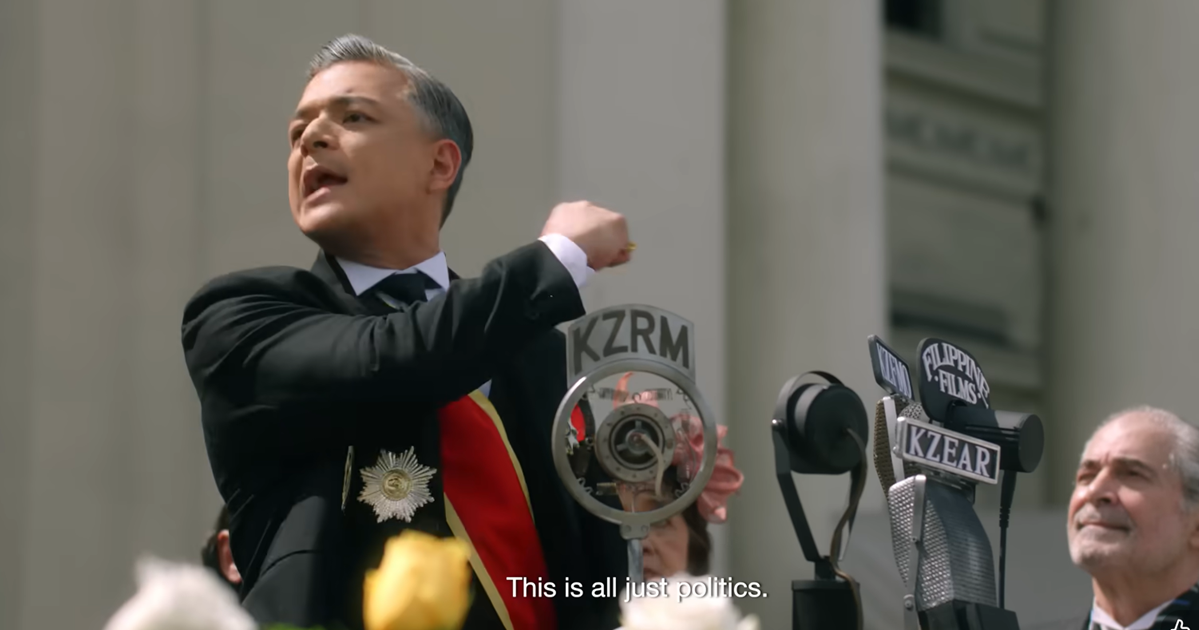
Jerrold Tarog's "Bayaniverse" films have finally come to an end as "Quezon," the final installment from the trilogy, hits cinemas nationwide.
More than showcasing the rise of Manuel L. Quezon (Jericho Rosales) in power, "Quezon" also delves into his complex relationship with Sergio Osmeña (Romnick Sarmenta)—a partnership once rooted in shared ideals but later strained by political differences.
In the biopic, the rift between Quezon and Osmeña serves as one of the film's pivotal scenes. It showed how their relationship, once built on mutual respect and a shared dream of Philippine independence, slowly filled with tension as they clashed over principles, leadership style, and power.
Quezon and Osmeña began as close allies in the Nacionalista Party, united by their goal of achieving Philippine independence from American rule under Governor-General Leonard Wood (Iain Glen). Osmeña was the Speaker of the House, while Quezon became Senate President.
As Quezon's popularity and influence grew, his assertive leadership began to overshadow Osmeña's calm and diplomatic approach, straining their alliance. Their rivalry stemmed not from hatred but from differing ideals and personal pride, with Quezon's firm, decisive style clashing with Osmeña's belief in collaboration and order.
Despite their disagreements on how to lead the nation under American rule, both shared the same goal of preparing the Philippines for independence. Ultimately, they set aside their differences temporarily when Quezon ran for president with Osmeña as his vice president. Both of them win, promising an independent nation for the Filipino people.
The relationship between Quezon and Osmeña mirrors the kind of political rivalries we see in the Philippines today. Once allies, they eventually drifted apart because of ambition and clashing beliefs, a pattern that continues to play out among leaders now.
Their story reminds Filipinos that real leadership isn't just about power or vision but about humility and teamwork. When politicians let personal interests get in the way of duty, it's the people who end up paying the price.
Tarog's trilogy reveals the humanity behind the nation's heroes
Aside from Quezon and Osmeña's political turmoil, the "Bayaniverse" trilogy also reveals that our national heroes are far more complex than their idealized public images suggest.
In "Heneral Luna," Antonio Luna (John Arcilla) was known for having a reputation of being a hot-tempered leader. Despite this, Luna was a brilliant tactician, whose fierce nationalism and strict discipline earned him both admiration and resentment.
While many see him as a true patriot fighting for unity and independence, others view him as arrogant and authoritarian. His uncompromising nature and strong personality made him a hero driven by love for his country, but also a tragic figure who met an untimely end after making too many enemies.
Meanwhile, in "Goyo: Ang Batang Heneral," one particular scene in the film showed how Goyo (Paulo Avelino) carefully curated his image to the public.
In that memorable scene, Goyo proudly poses for a formal photograph with his men, a moment meant to display confidence and glory. Yet beneath its polished surface lies quiet irony. Tarog uses this scene to show that heroism can sometimes be performative and that the pursuit of admiration and legacy can blur one's sense of purpose.
By portraying this photo session as both proud and hollow, Tarog humanizes Goyo, reminding viewers that image of public figures are carefully curated projections that rarely matches who they really are.
"Quezon" takes it up a notch, as Quezon asks Nadia (Therese Malvar), the daughter of his friend Joven Hernando (Cris Villanueva), an aspiring filmmaker, to create films that glorify his life and heroism which he used a propaganda machine to strengthen his image as he campaigns for the presidency.
The imagery across the "Bayaniverse" trilogy serves as a cautionary reflection on hero worship. It reminds viewers that leaders, no matter how noble they may seem, are still human and that the stories we believe about them can be shaped, curated, and manipulated through the machinery of power. —MGP, GMA Integrated News

