

 GMA Brandtalk
 Tracking
 Archives

Boracay Bridge plan sparks debate over transport, livelihood concerns
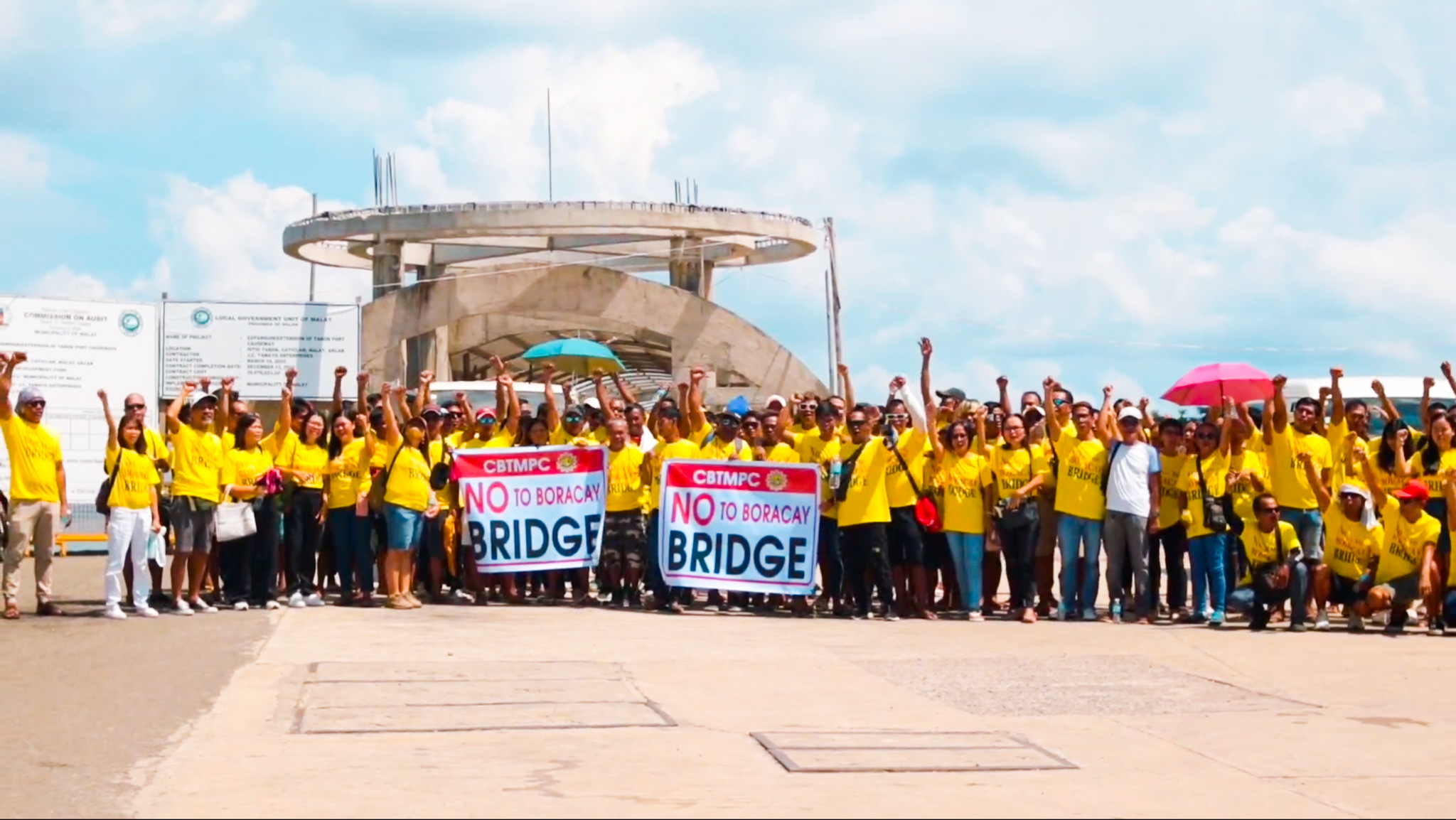
Known for its white sand and clear waters, Boracay remains one of the country’s top tourist destinations. But behind its postcard image, a dispute is brewing over a proposed bridge that would connect the island to Caticlan.
At the Caticlan Jetty Port, passengers typically take a 10- to 15-minute boat ride to Boracay for a boat fee of around P60. Recently, some boat operators have been spotted wearing shirts that read “No to Boracay Bridge,” signaling opposition to the project.
Some tourists support the plan, saying it could make travel easier.
“Para sa akin, bilang pumapasyal dito, pabor ako. Kasi para madali yung pagpunta sa island,” one visitor said.
["For me, as someone visiting here, I’m in favor of it. Because it makes getting to the island much easier."]
Others raised concerns about its impact.
“I don't think it's a good idea. It's gonna cause more traffic, more problems. That's part of the adventure here to come to Boracay is taking a boat. I'm totally against it, especially for the boat handlers and people like that,” a tourist said.
Boatmen are among those opposing the project.
Jun, a boatman, said the bridge could change the island’s character and affect livelihoods.
“Masisira kasi ‘yung imahe ng Boracay. Kasi ang liit-liit lang nung Isla natin tapos crowded pa sa mga sasakyan diyan. Marami kami na mawawalan ng trabaho. Pa’no na lang kami?” he said.
[“It will ruin Boracay’s image. Our island is so small, and yet it's already crowded with vehicles. Many of us will lose our jobs. What will happen to us?”]
The Boracay Bridge
The project, known as the Boracay Bridge, has been awarded to San Miguel Holdings Corporation (SMHC) and is estimated to cost nearly P8 billion. It will be implemented through a Public-Private Partnership with the Department of Public Works and Highways (DPWH).
The planned bridge will stretch about 2.54 kilometers, including a 1.14-kilometer main bridge, and will feature road lanes, pedestrian walkways, bicycle lanes, and utility systems.
For many in the local transport sector, the project raises concerns about job security.
Leo, a third-generation boatman who has worked in the area for 30 years, said boating has supported his family.
“Malaking tulong ‘yung pagbabangka sa buhay namin kasi napaaral ko ‘yung anak ko,” he said, adding that his income varies depending on the season.
[“Providing boat services is a huge help to our lives because it’s how I was able to send my child to school.”]
The bridge could directly affect his livelihood.
“Kaagaw mo na ‘yung tulay kung sakali. Okay lang kung ako lang mag-isa eh. Eh ‘yung pinapakain ko, pamilya ko. Mabigat sa loob. ‘Di ka nga halos makatulog. ‘Yan lang lagi ‘yung nasa isip mo,” he said.
[“If the bridge pushes through, it will be my competition. It would be fine if it were just me, but I have a family to feed. It weighs heavily on my heart. You can barely even sleep; it’s all that's on your mind.”]
Operators also raised concerns, including the Caticlan-Boracay Transport Multi-Purpose Cooperative (CBTMPC), which represents boatmen and operators.
Godofredo, a boat operator since 1989, said the business has helped support families and provide jobs.
“Talagang malaki ang kinatatakot namin kasi hindi naman negosyo itong mga bangka, hanapbuhay ito eh. Kung mawawala sa amin ‘yun, ay anong hanapbuhay nila?” he said.
["We are really terrified because these boats aren't just for profit; they are our way of life. If we lose that, what else is left for us to do?"]
He also questioned reports that a toll fee may be imposed to recover project costs.
“Sabi ko nga eh, kung halimbawa taga-Caticlan ako, may bitbit akong bisikleta, gusto kong magbisikleta sa tulay, eh kahit bisikileta magbabayad din eh. Anti-poor most likely, ‘yan ang opinion ko,” he said.
[“As I’ve said, for example I was from Caticlan and I had a bicycle with me and wanted to bike across the bridge—even a bicycle would have to pay. It’s most likely anti-poor; that’s my opinion.”]
The planned bridge comes as transport groups are still reeling from previously imposed changes.
In 2021, the Maritime Industry Authority (MARINA) ordered the modernization of boats, requiring operators to replace older wooden vessels with newer ones made of fiberglass, aluminum, or steel.
Arlie, a boat owner, said he had to sell his inherited boat and take on debt to comply with the modernization program.
“Binenta ko ‘yung bangka sa halagang 200 thousand lang. Naiyak lang kami, nakita namin ‘yung bangka namin na pumapalayo,” he said.
[“I sold the boat for only 200 thousand. We just cried watching our boat sails away.”]
He added that he borrowed millions to acquire a new boat, but has recently been unable to operate due to documentation issues.
“Talagang higpitan muna ng bulsa, walang trabaho, tambay lang sa bahay,” he said.
[“We really have to tighten our budget for now, there’s no work, just idling at home.”]
The CBTMPC secured loans from banks to help members purchase modern boats, and according to Godofredo, these loans are still being repaid, and projected to be settled by 2031.
Locals' stance
In Sitio Tabon Baybay, where part of the bridge may be built, some families fear displacement.
Mary Jane, a resident, said her family has lived in the area for generations.
“Lahat dito ng mga residente against sa project na ‘yan. Maaaring ma-demolish daw lahat ng mga residente rito. Kaya ‘yun nakakalungkot para sa amin,” she said.
[“All the residents here are against that project. It’s possible that all the residents here will be demolished. That’s why it is so saddening for us.”]
Local officials have also taken a stance against the project.
The Sangguniang Panlalawigan of Aklan passed Resolution No. 193-2025 expressing “strong objection” to the project, followed by additional resolutions in March and April 2026 which call for transparency, as the project was awarded despite opposition from local government units.
Former Vice Governor and Sangguniang Panlalawigan member Atty. Reynaldo Quimpo has also raised concerns about consultation and the protection of affected communities.
Potential benefits
Despite opposition, some sectors see potential benefits: for example, the bridge could improve transportation, increase tourism, and provide faster access during emergencies, especially when sea travel is not possible due to bad weather.
The DPWH maintains that the project is important infrastructure. Secretary Vince Dizon said consultations had been conducted and that concerns would be addressed.
“We are assuring the residents there and the stakeholders that whatever grievances they have and whatever their concerns, all of those concerns need to be addressed and all those concerns need to be satisfied,” he said.
He added that coordination with local governments is part of the responsibility of the private partner, SMHC.
As of now, no construction date has been set but according to project documents, work will begin only after right-of-way requirements are completed and the detailed design is approved. Construction is expected to take about three years.
The Department of Environment and Natural Resources (DENR) has yet to release a detailed position or findings on the project’s environmental impact.
KMJS tried to get a statement from former acting Mayor Abram Sualog, but he has not responded as of the time of this report.
The program also reached out for a statement from the project grantee, San Miguel Holdings Corporation, which will be building the bridge. They replied to the letter but referred the matter to San Miguel Corporation’s Media Affairs. They have yet to respond to the program’s invitation as of the time of this report. —JCB, GMA News

