

 GMA Brandtalk
 Tracking
 Archives

Funeral arrangements, remains: UP Law profs discuss calls to address same-sex partners' rights
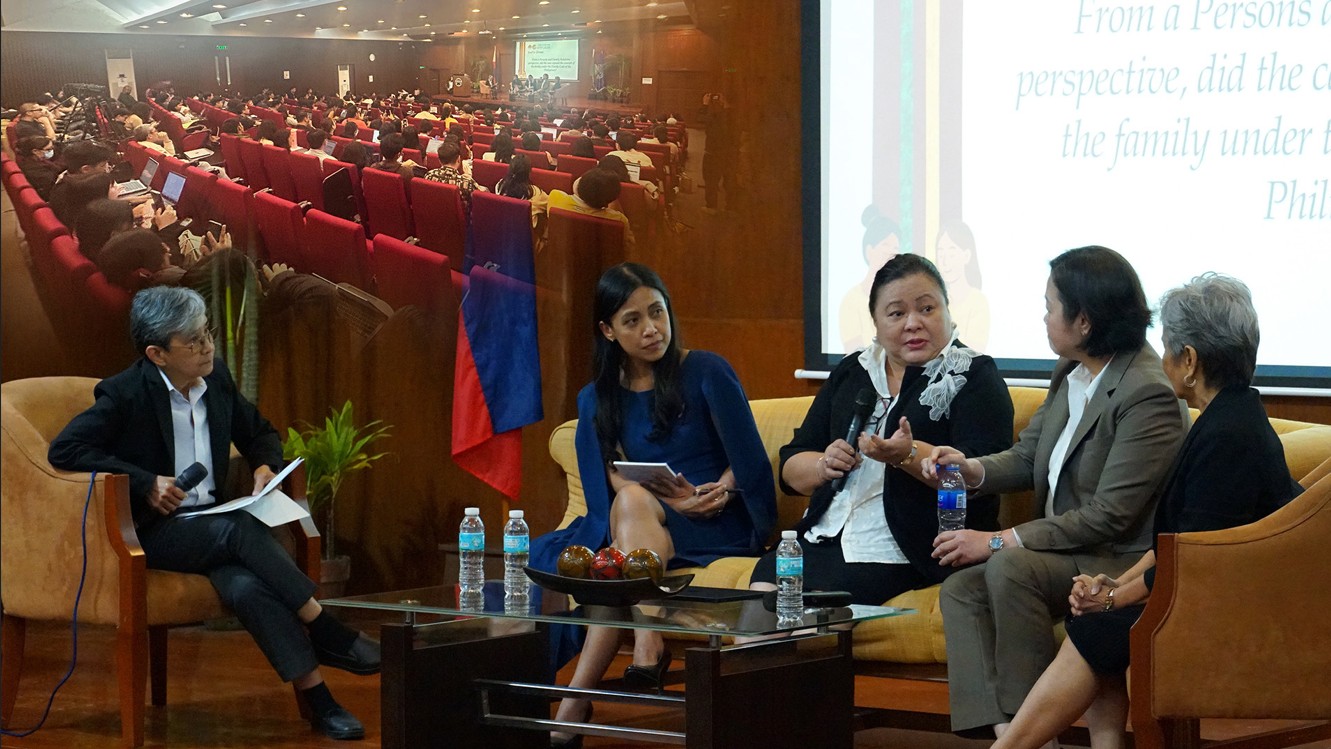
Faculty members of the University of the Philippines (UP) College of Law gathered to discuss insights and renewed calls after the recently released resolution of Josef v. Ursua, where the Supreme Court (SC) addressed that same-sex partners may also co-own properties under the Family Code instead of the Civil Code.
Organized by the UP Law Center Gender Law and Policy Program (UP GLPP), the roundtable event was held last March 18, 2026.
“As we move forward, this case serves as both a shield for property rights and a call for the legislature to address the legal gaps that still force those who love distinctively to navigate a complex and often discriminatory legal landscape,” said UP Law Dean Gwen Grecia-De Vera in her opening remarks for the event held in UP Diliman’s Malcolm Theater.
In the said ruling made public February 10, 2026, the SC addressed the right of cohabiting same-sex couples to co-own property under Article 148 of the Family Code, provided there is proof of actual contribution.
This, as the Court granted Jennifer Josef’s petition for partition of property, and recognized her as co-owner of the Quezon City house and lot she shared with respondent Evalyn Ursua.
Implementation challenges
“So again, it's the administrative implementation of this decision that I think will prove to be challenging,” said UP Law senior lecturer Atty. Froilyn Doyaoen-Pagayatan in her presentation concerning the ruling’s implications on succession law.
The onsite audience was composed of more than 100 law students from different schools, legal experts from the UP Law faculty, and members of civic society organizations.
“So, after you heard what Attorney Mia mentioned earlier about actual partitioning, you also have to deal with these matters with the administrative agencies,” she added, citing possible scenarios involving frontline government personnel — such as those in the Bureau of Internal Revenue (BIR) — who might not yet be familiar with
the SC ruling in Josef v. Ursua.
Responding to a question from GMA Integrated News, Doyaoen-Pagayatan said that the ruling also empowers members of the LGBTQ+ community who have been disowned by their families.
“[Some] same-sex couples, they've been tinakwil, pinalayas sa kanilang mga family, tinakwil ng kanilang mga parents, ng kanilang mga siblings,” she answered during the event’s open discussion portion.
(They've been disowned, cast out from their families, rejected by their parents, by their siblings.)
“Message ko lang [to these couples] is… Ito na po 'yung pagkakataon ninyo, para, to deprive them of enjoying your properties, when you pass on, dahil hindi sila naging mabait sa inyo at hindi kayo tinanggap,” she continued tongue-in-cheek, to a receptive audience.
(My message to these couples is... this is your opportunity, for you to deprive them of enjoying your properties, when you pass on, because they were not kind to you and did not accept you.)
Right to funeral arrangements
“What I'd like to look at is, in the existing framework, what can be extended to a couple who are of the same sex?” said Prof. Elizabeth Aguiling-Pangalangan in her presentation concerning the ruling’s impact on family relations law.
“Funeral arrangements also, which has to do with the fact that they are not considered next of kin, no? Because, again, these arrangements follow the rule also of—you know— in the hierarchy of, importance and closeness of kins,” she added in a latter part of her presentation.
The Civil Code currently provides that the duty and the right to make arrangements for a person’s funeral shall be in accordance with the said hierarchy.
Meanwhile, the hierarchy also figures in Article 308 of the Code which provides for the retention, internment, disposition, and exhumation of
human remains.
‘It took another six years’
Looking toward to the future, other UP Law faculty said there is an ongoing need for both legislative action and judicial review.
“Mukhang may timing sila [SC],” said senior lecturer Atty. Mia Gentugaya in an open discussion.
(It seems they have their timeline.)
“Before, in Falcis ‘di ba, they felt it was not yet time to do it. But I can't remember how long ago is Falcis. 2019? It took another 6 years before the Supreme Court, was quite prepared to mention,” continued Gentugaya during a discussion surrounding the SC’s seen role in addressing that the rights heteronormative couples enjoy extend to same-sex partners.
Gentugaya cited the 2019 case of Falcis v. Civil Registrar General where the SC declined, citing technical grounds, to grant Jesus Falcis’ petition to primarily declare Articles 1 and 2 of the Family Code, enacted into law by former President Corazon Aquino in 1987, as unconstitutional.
The said Family Code provisions currently define marriage as between man and woman; Falcis forwarded that there is no such explicit limitation in the 1987 Constitution.
“But I do agree, mayroon pa ring gaps,” added Gentugaya, saying Josef v. Ursua is not enough.
‘LGBTs and the allies are a force to reckon with’
On the same discussion of judicial review, senior lecturer and accountant Atty. Virginia Viray said that she recognizes that it is within the SC’s powers to rule that Articles 1 and 2 of the Family Code as unconstitutional.
“To be clear, I am not in favor of judicial legislation. However, as I mentioned in the talk, the power of judicial review is supposed to look at the law, and if it's unconstitutional because it violates the rights of certain persons or groups, which I think should be looked into more carefully by the Court,” said Viray.
“And they should not say, with all due respect to the Supreme Court, they shouldn't say that it's not within their power to look at the law and say that it's unconstitutional if it's violative of the rights of certain people,” she added.
Notwithstanding such a possible future ruling on Arts. 1 and 2 from the judiciary, Viray agreed with the other discussants that Josef v. Ursua underscores the reported necessity for certain laws and ordinances, both on a national level through Congress and on the ground through local government units (LGUs).
For this to happen, Viray said that ‘visibility’ plays a key role.
“One of the things that helps in ushering all the changes is the continuing visibility of LGBTs. Because it gives that—they see that the LGBTs and the allies are a force to reckon with,” she said.
“When everyone's hiding they think, you know, sino ba ’to, wala naman mga ‘yan, ano bang gagawin ng mga ‘yan? Wala naman sila eh. They're not a force to reckon with,” Viray cautioned.
(When everyone's hiding they think, you know, who are they, they don't matter, what are they going to do?They are nobodies. They're not a force to reckon with.)
“[Being out and vocal] is one's own personal journey. But for those who can, it's important to be visible,” she stressed.
‘Let us all challenge ourselves’
At the event’s conclusion, UP GLPP program director Prof. Leo Battad said that Josef v. Ursua calls on Congress and other government offices to address the rights of same-sex couples in the absence of a law recognizing their union. And, in line with Women’s Month, Battad also stressed that discrimination persists, not only for persons of diverse gender identity, but also for women.
To these ends, Battad recognized the need for legal reforms.
“Some of these reforms have been mentioned by our discussants and are currently being debated in Congress. Some of these bills respond to call for elimination and promotion of gender equality, such as: the proposed amendments to the discriminatory provisions in the Family Code about privileging male over female spouses on family. Of course, we're talking of heterosexual relationship,” said Battad in an enumeration.
“Amendments to VAWC and Safe Spaces Act regarding, more particularly, ICT-facilitated sexual violence, particularly against women. And there are also initiatives to amend or repeal adultery and concubinage, and to push for the passage of [the] Divorce Law,” Battad continued.
“Right to Care — Allowing and recognizing any adult to be an agent of another person, regardless of SOGIESC; as well as the SOGIE Equality Bill, Marriage Equality Bill or else the Civil Partnership Law,” Battad concluded.
According to Battad, the UP GLPP regards these bills as important for achieving gender equality. —RF, GMA Integrated News

