

 GMA Brandtalk
 Tracking
 Archives

Reiki or pranic healing? Take your pick from Manila’s master trainers
How would you like to be able to banish a headache, relieve a toothache, reduce the swelling of a foot, alleviate the symptoms of hypertension, remove phobias – or, more importantly for many Pinoys, even empower yourself to gain wealth?
Quackery? Tall tales and balderdash? These are just some of the comments I receive from friends and colleagues amid the head-shaking and disbelief whenever I talk to them about my very personal relationships with reiki and pranic healing – two of the more popular alternative treatments within New Age circles in the country today.
One of them is home-grown: a Filipino-Chinese businessman, the late Grand Master Choa Kok Sui, developed and first promoted pranic healing in Manila in the late 1980s. Meanwhile, the Japanese guru Mikao Usui started the Reiki System of Healing in the early 1900s, and it has since spread worldwide, eventually reaching our shores.
Both work with the basic concept that disease happens when one or some of the so-called “chakras” (Hindu Sanskrit term for “energy centers”) is not functioning well due to a range of factors. However, they differ in their approach to correct the imbalance in the body.
No-touch pranic healing
Pranic healers believe that a malfunctioning body gives off negative or diseased energy. Thus, their objective is to keep the chakras moving and functioning well, using a no-touch technique that aims to balance the energy centers of the body in order to generate good health and well-being, and in the process, even prosperity.
“It is a form of healing designed to complement Western medicine,” said Judy Papeck, a master trainer at the Institute for Inner Studies in Makati. It is the sole institute that certifies pranic healing practitioners and instructors worldwide, but there are other wellness centers that teach pranic healing in the country.
The institute offers learning modules that include scanning, cleansing, energizing, and stabilizing the body to rid oneself of disease. I studied it while I was still in Thailand, one of the more than 150 countries where there are practitioners of the craft. Its books and manuals have been translated into over 27 languages – proving that a healing art started by a Filipino can gain international fame.
Pranic healing is used to scan the body for malfunctioning chakras, remove the diseased area, revitalize these chakras through the application of energy from the Divine or Higher Source – or God Consciousness as some people call it – and stabilize the energy of that chakra to ensure that it does not malfunction again.
Throughout the entire process, the hands are used to feel and repair the body’s energy fields – but without touching the patient. Healing of a sick person can even be done from a distance, meaning the healer and the patient might be in two different places – and still generate the same results.
In addition to better health, Papeck says the healing modality also increases our energy systems – including widening our auras (the so-called energy fields around the body which, to some intuitive people or psychics, look like bands of white or colored halos).
A person’s financial state can also improve once the energy centers are performing normally, because the physical and mental faculties are balanced and working more efficiently, according to Papeck.
Hands-on reiki healing
On the other hand, unlike pranic healing, reiki has a literally hands-on approach to healing.
“We lay our hands on all of the chakras, in this case, the seven major chakras -- crown, ajna (located in the space between the eyes), throat, solar plexus, sacral (sex organs), meng mein (a point between your basic and solar plexus), and basic (at the bottom end of your spine), as well as the thighs, knees, legs and the feet,” says reiki master healer Lilian Jarales of the RUAH Energy and Inner Knowledge Institute.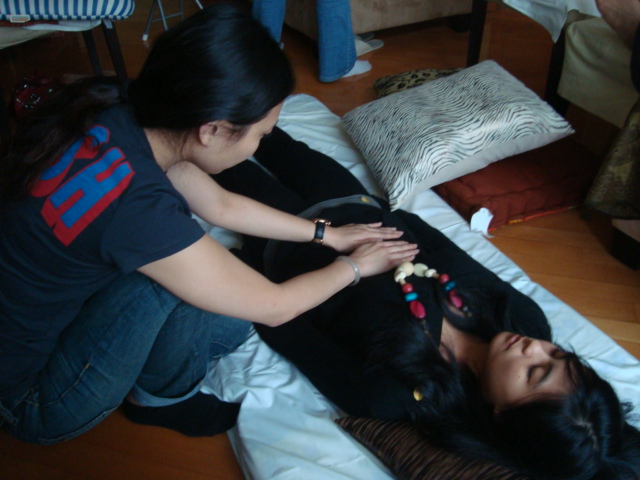
Reiki healers are trained to sensitize their hands by gliding through all these chakras so that they can detect which ones are malfunctioning. Connecting to a higher plane of consciousness, and swept in a sort of meditative trance, the reiki practitioner can summon and become a channeler of positive energy, resulting in the healing of a patient.
Another difference with pranic healing is that in reiki, there is no such thing as “negative energy,” says Jarales. Reiki healers believe that they can transmute any negative energy they detect in the chakras to positive energy. Hence, the “cleansing” or act of removing diseased energy from the body to enable it to function well again, as practiced in pranic healing, does not happen in reiki.
Like pranic healing, however, reiki also balances the chakras – usually in pairs – in a technique called “heaven and earth chakra balancing.”
Reiki healing is taught by several wellness centers and individual master instructors in the Philippines, among them Jarales, who says she became an “intuitive healer” at the age of eight and a reiki healer since 2004.
Channel of energy
Of course, there are many cases when diseases are not removed by either pranic or reiki healing.
“Pranic healing teaches that one can heal by being a channel of energy from God or the Divine Source,” says Papeck. That means a pranic healer can assist in the healing, but the sick person will ultimately be responsible for its success.
Similarly, Jarales asserts that healing from reiki can only take place when the sick person’s psychic self or to some, the “soul level,” also agrees to the healing.
But when both the healer and patient are in sync, the benefits can run the gamut of diseases – from the most basic cold to the more debilitating ones like cancer. However, it is recommended that persons who have serious diseases must seek the counsel of medical physicians first, and consider alternative healing modalities as complementary to their treatment. – YA, GMA News
Photos courtesy of the Institute for Inner Studies and Reiki Inc.

