

 GMA Brandtalk
 Tracking
 Archives

Unang yakap: Why breast is best
Women Talk
One day I received a frantic call at the clinic from an 18-year-old patient who was still in her hospital room. She had just delivered her first baby that morning, and was starting to breastfeed. She was afraid, she said, that her milk was “dirty” because it looked yellowish and not at all milky white.
Upon arrival in her room, she showed me the “milk” coming out of her breast: it was yellowish and thick. I quickly reassured her that this was called “colostrum,” the first liquid that comes out for the first few days before mother’s milk. Colostrum is a very rich source of protein and, most of all, immune bodies – to fight off infections of the newborn. Because of this very important function, colostrum was often called “liquid gold.” Thus reassured, she quickly resumed her breastfeeding, and I teased her about forgetting what we had discussed before, during her prenatal check-ups, and that she had not done her own share of reading on breastfeeding before her delivery.
For indeed, the preparation for breastfeeding starts immediately after the woman learns that she is pregnant. Not only is she encouraged to read about the changes occurring in her body during the next few months of gestation, she is also advised to ask about breastfeeding from her health care giver, and from women relatives and friends. Studies have shown that supportive females around a would-be mother, especially her own mother, makes for successful breastfeeding.
Thanks to recent public advocacy and legislation, more mothers now nurse their infants, knowing its advantages over formula feeding. Colostrum has been shown to protect infants from life-threatening infections, as the baby’s gut is still considered sterile (too clean, and without good bacteria to fight against illness) when it is born. Breast milk also protects against development of allergies, including asthma. Mother’s milk too, contains the perfect combination of sugar, fat, protein, and water easily digested by the baby.
There are no bottles to sterilize, and no expensive baby formula powder to buy, as the cost of cow milk formula powder has become quite prohibitive. Neither is there a need to set up sterilizing paraphernalia for the bottles and rubber nipples.
The mother can also feed the baby “on demand,” that is, give her breasts any time the baby wants to do so, a schedule which is in tune with the baby’s body. This may become a bit demanding during the first few weeks, when both mother and baby are getting used to their own waking/sleeping schedules. The newborn would want to feed often (e.g. every two hours), as the baby’s stomach can only hold about a teaspoonful of liquid at one time. Mother’s milk is also thinner and watery than formula milk, so the baby gets hungrier often. But as the infant grows, its stomach also increases its capacity, so the intervals between feeding become longer.
Mother and child
The main argument for breastfeeding, however, is the body-to-body contact that the baby and the mother enjoy. In the Essential Newborn Care protocol, after clearing out the nasal passages and checking that the vital signs of the baby are normal, we immediately put the baby prone in between the mother’s breasts. The mother can thus cuddle and talk to her baby as soon as it is born.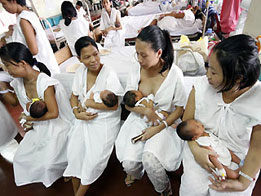 This is the “Unang Yakap” advocacy in our country, which includes promotion of early (within the first hour) mother and baby bonding, and breastfeeding. The skin-to-skin contact also helps in transferring good bacteria from the skin of the mother to the baby. This Philippine “Unang Yakap” campaign was given a thumbs-up by the World Health Organization, as evidence has shown that breastfeeding leads to lower neonatal mortality rates in developing countries.
There is also the so-called rooting reflex, where, by tapping one side of the baby’s cheek near its mouth, the baby’s head will naturally turn to that side with its mouth open. The newborn will eventually find the nipple and the breast, and will start sucking. This is a good “latching on” for the newborn. After a short stay in the Recovery Room to make sure the mother is stable, both she and her baby will be brought back to the mother’s room, and the baby is “roomed-in” with her until discharge from the hospital.
Studies show that breastfeeding increases the release of oxytocin, a hormone that causes the uterus to contract and help it regain its normal size faster, and eventually leads to faster weight loss for the mother.
And yes, breastfeeding mothers are assured of good protection against pregnancy at least for the first six months, if they are exclusively breastfeeding, which means the baby is fed only breast milk (not even water). The hormone prolactin, released by the brain, and which is responsible for milk production, will prevent ovulation; however we need to underline the words “exclusively breastfeeding” or the so-called LAM (Lactation Amenorrhea Method). After the sixth month, when other foods are introduced, breastfeeding times may become lesser, so the protection no longer holds true.
Mixed feeding
Many mothers inquire about mixed feeding: that is, giving both breast and formulas. Advocates of breastfeeding strongly advise against this practice, as this can lead to “nipple confusion.” The rubber nipples of feeding bottles are usually larger and have bigger holes, so the formula milk comes out in larger spurts, unlike the small trickle of the breast.
Formula milk tend to be sweeter as well, so babies thus fed with formula milk become fussy and irritable when returned to the breast, looking for larger nipples, bigger volumes, and sweeter milk. And because of this sweetness, some studies show that many bottle-fed babies become overweight, increasing the probability of these infants turning into overweight adults. Cow milk proteins are less digestible too, so diarrhea could be a problem. Needless to say, pacifiers are a no-no as they could also lead to "nipple confusion."
How about water? It seems that feeding the baby water (whether through a cup or bottle) is not needed while the baby is fully breastfeeding. Studies have shown that breast milk has enough water content for the newborn.
Inverted nipples could be a problem, but as early as the sixth month of pregnancy, if the nipples are inverted, manual manipulation could be done to bring them out. Care should be taken though, not to produce uterine contractions during the nipple manipulation which may lead to preterm labor. Moreover, with the proper technique of holding the baby, a mother could still breastfeed well even with inverted nipples, as the baby will be sucking around the areola (the dark, colored area of the breast), and not only on the nipple.
Increasing breast milk
Malunggay (Moringa oleifera) leaves have lately been in the limelight for breastfeeding mothers. Some small studies show that they increase breast milk production. Fresh malunggay leaves are readily available in our markets, so it is a wonder why some women still rely on store-bought malunggay tablets and capsules for their daily consumption.
However, the best way to increase milk production really is for the baby to suck more, sending signals to the brain centers (positive feedback). By emptying the breasts regularly, more milk will be produced. Taking in more liquids (soups, juices, water), eating more vegetables and fruits, and generally being healthy will redound to good milk production. This is nature’s way of replenishing what is needed by the young of the species.
One of the best ways to encourage breastfeeding too, is for the other members of the family, especially the father and other children, to support the mother while she is doing so. Helping her prepare the newborn’s clothes or diapers, and generally being physically present and being cheerful, can boost the mother’s self-esteem. She can also express her milk when the supply is abundant, and the milk can be stored and be fed to the baby later.
When not to breastfeed
There are, however, contraindications to breastfeeding. These occur in cases where the mother has HIV or full-blown AIDS (although some breastfeeding advocates say it is still possible, when the mother is on adequate retroviral medications), or when the mother is undergoing chemotherapy for cancer. Some women may also be so debilitated (with far-advanced PTB, severe malnutrition), including psychotic and violent patients, that breastfeeding will be most unhealthy and impractical for them and for their babies.
In a very few instances too, there are some babies that cannot tolerate milk. If the baby does not thrive well (irritable, vomits, does not suck well, nor gain weight) a consultation with a pediatrician is needed.
Healthy babies and moms
Indeed, we are happy to note the increase of breastfeeding mothers in the country.
After the national law on breastfeeding (RA 10078) was ratified, many offices now have breastfeeding areas in the workplace. Mothers at work are given 40 minutes (with pay) for the breastfeeding sessions, which can be broken down into shorter intervals totaling 40 minutes daily. Many malls too, have breastfeeding rooms, in support of this advocacy.
For indeed, with such healthy benefits for both mother and child, the worry-free preparations and its economic advantages, choosing to breastfeed is simple common sense. And yes, we should not forget to add that breast milk comes in such beautiful and lovely containers, too. -- YA, GMA News
Alice M. Sun-Cua is a practicing obstetrician-gynecologist at San Juan de Dios Hospital in Pasay City.

