

 GMA Brandtalk
 Tracking
 Archives

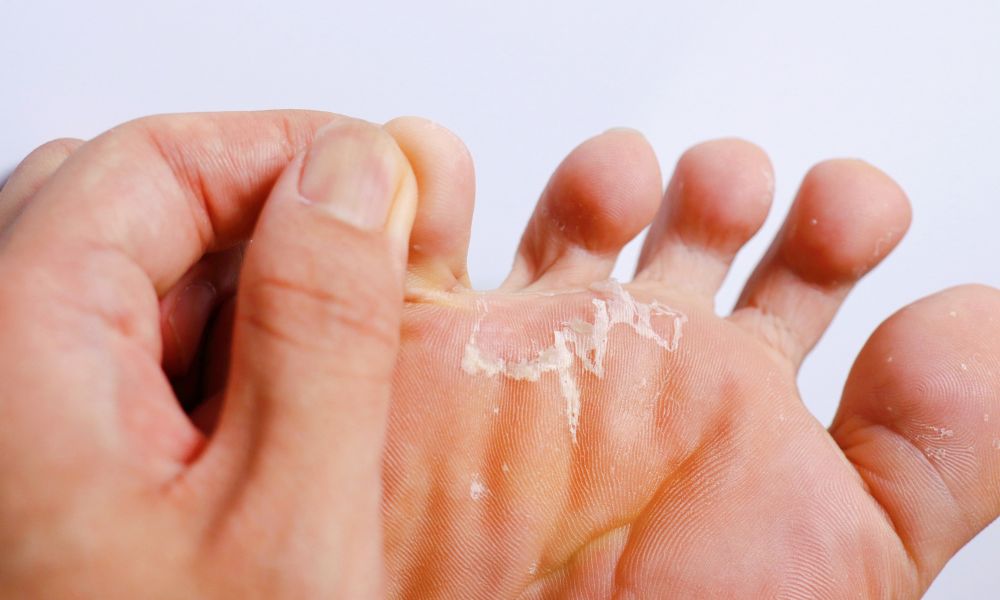
Skin on your feet is peeling? Expert explains why
Welcome to Doctor's Corner, where medical experts from Makati Medical Center will answer health questions from readers! Got a question? Send them over to comment@gmanews.tv.
Why is the skin on the bottom of my feet peeling?
There’s a reason why the skin on the soles of our feet is thick: It acts as a cushion from the pressure of weight-bearing actions like prolonged standing, walking, jumping, and running.
Sometimes though, constant pressure from these actions can cause the skin on the soles of our feet to peel. So too can wearing ill-fitting shoes, a lack of or too much moisture on the feet, and infection.
If the peeling and flaking come with itchiness and redness, you might have a fungal infection like athlete’s foot or ringworm.
If the patches of skin are dry, it could be due to eczema or psoriasis. Tight shoes that chafe on parts of your foot can leave you with blisters. And if your heels are dry and cracked, it’s likely because you’ve been standing too long or exposing your heels in open-back shoes.
Interestingly, excessive moisture is also a reason for skin to peel. Hyperhidrosis or sweating profusely can make the skin soft, tear, and peel.
Could the weather or a vitamin deficiency have anything to do with it?
Yes, and yes. Heat and humidity as well as cold, dry weather rob moisture from your skin, including the skin of your feet, resulting in peeling.
A lack of vitamins B3 (Niacin), B7 (Biotin), and E will reflect in dry, flaky skin. If your skin is scaly and your wounds take long to heal, you may be deficient in Vitamin C.
What can I do to fix it?
If your peeling is infection-related, an anti-fungal cream will help. Otherwise, you can restore moisture on your feet by applying a cream-based, fragrance-free moisturizer after bathing in lukewarm (not hot) water and wearing cotton socks to lock in the moisture.
For additional foot care, do the soak and seal method, wherein you soak your foot in lukewarm water. After soaking, apply mild, fragrance-free moisturizer within 3 minutes to lock in moisture. Another alternative is to include a ketolytic like urea or lactic acid, which have clinical data supporting their ability to safely break down and smoothen thickened skin.
Does your skin continue to peel despite these efforts, and is accompanied by redness and itchiness that won’t go away? See your doctor immediately.
For more health and wellness tips and educational reads, subscribe to GMA News Online's weekly newsletter, The Boost. Don't forget to confirm your email after signing up! — LA, GMA Integrated News
Claudine Rae Lagman-Javier, MD, MD, FPDS, FPADSFI, is a dermatologist at the Makati Medical Center. She is a Fellow of the Philippine Dermatological Society, the Philippine Academy of Dermatologic Surgery Foundation Inc., Makati Medical Society, and the International Society of Dermatologic Surgery.

