

 GMA Brandtalk
 Tracking
 Archives

Top surgery for transmen: How it works and why it's important for some
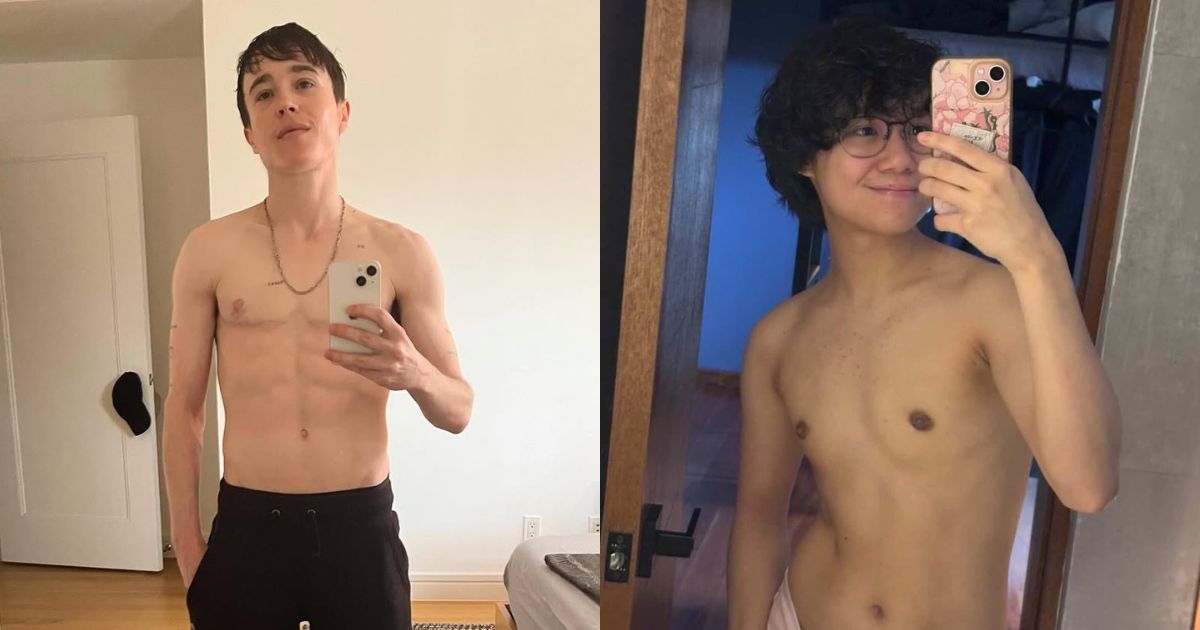
It was a social media filter that made Kren Yap finally feel like himself.
Assigned female at birth, he spent his formative years expressing himself as a butch lesbian in an all-girls’ school. It wasn’t until he entered the workforce and met a transgender woman that he started to expand how he thought about his identity.
Without role models but full of questions he needed answers to, he stumbled upon a video of a Cebuano transgender man. He reached out to the vlogger to talk about what he was going through even as he continued his internet research. It was through this conversation that he realized that he was actually a transman as well.
The vlogger referred him to the Pioneer Filipino Transmen Movement, where Yap learned more about gender identity and his own. Pioneer FTM began as a support group for transmen who struggled to access the medical services that they needed for their transition. Today it is a civil society organization advocating for transgender rights in the Philippines.
One day, he was playing around with a filter on a social media app that had just become popular. Suddenly he could see what he looked like with a moustache and a beard.
“Kinukwento ko ‘to, naiiyak ako,” Yap recalled. “Nung nag-selfie ako with it, I finally saw myself. ‘Yung ganung feeling. Parang, (expletive) ako ‘to! Ako ‘to!”
(“I’m getting teary-eyed just telling you this story. When I took a selfie with it, I finally saw myself. That was the feeling. It was like, this is me! This is me!”)
Reflecting on his youth, he realized that he had always hated having his picture taken.
“In hindsight, maybe it was because that wasn’t me,” Yap said.
Yap was determined to look exactly like the person he could be. He didn’t want it to remain a social media filter.
He did the math to make it happen through medical means, including the numbers in his plans for the future, but it was the pandemic that forced him to make his dreams come true after years of procrastinating.
“As more and more people were dying in my circles, I said to myself, ‘If I die tomorrow—and I had COVID-19 twice—I don’t wanna be in a coffin and people look at me and I’m a girl. When I die, I wanna have a moustache, I wanna have a beard. I wanna look (like) me when I die,’” Yap recalled.
Transitioning 101
How do you transition? This is a question Rocky Rinabor, the executive director of Pioneer FTM, often gets from the community.
First, he clarified, one doesn’t need to undergo any medical procedures to become a transgender person. One can identify “as a man or a woman, non-binary, or gender-diverse person” without having to appear a certain way.
Rinabor then went on to explain that there are different kinds of transitioning.
Social transitioning is where one comes out as a trans person. For transmen, he begins “introducing himself as a masculine person, saying his pronouns and lived name,” said Rinabor.
This is also not required. It is possible for a trans person to be the only one to know that he or she is trans and keep this to himself or herself.
Legal transitioning involves changing gender markers on legal documents.
“If I am assigned female at birth, what you see on my legal documents is ‘female,’” Rinabor said. “There’s no way to change that (in the Philippines) at the moment. But part of legal transitioning is actually owning that identity and being recognized by the government. So if I’m a transgender man, then I should be able to have my gender marker as a man or as a transgender man.”
Medical transitioning means going through gender-affirming (or gender-affirmative) care. The World Health Organization defines this as “any single or combination of a number of social, psychological, behavioural or medical (including hormonal treatment or surgery) interventions designed to support and affirm an individual’s gender identity.”
Transmen in particular transition medically to “masculinize (their) physiology,” said Rinabor. So gender-affirming hormone therapy has one taking testosterone given the dominance of estrogen in his body. Its effects include the growth of facial hair; the broadening of shoulders; and cessation of menstruation.
When Yap began hormone therapy during the pandemic, he noticed changes in his voice, his appearance, and his body fat distribution. From being teased as “Nicki Minaj” for having a pear-shaped body, he was able to have his more ideal form (also through exercise).
Both he and Rinabor experienced a drastic change in their mood and outlook in life.
“I used to be so hot-headed. I was so competitive and I was a man-hater to a very unhealthy level because all of my exes left me for cisgender males… I would even bring my biases to work. When I started (hormone therapy), I was finally not insecure about how I looked, about myself anymore,” Yap said.
“Growing up, marami akong poot sa mundo, maraming galit sa mundo na hindi ko ma-explain,” Rinabor recalled.
(“Growing up, I had a lot of rage towards the world, a lot of anger at the world, and I couldn’t explain it.”)
His parents enrolled him in anger management programs, having him see psychiatrists in his youth.
Within a month after he began hormone therapy, his therapist told him that he no longer needed to continue his sessions as the intervention had been helpful.
“I became very gentle… I felt free,” Rinabor said. “My relationships with people improved. I didn’t have a lot of friends before and hated being with people… My confidence shot up as well. I felt like I could face anyone after hormone therapy.”
Yap had a similar experience.
“I’m now very secure in myself. I don’t need to prove myself anymore. But prior to hormone therapy, I was very toxic,” he said.
What is gender dysphoria?
Rinabor recalled feeling a deep discomfort with himself and his body prior to transitioning. It was something he began experiencing at a young age.
“Gender dysphoria begins with how you are seen, how you are invalidated because you appear
a certain way or your appearance does not ‘align’ with how the Filipino society typically sees a man and a woman or a masculine and a feminine,” he said.
As early as five years old, he already identified as a boy. He wasn’t familiar with his body yet, and saw himself as masculine. As he entered puberty and was told by those around him, “Babae ka, hindi ka lalaki,” (“You’re a girl, not a boy.”) he began to experience gender dysphoria. Rinabor hated what he saw whenever he looked in the mirror.
“Gender dysphoria is, the body and the mind are not congruent. It’s like a male living in a female’s body,” said Dr. Alvin Jorge, the president of the Philippine Federation of Cosmetic Surgeons, and a gender affirmation surgeon. He performs surgeries such as top surgery or double mastectomy for transmen, as well as bottom surgery or vaginoplasty for transwomen at his clinic Cosmedics in Taguig City.
“It essentially means your perception of yourself does not align with the physical appearance,” Yap added. “That cognitive misalignment can drive you crazy.”
He remembered a comment his colleague made at the airport once.
“O, baka hindi ka pumasa sa Immigration kasi babae ‘yung passport mo tapos ganyan itsura mo.”
(“Are you sure Immigration will approve you when your passport said ‘female’ but you look like that?”)
Yap pretended to go along with it but those words pushed him into depression. He got a fever when he arrived home and spent days crying. He couldn’t eat or sleep. He wanted to disappear.
Years of feeling dysphoric about his chest also led to his hunched posture, as he tried to conceal his front.
These days as he continues his transition, he is able to manage the dysphoria. His family is immensely supportive, and he journals, works out, and is active in the transmen community. He also gives the community a voice through the films he produces.
And one day, he hopes to undergo top surgery.
How does top surgery go?
“Top surgery is a procedure for transmen… who are desiring to have a male-appearing chest. These are patients who usually have large breasts and their concern is that they have to hide their breasts in order to appear more male. By having the surgery, that will help them be more in tune with their chosen gender,” explained Jorge.
The entire breast tissue is removed, and there are different techniques to perform this depending on the size of the breasts, he said.
Some celebrities have undergone the surgery, including Hollywood actor Elliot Page and Lea Salonga's son Nic Chien.
(Warning: The next part may be graphic for some readers.)
“If the breast is not that big, what you can do is to liposuction the surrounding fat, and maybe a little bit of the breast tissue. We can make a small incision around the areola, and from that small incision we’ll be able to take out the breast tissue,” Jorge said.
“As for breasts that are slightly bigger, sometimes we make a donut-like incision of the skin so that excess skin is removed. That will be your access point in removing the breast tissue. And then you close it by making a purse-string suture. When you tighten it like that, the incision becomes smaller, and it will match the circumference or diameter of your smaller areola.”
“And for very big breasts, that will involve a long incision so you can remove the whole breast. And usually with that technique, you’ll have to remove a certain part of your nipple-areolar complex, and once you’ve removed everything and closed it up, then you put back your nipple and areola.”
The procedure takes about four to five hours.
But the preparation is just as important. Jorge has the patient consult a psychiatrist to determine if he is a good candidate for the surgery and is in his right mind to make such a decision.
“Kailangan nasa tamang pag-iisip kasi ‘yung tatanggalin natin, hindi natin puwedeng ibalik,” he stresses.
(“He has to be in his right mind because we cannot put back what we are about to remove.”)
Usually, these are the patients who have already been living in their chosen gender for some time.
Aside from the mind, it is also vital to see whether the patient is physically fit.
“Diagnostic tests like bloodwork, urine, ECG, X-ray, just to see if all their body systems are ready to take the challenge of surgery. And apart from that, I usually request for a clearance from a cardiologist to see the heart and lung status of the patient. This will definitely bring down the risk of surgery,” Jorge said.
Patients may have to stop hormone therapy prior to the surgery.
Patients must also be financially prepared for it. For example, Rinabor spent around P250,000 for everything from the diagnostic tests, to the surgery, to the post-surgery care.
He warns that he has seen community members deprioritize the quality of the care and the surgery they get because the gender dysphoria they experience is too great.
“For them, kung 150K, 100K, keri na ‘yan. (They) don’t care if the doctor is… experienced… or (they) will be safe,” Rinabor said.
(“For them, if it’s worth P150,000 or P100,000, they do it already. They don’t care if the doctor is experienced or they will be safe.”)
As for what happens after the surgery, Jorge said that there may be drains placed to “evacuate possible bleeding or fluid accumulation inside the chest.”
Once the “output” is OK, the drain is removed, usually after two or three days.
“Stitches are usually taken out in one to two weeks and usually they have compression bandage on the area… to minimize the swelling on the operative side,” he added. At this point, the wound has somewhat healed.
The patient can begin light workouts a month after surgery, and heavy lifting about two months after. But a few days after surgery, the patient will already be “up and about,” Jorge said.
With or without surgery, or any kind of medical transition, Yap has this reminder, both for himself, and for others like him: “No one can take away your identity from you.” —MGP, GMA News

