

 GMA Brandtalk
 Tracking
 Archives

Online shopping, fake delivery scams top ‘12 scams of Christmas’ list as holiday fraud surges
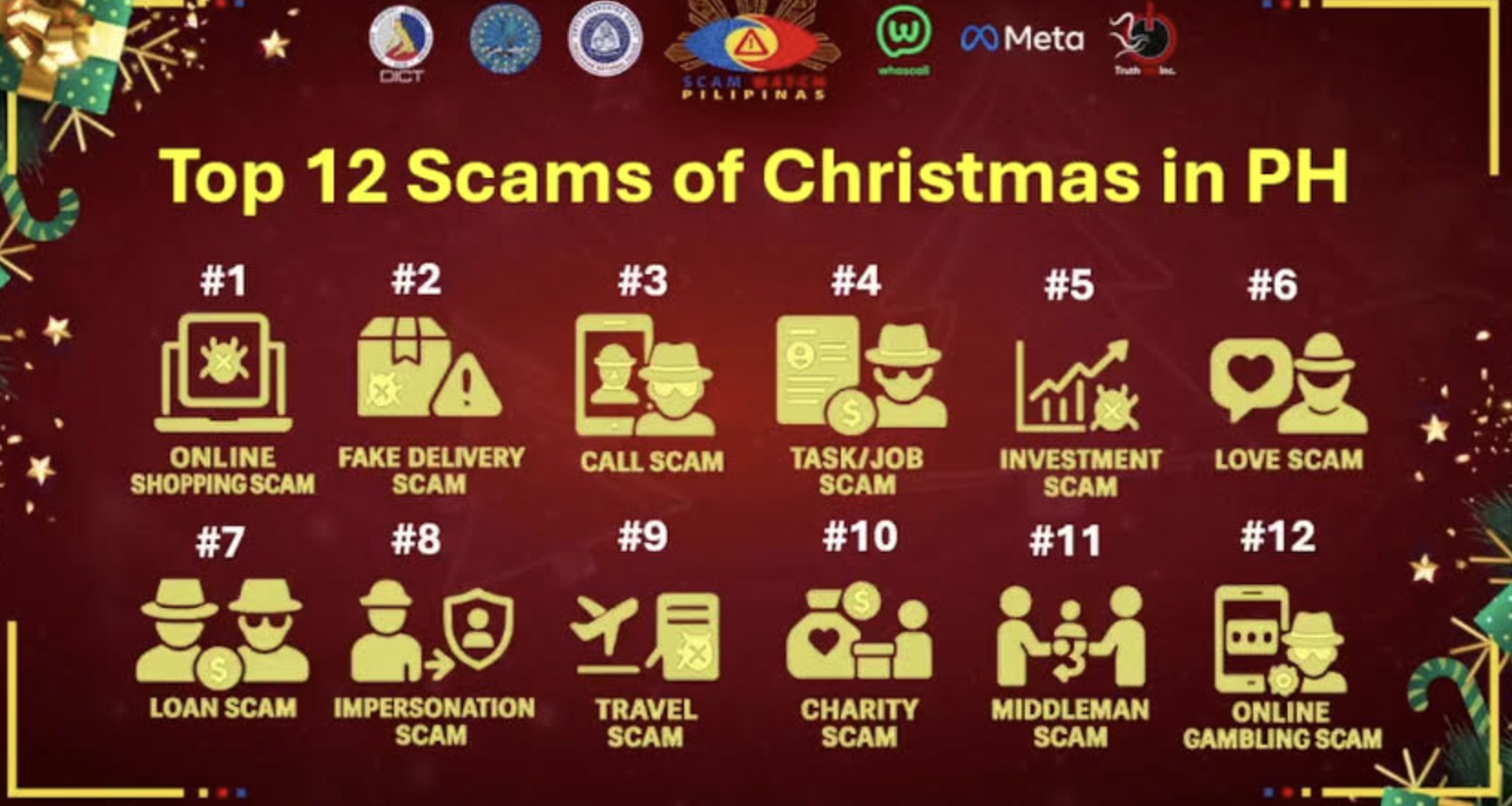
Online shopping scams and fake delivery schemes are expected to hit Filipinos hardest this holiday season, topping the government’s newly released “12 Scams of Christmas” list unveiled Monday by the Cybercrime Investigation and Coordinating Center (CICC) and Scam Watch Pilipinas.
Now on its third year, the annual anti-scam campaign is based on complaints lodged through the national anti-scam hotline 1326, Scam Watch reports, and data gathered with government and private partners.
The Top 12 Scams of Christmas in the Philippines:
- Online Shopping Scam
- Fake Delivery Scam
- Call Scam
- Task / Job Scam
- Investment Scam
- Love Scam
- Loan Scam
- Impersonation Scam
- Travel Scam
- Charity Scam
- Middleman Scam
- Online Gambling Scam
Scam Watch Pilipinas co-founder Jocel De Guzman presented the list at a press conference on Monday.
He said online shopping scams have surged after massive sales like 11.11 and ahead of Black Friday and 12.12, often involving fake seller accounts, fake websites, and fake products.
“Number one, fake yung Facebook account pretending to be a shopping website. Number two, fake yung shopping website itself. Number three, fake yung account at fake yung binibenta,” he said.
(First, the Facebook account is fake. Second, the website is fake. Third, the account and the products are fake.)
He shared how one victim lost P12,000 after unknowingly buying from a fake IKEA website.
Shoppers were urged to stick to official apps and avoid merchants asking for direct GCash payments “for more discounts.”
Meanwhile, the agency also said delivery scams have evolved from phishing messages to cash-on-delivery (COD) fraud, targeting both buyers and even delivery riders.
“These scammers are now maximizing COD… papabayaran muna sa delivery driver yung item. Either walang item o wala namang laman,” he noted.
(Scammers now maximize COD, they make drivers collect payment first, but the package is empty or contains nothing of value.)
Others involve rogue riders themselves running off with cash.
Consumers were advised to:
- Track orders carefully
- Avoid third-party ‘padala’ arrangements
- Refuse COD if they did not personally order the item
Call scams, investment schemes, and ‘love scams’ still spreading
Despite law enforcement crackdowns, call scams remain widespread, with scammers posing as credit card agents, sometimes even knowing which card the target holds.
Investment scams have also merged with romance schemes, De Guzman warned:
“Ang ginawa nila… pinadaan na nila sa love scam. You now have an online relationship, and then they get you to invest.”
(They now pass it through love scams. You develop an online relationship, then they convince you to invest.)
Victims are often aged 45 and above, widowed, separated, or living alone and “lonely during Christmas.”
Loan scams: illegal lending apps still harassing borrowers
De Guzman said illegal OLAs (online lending apps) remain active — often not on Play Store or App Store, but web-based, and demanding access to contacts and photos.
“Pag dinecline mo, hindi ka na makaka-utang… at ipapahiya ka nila. Utang ay utang pero hindi ito dahilan para ma-haras kayo,” he said.
(If you decline, you can’t borrow and they will shame you to your contacts. A debt is still a debt — but that is not an excuse for harassment.)
Impersonation, travel, charity, middleman and gambling scams also flagged
Scammers are increasingly hijacking Facebook Messenger accounts and pretending to be friends or family urgently borrowing money:
“Pag umutang—tawagan nyo.”(When they ask to borrow money from you— call them to confirm.)
Travel scams are expected to spike as Filipinos book flights and hotels. To which, CICC has warned against:
- Fake booking apps
- Small unknown travel sites
- QR code charity scams under a private name
Middleman scams, however, are common in gadget reselling, who trick buyers into paying fake brokers.
10,000 formal scam victims
De Guzman said 10,000 victims officially reported scams to CICC in 2024, while 30,000 reports went through the eGov app.
But most victims still never report. “Pag ikaw na-scam at hindi mo ni-report, ang susunod na bibiktimahin niyan yung mahal mo sa buhay,” De Guzman warned.
(If you get scammed and don’t report it, the next victim may be someone you love.)
CICC: Scams may change every season, but vigilance must be constant
CICC Acting Executive Director Atty. Renato “Aboy” Paraiso said scammers adjust techniques year-round — but public awareness must stay ahead.
“Nagbabago lang yung priorities... but every Filipino should now be aware of scam types,” he noted.
(Only the priorities change… but every Filipino must now be aware of these scams.)
He said more public education efforts, including infomercials, are coming soon, with help from private partners and media.
How to fight back: ‘Kontra-scam attitude’
De Guzman repeated four reminders: “Magdamot — mag-duda — magsnob — magsumbong.”
(Be selfish — be suspicious — ignore — report.)
He also urged the public to call 1326, now recognized by Malacañang as the National Anti-Scam Hotline. — LA, GMA Integrated News

