IF IT’S THE MIDDLE OF APRIL and you’re thinking of traveling to Southeast Asia, most people will probably warn you about a “silly" festival known as Songkran, an event often marked by water dousing and street revelry. But in a quiet corner of Thailand, near the Burmese border, the Mon people still retain the spirit of this festival, which is their equivalent of the New Year’s celebration in other parts of the world. One of the major ethnic communities in Burma, the Mon people fled to neighboring countries due to the repressive military regime in their homeland. The sleepy township of Sangkhlaburi in northwestern Thailand hosts a large population of Mon villagers, such that locals refer to a “Mon side" and a “Thai side" separated by a rickety wooden span known as the Mon bridge.
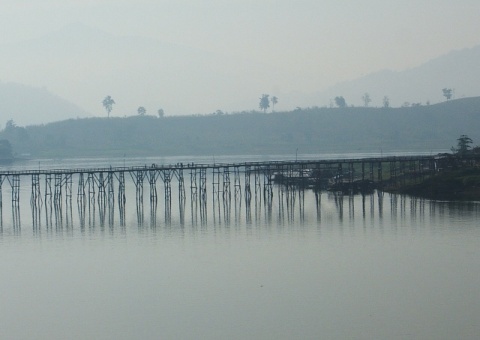
On a misty morning, the Mon bridge sits serenely below the mountains around Sangklaburi.
Some years back, I was in Sangkhlaburi to assist exiled Mon journalists improve their environmental reporting skills when the Songkran festival in Thailand was celebrated between April 13 and 17. Family members came home from all parts of the world for joyous reunions, and all of them took part in the festivities. The 800-meter Mon bridge was the venue for the annual ritual that signals the start of the Songkran celebration. Before daybreak, hundreds of Mon villagers wearing traditional red longyi (wraparound cloth) and white shirts started forming a colorful line along the length of the bridge. They came with intricately carved bowls laden with small packets of rice, salt, candy, and other foodstuff. As the sun rose in the east, monks in orange robes arrived with their plain tin bowls. Moving slowly across the bridge, they accepted the offerings from the villagers with heads bowed in a gesture of humility and gratitude. Some of the boys teased the younger monks by pretending to steal the money placed inside the bowls, which filled up quickly due to the sheer number of villagers making an offering. Every few steps, the monks had to empty their bowls inside sacks carried by several assistants following them. At the end of the bridge, vehicles awaited the monks to take them back to the temple and the villagers trooped back to their houses.
Click here to view the slideshow in full screen Communal meals The center of the Songkran festivities are the temple and Monastery, on the outskirts of the Mon village, and the gleaming Pagoda that towers over the lake. By mid-morning, younger members of the community were on the road again, this time bearing food for their parents who had gone off to the temple earlier for meditation. For three days, this would be a daily ritual – sons and daughters bringing food and bathing their elders in the temple or the pagoda, a spiritual cleansing and renewal of family ties that keeps the community together. Gathered inside a great hall with an image of Buddha on one end, the young clan members huddle together in the center, intoning chants with the monks just before noon. After the prayers, the younger Mon villagers stand up to share lunch with the elderly women, all wearing identical brown skirts and white blouses with a brown scarf slung on the shoulder, who are seated at the back of the hall. The fathers and the uncles are grouped on the right side, dressed in everyday wear. As is the Buddhist custom, all the footwear is left on the stairs. When the communal luncheon ends, the villagers make a beeline for the exits, making one wonder how they are able to find their slippers among the hundreds of pairs strewn on the wooden steps. The women gingerly balance the trays of leftover food on their heads, even riding side saddle on motorbikes in their elegantly decorated skirts. One could almost hear a collective gasp when a young man, obviously not used to the mad scramble, lost his footing on the stairs and the dishes in his tray crashed to the ground. It is considered bad luck to break something during the solemn festival, a young Mon Villager says.
Cleansing ritual At the Pagoda, competing groups pitted skills in traditional games - climbing a greasy pole to retrieve the prize at the top, playing tug-of-war, hitting seeds on the ground, and racing to the finish line with a heavy load on one’s head. Little children in traditional garb performed Mon dances, swaying to the beat of ethnic music played on native drums and flutes. Explaining the extended New Year’s Celebration, one of the Mon editors said April 13 marks the end of the old year in their Buddhist calendar. April 14 to 16 are neither part of the old year or the new year, and are known as Songkran days. In the Mon belief system, Songkran refers to an ancient debate among two powerful spirits regarding the exact number of days in a week. The spirit who bet on eight days lost, resulting in the variable duration of Songkran every year, or so the story goes. It is said that a Mon baby born during the 12 hours in the middle of the week, which is the contested time frame, is doomed to a lifetime of suffering. On the first day of the Buddhist New Year, the highlight of the festival, the Mon villagers took part in a cleansing ritual that is supposed to remove the sins of the past year so they could start the new year a with clean slate. They trooped to the pagoda around mid-afternoon carrying bowls filled with water and flowers, which they poured inside bamboo poles split in half. The intricate network of bamboo pipes formed a triangle that ended in three poles framed by a trellis of flowers, with a small wooden seat below. At the appointed time, the crowd of worshippers joined the monks in their Buddhist chants. From the entrance to the pagoda, the monks stepped on the backs of male penitents lining their path to the bamboo structure. Several golden Buddha images, each held by a village elder, preceded them. One by one, the images were carefully washed under the bamboo shower, before getting additional dousing from a group of villagers lining the path back to the temple. Each monk also got a thorough washing, with some dusting of powder, a Thai tradition that has crept into their ritual, the Mon people say.
Sun pagoda After the solemn ceremony, it was time for revelry, with the Mon villagers splashing water at each other and whoever crossed their paths. During the previous three days in fact, it was a common sight in the streets. This is the picture most commonly associated with Songkran, which totally misses the point of the festival. The following day, it was almost anti-climactic to see the procession of Mon villagers, once again in their traditional garb and seemingly none the worse from the previous day’s splashing contest, going to the golden pagoda for yet another ritual. During the Songkran festival, several villagers had been building a sun pagoda on the grounds, and this time, the head monk had come to bless it, along with the many offerings to the temple. Beside the sun pagoda, other villagers had left bamboo poles on a tree to ward off misfortune and court prosperity for the coming year. Celebrating the Songkran in Sangkhlaburi was a rare opportunity to experience the true spirit of the religious festival. Travelers to Southeast Asia during the hot summers months would do well to discover such timeless rituals in little known districts off the beaten path, instead of constantly whining about the “silliness" of it all.
– GMANews.TV 

 GMA Brandtalk
 Tracking
 Archives


