

 GMA Brandtalk
 Tracking
 Archives

Pamplona on a quiet day in spring
Our ophthalmologist friend E., now practicing her specialty in Manila, suggested that my husband Alex and I visit Pamplona if we were in Spain. She had her post-graduate training in the University of Navarra, and had beautiful memories of her two-year stay. Better to see Iruña (the Euskadi name of Pamplona) outside the Feria de San Fermines in July, she advised, knowing that we preferred quiet strolls and tranquil nooks. The San Fermines festival refers to the very popular “run of the bulls” (or encierro). Every day for eight days starting July 7th, young (and not so young) people, dressed in white shirts with red bandanas around their shoulders, follow the bulls as they are let out from the corrals and negotiate the streets with its three corners until they reach the Plaza de Toro. We had seen on TV how manic these runs could get, with people getting gored and injured; when things really get bad, there are fatalities. The scenes brought to mind Hemingway’s The Sun Also Rises, with its “lost generation” characters, although friend E. reminded us that Hemingway never actually ran with the bulls; he wisely waited in the bullring for the bulls to come in, then joined the revelry inside. Not ones to relish being gored and wanting a more serene atmosphere, we went to Pamplona on an early spring day. Cool but sunny, the weather was perfect for simply going around and discovering things for ourselves. After a 40-minute “power walk” from our hotel in San Sebastian, Alex and I reached the train station, where we took the 10:45 AM Talgo train to Pamplona. From the station, a quick bus ride brought us to the center of town. 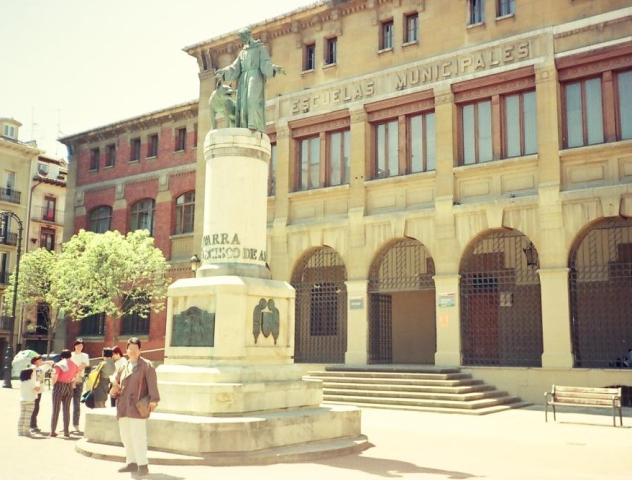 Walking around we found ourselves in bustling Plaza de San Francisco, where we saw many elderly people seated on benches, singly or in groups, taking in the sun quietly. The municipal school was there too, with the statue of St. Francis de Assisi placed high on a pedestal, in front of the main doors. It must have been lunch break, as children in uniforms ran hither and yon, their energies finding release after being cooped up in their classrooms the whole morning. We found seats at the Stella Damm Restaurant, and ordered jamon y queso bocadillo (ham and cheese sandwich) with cafe con leche and cerveza. It was good to come in from the fierce sun, although after a while the lights in the restaurant seemed to have dimmed. I asked the proprietor in Spanish if they were closing, and he said, “No, no, mas tarde. Tres o cuatro!” (“Oh no, later. At three or four o’clock!”) In my travel journal, I wrote, “Wow, a local understands my spoken Spanish now!” Certainly a rite of passage of sorts for me, at that time. Thus fortified we walked toward Plaza del Castillo, where we marvelled at the beautiful gazebo (locally called the quiosco de musica), a venue for shows and music festivals. It had a round ceiling with colorful paintings on its underside, and was accessible through concrete steps. We went across to the Cafe Bar Iruña, the iconic 1888 restaurant of the city. There were floor-to-ceiling mirrors, probably for the patrons to see and be seen. The medieval ambience was such that one could imagine ladies in long taffeta gowns with pastel-colored silk parasols arriving in horse-drawn carriages and, sitting in one of the cafe’s plush seats, giving the handsome men furtive glances from their fan-covered faces. Of course, one of its famous patrons was Ernest Hemingway, who had this café as a setting in his novel on love, matadors, and sexual dysfunction.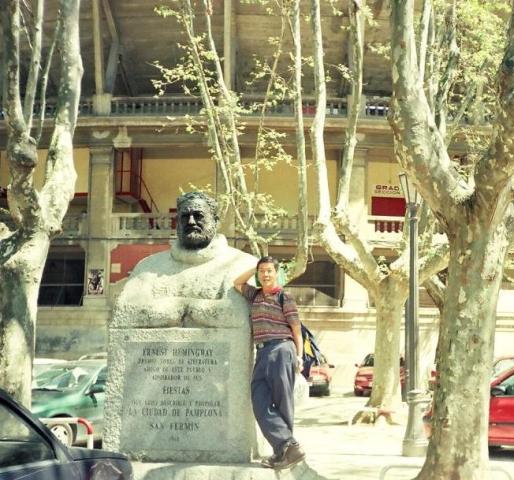
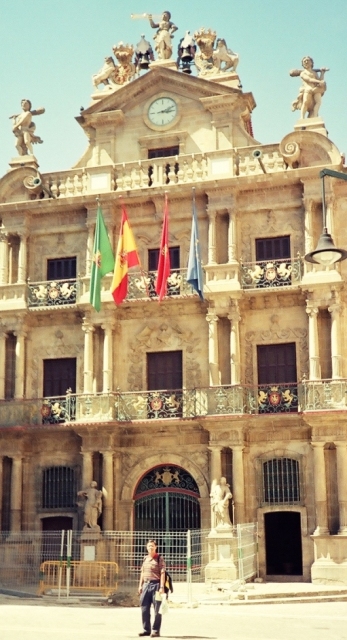 Further on, we came upon the
 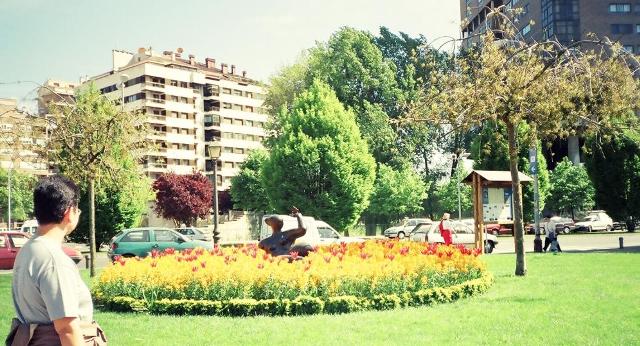 And because we had time Alex and I walked around the newer part of the city and enjoyed the installation art amidst early blooms that blanketed the parks beside the busy thoroughfares. Indeed, both medieval and modern identities of the city seemed to flow seamlessly into each other, making for an eclectic whole. We may not have caught Pamplona in its encierro frenzy, but friend E. was right – Iruña certainly held its own magic that April, when we were able to go around in the quiet streets, and meet the locals in a peaceful atmosphere. There will be another time for the lively revelry and all-night and day carousing of a San Fermines celebration later, one sunny July. – YA, GMA News
