

 GMA Brandtalk
 Tracking
 Archives

ADVERTISEMENT
Filtered By: Lifestyle
Lifestyle
Dragons and poetry in Ha Long Bay
+
Make this your preferred source to get more updates from this publisher on Google.
Mountains glisten with water’s shadow/water spills all over the sky... Lord Trịnh Cương
I remembered these lines as I looked out through the gauzy curtains of our fourth floor room at the Great Ha Long Bay Hotel. It was a chilly gray February morning, and soft rain was falling. Across the waters, mists swirled around the rocky outcrops that rose like mysterious statues standing guard over the numerous sea vessels docked at the pier. Some of the boats looked like century-old, exotic oriental junks with their fan-like, brown leather and bamboo sails. 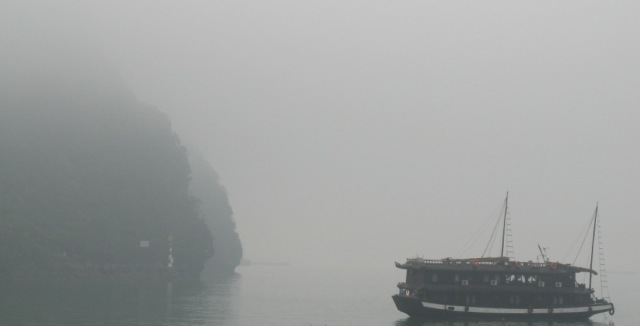 My husband Alex and I, together with Filipino poets Marjorie Evasco and Dinah Roma Sianturi, were in Ha Long Bay upon the kind invitation of the Vietnam Writers’ Association. Marj, Dinah, and I were to share our poetry with about 80 international poets from 26 countries, and 40 Vietnamese poets in the 1st Asia-Pacific Poetry Festival in Ha Long Bay, and later in Hanoi. The first morning saw the opening of the poetry festival with formal but festive ceremonies attended by all the poets and representatives of the Vietnamese government, together with a rousing band, fireworks, and lovely girls in their native colorful au dais. We also met the moving force behind the festival, Mr. Huu Thinh, Chairman of the Vietnam Writers Association. Later, we boarded a bus towards the Bai Tho Mountain, also known as the Poetry Mountain, where, during the 15th century, Emperor Le Thanh Tong, moved by the beauty of Ha Long, wrote poetry about its enchantment, and had the poem engraved on one side of the mountain. Half jutting out into the sea, Bai Tho Mountain was accessible by foot, and we started walking towards it after the bus dropped us off at a busy street corner. Soon enough, the smell of the sea became stronger. We were winding our way around the foot of the mountain, near docking areas for small boats, some with fishnets draped across their decks. As we slowly walked through stony paths, it started to drizzle. The sudden drop of temperature brought in the mist, and as I turned into one mountain corner I gasped. Just across the bay were the rocky outcrops, half-covered by wispy vapors, the sea and sky merging in a swirl of white and gray, not unlike a calligraphic Chinese painting.
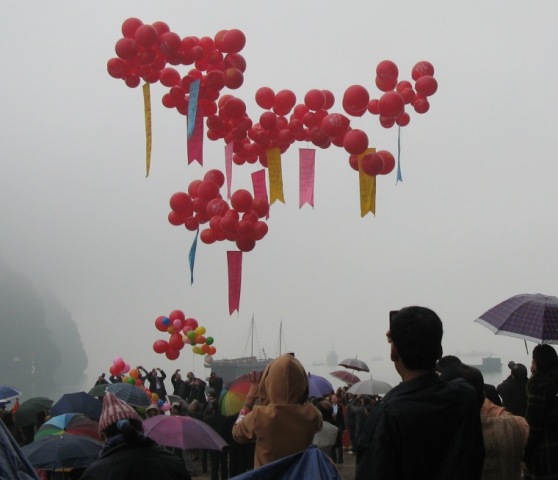
 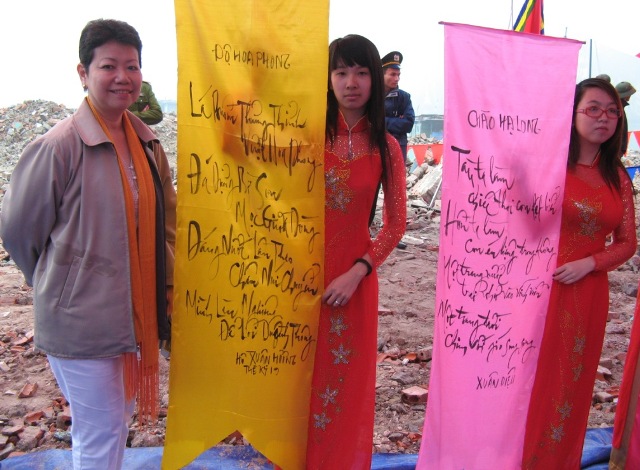 Girls in colorful Vietnamese costumes, holding poetry written in bright banners with red balloons, lined the path towards the ceremony dais. After the formal speeches by representatives of the various Vietnamese organizations, especially those from the Quang Ninh Province to which Ha Long Bay belongs, and spectacular native dances, a Buddhist monk prayed over the festivities. One by one, all the poets offered incense sticks to the Bai Tho Mountain and the emperor, in gratitude and for a successful festival ahead. All too soon the banners of poetry, festooned with red balloons, were released into the sky from the edge of the waters. With the backdrop of white and gray mist, the rising colors filled the sky, like numerous jewels being borne heavenward. I stood by a stony cliff from afar, and felt the soaring joy of the moment.
  What ensued was a beautiful and graceful time for sharing poetry with each other. It was a time too, to meet new poet friends from Japan, UK, Thailand, India, Singapore, New Zealand, and Russia. Old friend Azam Abidov from Uzbekistan was there too, and we greeted each other warmly, reminiscing about our poetry reading in Medellín three years ago. We met many Vietnamese writers, too, notably Nguyen Phan Que Mai, who tirelessly did many of the poetry translations into Vietnamese, did unforgettable emceeing jobs, and was the busiest among the local poets. There was also Ms. Dong Kim Hoa, fluent in Russian, who headed the administrative staff; Tuyet Nga, who graciously gifted me a copy of her poetry; Mary Croy from Milwaukee but now a resident of Hanoi; and young poets like Phu’o’ng Quôc Ngô, who kindly fetched us from the Hanoi airport when we arrived late at night, our first time in Vietnam. The feeling of solidarity among the poets was palpable, as we read and listened to poetry for another day. As a gift from our hosts, we were invited for an afternoon cruise around the bay. We got on a wooden ferry that looked like a Chinese junk, but within were modern amenities: eight comfortable tables with seats for six to eight each, a small kitchen, lavatory, forward deck and a second level viewing deck. The wind was chilly, and the constant rain made it more so. Alex and I clambered up the second level deck, and we gasped at the open air views of the bay.
 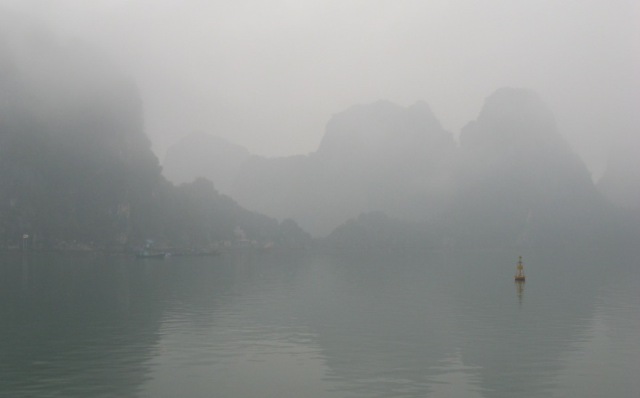 Legend has it that a thousand years ago, during a foreign invasion of Ha Long, the gods protected the people by sending a family of dragons who descended (hence the name, from the Chinese下龍, pronounced Ha Long, literally meaning, “Descending Dragons”) and spewed out jade and jewels. These became a chain of mountains that prevented the enemies from going near the coasts, and the invasion was thwarted. Eventually the place where the mother dragon descended was called Ha Long, and other nearby places were said to be where her little dragons played and swished their tails.
 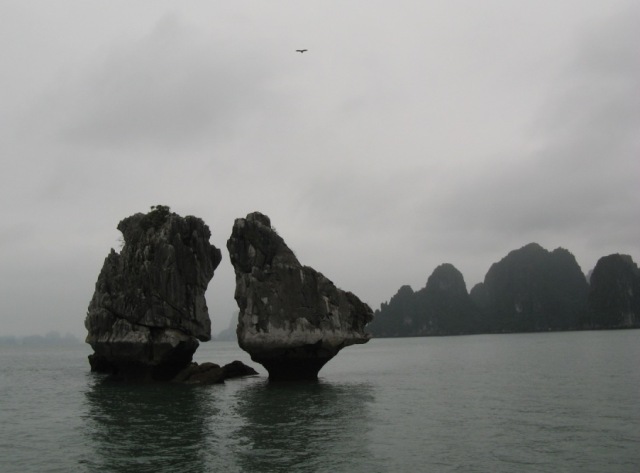 Indeed, there were so many rocky outcrops (numbering about 3,000, it was said, which took tens of millions of years to form) that greeted us as our boat manuevered itself into the bay. Some of these limestone karsts resembled animals, the most famous of which was the “Kissing Rocks,” now taken as the logo of the Vietnam Tourism Association. Some rocks resembled tall mountains with lush vegetation, some were small and stony. Still others were so huge they had deep grottoes and caves within them. Further on we saw fishing villages at the foot of these rocks, and our guide said there were floating restaurants, too, in these communities, serving freshly caught seafood. The numerous plant species in the bay too, were noted for their biodiversity. No wonder Ha Long Bay has been a UNESO World Heritage Site since 1994; very recently it was named one of the New Seven Wonders of Nature. That evening, standing by the window I looked out into Ha Long Bay, the waters dark and still from the distance. The moon shone softly, and a slight movement, as if a twitch of a dragon’s tail, arrested my eyes. Could it be one of the heavenly dragons coming alive after these thousand years? It began to drizzle, and the raindrops looked like the jade and jewels that spewed forth from the dragons’ fiery mouths. Indeed, magic and myth: Ha Long Bay had it all. - YA, GMA News
