

 GMA Brandtalk
 Tracking
 Archives

ADVERTISEMENT
Filtered By: Lifestyle
Lifestyle
The mosque-cathedral and other splendors of Córdoba
+
Make this your preferred source to get more updates from this publisher on Google.
Córdoba, Spain It was early May when my husband Alex and I reached Córdoba by Andalusian Express, a fast 45-minute train from Sevilla. We often read about the beautiful mezquita (mosque) and the patio cordobés (an open courtyard filled with pots of flowers and gardens with trees and fountains); the beautiful sunny day certainly augured well for such an expedition. We went down Avenida de América and slowly walked towards Plaza Tendillas, the center of town. Tall buildings and commercial centers made for a vibrant atmosphere of a modern city, but as we went further south, the very air seemed to have slowed down. We were greeted by white-washed houses in maze-like streets, and had to open our guide book several times to orient ourselves. It was not too long though, when we were greeted by an enormous complex of a medieval-looking wall enclosing several blocks, with a tall belfry and two dome-like structures. Indeed, it was the Mezquita-Catedral of Córdoba, also known as the Cathedral of Our Lady of the Assumption. 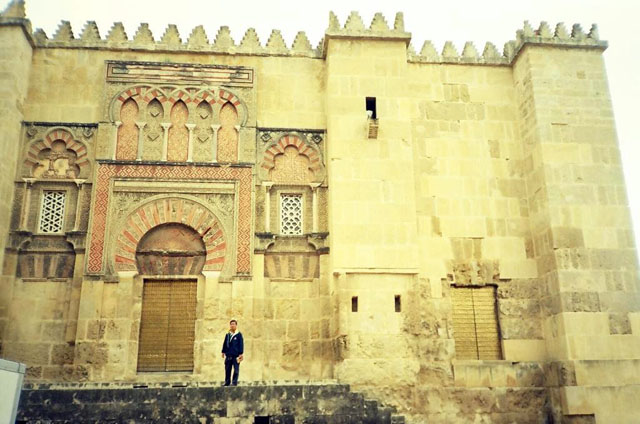 The mosque was built from the Visigoth remains of the early Basilica of St. Vincent in 786 AD, when Caliph Abd al-Rahman I used the white marble and red bricks to form the arches of the Muslim temple. Further expansion was done by Abd al-Rahman II who acquired more land for the mosque, and by Al Hakam II who added a mihrab, a naturally-lit central dome lined by Byzantine tiles, and whose central arch faced Mecca. During the Reconquest in 1236, the Catholic Spanish monarchs, instead of destroying the beautiful mosque, transformed it into a Roman Catholic cathedral consecrated to the Blessed Virgin. A huge altar mayor was constructed at the center, and the minaret was transformed into a tall belfry. This unique blend of Christian and Islamic influences was well-preserved through the ages.
 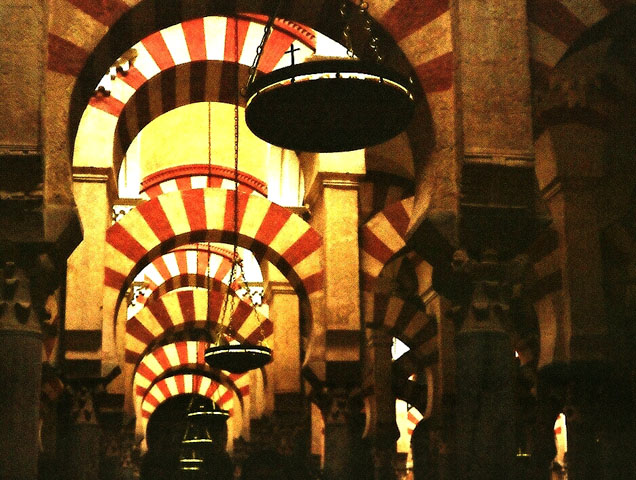 What struck me most were the unending white and red double arches high above us, supported by more than 100 marble pillars in the prayer room. It was like facing a reflection on a mirror facing another mirror, the striped arches seemingly endless, resting on columns lined perfectly in rows. These columns, like the arches, were also said to have come from the previous St. Vincent Christian Basilica, and was made of marble and semi-precious stones. The lower arches were fashioned like horseshoes (lending the archways a familiar Islamic, keyhole shape) whereas the upper arches were semi-circular. The double arches allowed for a higher ceiling, giving the mosque-cathedral an airy atmosphere, even with the limited heights of the marble columns that supported them. We reached the mihrab and were awestruck by the beautiful and intricate mosaics that lined the walls and the archway, small multi-hued tiles that sparkled in the sunlit room. The High Chapel, together with the impressive cathedral dome, was slowly built through the centuries. Age-old wooden seats lined the choir loft, complete with an organ. But what boggled the mind was the blending of both Islamic and Catholic aspects in one edifice, the long history of Córdoba seen in an interplay, and perhaps clashes, of religion and politics reflected in architecture. Visigoths, Muslim caliphs, Catholic monarchs and ecclesiastical hierarchs all participated in the building of this palace-like complex, each of them contributing to the whole. Outside, we noted that the white marble and red brick archways were covered, although in some areas quite unsuccessfully, with stone and concrete. Indeed, it was difficult to “erase” several centuries of culture so deeply ingrained in the area. We walked slowly towards the Guadalquivir River, and noted a beautiful tall column with stone sculptures, topped by an angel that looked like a pilgrim. Looking at it closely, we discovered luxuriant ferns and plants within the robes of the figures, which were St. Acisclus, St. Victoria and St. Barbara. The angel was the archangel St. Raphael, the city’s patron saint. The monument was the “Triunfo de San Rafael” (Triumph of St. Raphael), located at the entrance of the Roman Bridge spanning the river. Cordobese lore had it that during the 17th century the people prayed to St. Raphael to deliver their town from a pestilence. The archangel answered their prayers, and since then St. Raphael had become the guardian of Córdoba, and several figures of the archangel could be found around the city. From the river we could see that the cathedral dome dominated the skyline, together with the slim belfry. Just off the cathedral was the alcázar, a fortress-like edifice which was the summer residence of the Catholic monarchs, said to contain fountains, luxuriant gardens, and palm trees. This was also, for a time, the headquarters of the Inquisition. Without knowing it we had reached the Judería, or the Jewish quarters. The Muslims and the Jews lived harmoniously for centuries, but in 1492, the Jews, unless they embraced Catholicism, were expelled from Córdoba. Many of them converted and continued to live around the area of the mezquita. A sombre statue of a seated Maimonides, a beloved Jewish philosopher, scientist and doctor, who lived during the age of the caliphate, was seen at the Plaza Tiberiades, his left hand holding a book on his lap, and his right gently holding on to his seat. Our guide book advised us to meander around the small streets away from the touristy mezquita area, if we wanted authentic Córdoban cuisine. So we hied off towards smaller streets until we reached Calle Cardenal Gonzáles, where Mesón La Moreneta (The Moreneta Restaurant) was. It was quiet and welcoming with its abundance of flower pots with red and orange blooms in its patio. Feeling adventurous, we ordered the Gazpacho Andaluz (cold Andalucian soup) and the Rabo de Toro (Ox Tail in Tomato soup), the latter said to be a Córdoban specialty. And indeed we were not disappointed. The soup was cold and delicious, tart and teeming with fresh vegetable flavors, perfect after an almost three-hour exploration around the neighborhood. The ox tail was cut crosswise, the bone hollow without the marrow, looking like a large white ring with substantial meat attached to it. The tail was simmered in a delicate tomato sauce until very tender, and indeed it was delectable and filling, served with fried potatoes. For dessert we had chocolate ice cream and natillas (creamy sweet custard).
 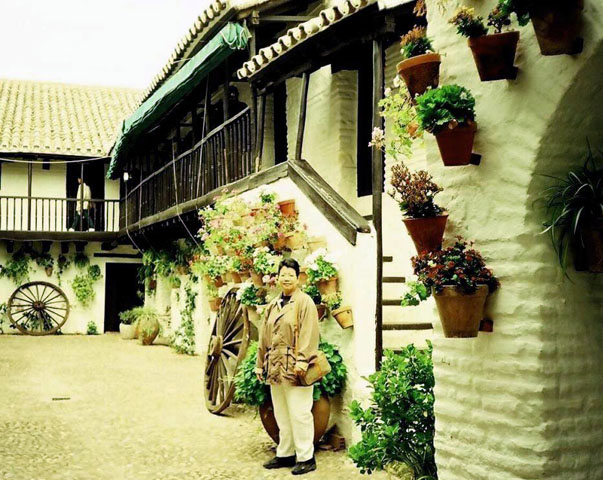 Afterwards, Alex and I found the energy to simply walk around the narrow streets and witness for ourselves the pride of the citizens in their open-air courtyards, some with fountains and orange and lime trees bearing colorful citrus fruits. Along the Calleja de Flores we lingered behind iron grills leading to patios with gardenias, roses, daisies, carnations, and other blooms I couldn’t identify, but no less colorful and showy. They were mostly in terra cotta pots arranged artistically on the garden floor, although some houses anchored these pots on the walls, so that splashes of colors were seen starkly against the white walls. In other houses, ferns and other plants were also grown in different-sized jars. In one particular house with a flower-filled patio, soft guitar music could be heard. Alex and I smiled and lingered as we discerned a gentle rendition of our favorite Romanza melody, popularized in the French movie Jeux Interdits (Forbidden Games). Alex used to play the classic guitar, and this was one of the pieces that he aspired to learn.
 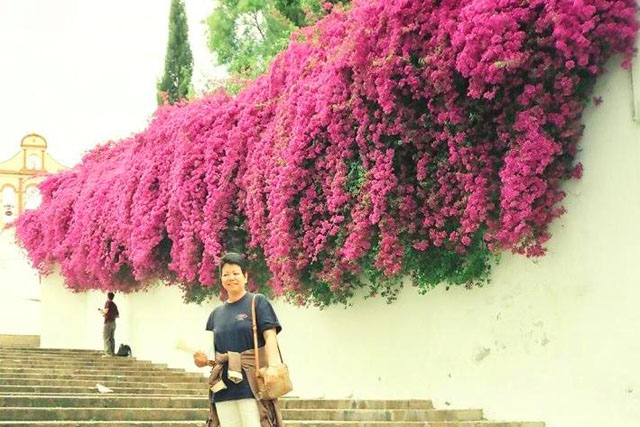 Further on, we wandered into a plaza with wide concrete stairs beyond which a belfry of a white-washed church could be seen. What attracted us most was the huge cascade of bougainvillea blooms, dark fuchsia and luxuriant, thick swaths of them covering one of the walls. It was as if an exuberant brush of an artist suddenly found frenzied inspiration, covering the whole wall in all shades of red. Not to be forgotten of course was our desire to see the 14th century Posada del Potro (literally, the Inn for Colts or Horses), a place mentioned in the second book of Don Quixote, and where Miguel Cervantes allegedly stayed. We found it, a two-storey wooden house with wide porches filled with flowers in earthen pots, grouped together on the ground or attached to the outside walls. Wooden horse carriage wheels added a rustic feel to the whole scene. In the nearby Plaza del Potro, a serene fountain with a playful young horse at the center was seen at one end. Later, leafing through picture albums and travel journals, we remember Córdoba vividly: the Mezquita-Catedral, the inspiring arches inside it, the mosaics of the mihrab, the high altar, the dome; the tasty Rabo de Toro; but most of all the patio cordobés, the blooms and fountains, the orange trees, and the enchanting solo guitar music in the air. – YA, GMA News
The mosque was built from the Visigoth remains of the early Basilica of St. Vincent in 786 AD, when Caliph Abd al-Rahman I used the white marble and red bricks to form the arches of the Muslim temple. Further expansion was done by Abd al-Rahman II who acquired more land for the mosque, and by Al Hakam II who added a mihrab, a naturally-lit central dome lined by Byzantine tiles, and whose central arch faced Mecca. During the Reconquest in 1236, the Catholic Spanish monarchs, instead of destroying the beautiful mosque, transformed it into a Roman Catholic cathedral consecrated to the Blessed Virgin. A huge altar mayor was constructed at the center, and the minaret was transformed into a tall belfry. This unique blend of Christian and Islamic influences was well-preserved through the ages. What struck me most were the unending white and red double arches high above us, supported by more than 100 marble pillars in the prayer room. It was like facing a reflection on a mirror facing another mirror, the striped arches seemingly endless, resting on columns lined perfectly in rows. These columns, like the arches, were also said to have come from the previous St. Vincent Christian Basilica, and was made of marble and semi-precious stones. The lower arches were fashioned like horseshoes (lending the archways a familiar Islamic, keyhole shape) whereas the upper arches were semi-circular. The double arches allowed for a higher ceiling, giving the mosque-cathedral an airy atmosphere, even with the limited heights of the marble columns that supported them. We reached the mihrab and were awestruck by the beautiful and intricate mosaics that lined the walls and the archway, small multi-hued tiles that sparkled in the sunlit room. The High Chapel, together with the impressive cathedral dome, was slowly built through the centuries. Age-old wooden seats lined the choir loft, complete with an organ. But what boggled the mind was the blending of both Islamic and Catholic aspects in one edifice, the long history of Córdoba seen in an interplay, and perhaps clashes, of religion and politics reflected in architecture. Visigoths, Muslim caliphs, Catholic monarchs and ecclesiastical hierarchs all participated in the building of this palace-like complex, each of them contributing to the whole. Outside, we noted that the white marble and red brick archways were covered, although in some areas quite unsuccessfully, with stone and concrete. Indeed, it was difficult to “erase” several centuries of culture so deeply ingrained in the area. We walked slowly towards the Guadalquivir River, and noted a beautiful tall column with stone sculptures, topped by an angel that looked like a pilgrim. Looking at it closely, we discovered luxuriant ferns and plants within the robes of the figures, which were St. Acisclus, St. Victoria and St. Barbara. The angel was the archangel St. Raphael, the city’s patron saint. The monument was the “Triunfo de San Rafael” (Triumph of St. Raphael), located at the entrance of the Roman Bridge spanning the river. Cordobese lore had it that during the 17th century the people prayed to St. Raphael to deliver their town from a pestilence. The archangel answered their prayers, and since then St. Raphael had become the guardian of Córdoba, and several figures of the archangel could be found around the city. From the river we could see that the cathedral dome dominated the skyline, together with the slim belfry. Just off the cathedral was the alcázar, a fortress-like edifice which was the summer residence of the Catholic monarchs, said to contain fountains, luxuriant gardens, and palm trees. This was also, for a time, the headquarters of the Inquisition. Without knowing it we had reached the Judería, or the Jewish quarters. The Muslims and the Jews lived harmoniously for centuries, but in 1492, the Jews, unless they embraced Catholicism, were expelled from Córdoba. Many of them converted and continued to live around the area of the mezquita. A sombre statue of a seated Maimonides, a beloved Jewish philosopher, scientist and doctor, who lived during the age of the caliphate, was seen at the Plaza Tiberiades, his left hand holding a book on his lap, and his right gently holding on to his seat. Our guide book advised us to meander around the small streets away from the touristy mezquita area, if we wanted authentic Córdoban cuisine. So we hied off towards smaller streets until we reached Calle Cardenal Gonzáles, where Mesón La Moreneta (The Moreneta Restaurant) was. It was quiet and welcoming with its abundance of flower pots with red and orange blooms in its patio. Feeling adventurous, we ordered the Gazpacho Andaluz (cold Andalucian soup) and the Rabo de Toro (Ox Tail in Tomato soup), the latter said to be a Córdoban specialty. And indeed we were not disappointed. The soup was cold and delicious, tart and teeming with fresh vegetable flavors, perfect after an almost three-hour exploration around the neighborhood. The ox tail was cut crosswise, the bone hollow without the marrow, looking like a large white ring with substantial meat attached to it. The tail was simmered in a delicate tomato sauce until very tender, and indeed it was delectable and filling, served with fried potatoes. For dessert we had chocolate ice cream and natillas (creamy sweet custard). Afterwards, Alex and I found the energy to simply walk around the narrow streets and witness for ourselves the pride of the citizens in their open-air courtyards, some with fountains and orange and lime trees bearing colorful citrus fruits. Along the Calleja de Flores we lingered behind iron grills leading to patios with gardenias, roses, daisies, carnations, and other blooms I couldn’t identify, but no less colorful and showy. They were mostly in terra cotta pots arranged artistically on the garden floor, although some houses anchored these pots on the walls, so that splashes of colors were seen starkly against the white walls. In other houses, ferns and other plants were also grown in different-sized jars. In one particular house with a flower-filled patio, soft guitar music could be heard. Alex and I smiled and lingered as we discerned a gentle rendition of our favorite Romanza melody, popularized in the French movie Jeux Interdits (Forbidden Games). Alex used to play the classic guitar, and this was one of the pieces that he aspired to learn. Further on, we wandered into a plaza with wide concrete stairs beyond which a belfry of a white-washed church could be seen. What attracted us most was the huge cascade of bougainvillea blooms, dark fuchsia and luxuriant, thick swaths of them covering one of the walls. It was as if an exuberant brush of an artist suddenly found frenzied inspiration, covering the whole wall in all shades of red. Not to be forgotten of course was our desire to see the 14th century Posada del Potro (literally, the Inn for Colts or Horses), a place mentioned in the second book of Don Quixote, and where Miguel Cervantes allegedly stayed. We found it, a two-storey wooden house with wide porches filled with flowers in earthen pots, grouped together on the ground or attached to the outside walls. Wooden horse carriage wheels added a rustic feel to the whole scene. In the nearby Plaza del Potro, a serene fountain with a playful young horse at the center was seen at one end. Later, leafing through picture albums and travel journals, we remember Córdoba vividly: the Mezquita-Catedral, the inspiring arches inside it, the mosaics of the mihrab, the high altar, the dome; the tasty Rabo de Toro; but most of all the patio cordobés, the blooms and fountains, the orange trees, and the enchanting solo guitar music in the air. – YA, GMA News 
