

 GMA Brandtalk
 Tracking
 Archives

ADVERTISEMENT
Filtered By: Lifestyle
Lifestyle
Misty Lake Como of Lombardy, Italy
+
Make this your preferred source to get more updates from this publisher on Google.
“Misty mountain tops, serene lakeshore walks. I could stay here forever...!”
Such an enthusiastic entry indeed, in my travel journal. My husband Alex and I were in Milan, Italy, when we learned that the Lombardy Lake District of north Italy was only an hour away by train. We have heard of and read about Lake Como, and Bellagio, the writers’ haven overlooking the lake, from friends who enthused about its quiet beauty. It didn’t matter that it was raining lightly that early spring day when we set out of our Milan hotel, the Hotel Zara, only a few blocks away from the Stazione Centrale. The sign on the train that we took said “Basel,” though, which was the terminal station, and for a few seconds we toyed with the idea of going straight to this town, or even Lugano, which was nearer. In the end, Alex and I promised to save the Swiss trips for another day.  As we went out of Como’s Stazione San Giovanni, a light drizzle greeted us; the chilly air nearly froze our ears, and we had to bundle up some more with extra scarves and jackets. There were long stone steps leading towards a small park, and the profusion of colorful tulips between the stairs made us pause. They grew like scarlet and blushing pink carpets, all the way down to the street level, in spite of the cold weather (or perhaps, because of it). An installation art of two large bronze hands painted gray was at the center of the park after the steps; the hands were wrinkled, the right held upright towards the icy sky, and the left supine and curved, as if begging for warmth. We followed our trusty guide book’s directions to turn left after the stone steps, then right; before we knew it we “bumped” into Lake Como, a large body of water that was covered in thin mist. Across the lake was a vista of beautiful villas and houses perched on different levels, stark against dark green mountains. This backdrop looked eerily beautiful, as it changed every time the mist moved. For a moment, a part of the mountain disappeared while some parts were lightly covered, as the silhouettes of the houses were limned through the floating shapes of the vapor. By the lakeside, many ferry boats, tied to colorful blue and white poles, announced “Lake Tours” for a day. There were three long lakes that formed the forked Lake Como, joined at the towns of Bellagio, Menaggio, and Varenna, and a ferry boat ride enabled one to look at the towns from the lake in just a couple of hours.
 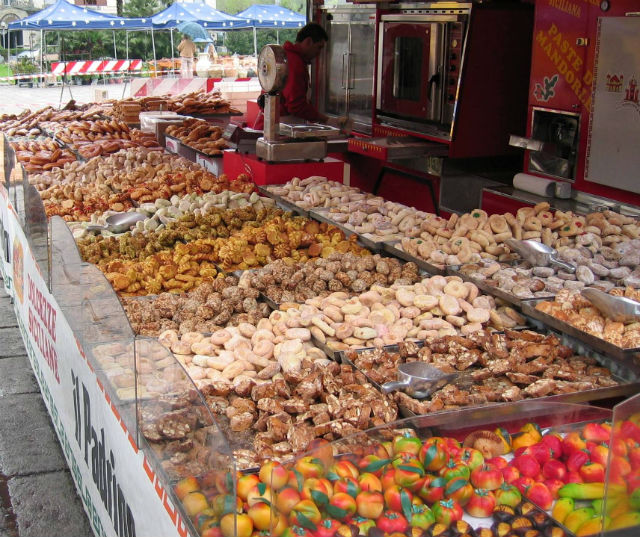 We reached Piazza Cavour, the main square, and discovered an ongoing country fair – colorful kiosks sold cheese, fruits, candy and bread, the many varieties making our heads giddy. One of the shops had an overload of candy in multi-hued shapes and sizes. I espied some Turkish delights rolled in fine coconut in one corner, and couldn’t help but get two small pouches of the sweet, gelatinous and fragrant rectangles. A large offering too of bread, some painted and shaped to look like red apples, tempted the eyes. Tearing ourselves away from such enticing goods, we continued, following the curve of the lake, from time to time pausing to look at the beautiful ivy-covered villas and terraced windows along the way, until we reached a barrier of a private property. We turned back, reached the center of town again, and discovered the beautiful duomo (Cathedral).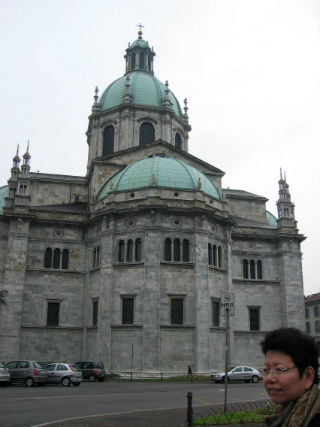
The Swiss Alps seen from Bellagio, with the lakeside houses and ferry boat landings
Bread galore in one of the kiosks at the country fair
The cupola of the Cathedral and its central apse
Como’s Cathedral of the Assumption was consecrated to the Blessed Virgin Mary, and was also the seat of the Bishop of Como. Construction started in 1396, but the entire edifice was finished only in 1770. In its West Front an exquisite rose window was seen; the façade had several images in stone niches, while the main portals had statues of Roman philosopher and military statesman Pliny the Elder (yes, he of the “Naturalis Historia” fame) and his nephew, Pliny the Younger. Both were born in Como. We went around to where the dome (cupola) was, and noted its beautiful and imposing structure.
We hurried on to the Stazione Nord nearby where the bus stations were, and looked for the schedule for Bellagio, and found that the next trip was about an hour away. Just in time to grab a quick lunch at a nearby food shop, where we had coffee and a beef sandwich. There we met Mel, a Filipina food server, a Como resident for six years. And how were things at home, she immediately asked, a sad smile on her face and an unmistakable catch in her voice. She planned to save enough to go back to Romblon, she said, where an elderly mother waited for her.
A small queue had already formed at the bus stop under the sign “Bellagio.” In front of us was a young Asian male in his early 20s, who turned out to be Martin, a Filipino from Las Piñas, who was going to his part-time job in Nesso, a town along the way to Bellagio. He had been in Como for a year and a half, and was staying with his uncle. He hoped to get settled in Italy, he said, as he liked the place.
The bus finally came, and it slowly wound its way through twisting and turning narrow roads. We enjoyed the picturesque views of the mountains and the lake, including private villas and homes facing the waters. We were dropped off at the main square of Bellagio, where we discovered quaint shops and sidewalk cafés. As we strolled along the lakeside promenade, the sun suddenly shone through, and the mist lifted a little. We gazed across the vast lake, looked at the mountains, and suddenly gasped. Beyond the dark green peaks we saw a taller range of white mountains, glistening against the sun. It took us several seconds to realize that we were looking at the Swiss Alps, blindingly white and majestic. Speechless with wonder we gazed and gazed, Alex and I, as it was our first time to see the popular Alps. The snow-capped mountains were breathtaking, looking as if gilded with liquid silver, the sun’s rays forming long shadow and light patterns on its slopes. A transcendent moment indeed, for these two travelers! 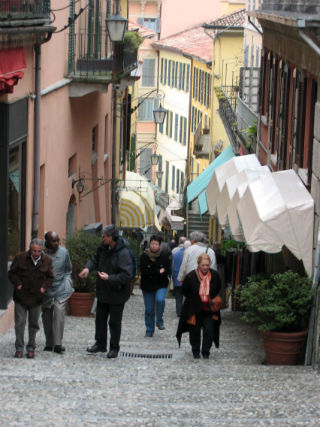
Pastel colored houses and old lampposts give character to Bellagio streets paved with cobblestones.
We walked around town and found ourselves traversing narrow and steep cobblestone steps lined by shops selling postcards, silk scarves, hats, and clothes. Medieval-looking lampposts lined the streets, and the houses and shops were in pastel colors seen in fairy-tale books; some of the walls were covered by moss and ivy plants. The air continued to be cold and even the locals and a few tourists were thickly bundled. We found the 12th century Romanesque Chiesa di San Giacomo (Church of St. James the Just), beautiful and quiet, perched on one of the hills. The church was empty when we went in, and we noted that its central nave featured a colorful painting with a gold background depicting the stoning of St. James above the altar’s brightly-lit tabernacle. It was good just to be seated in one of the pews gathering our thoughts, a-whirl with new discoveries, and of course to rest our feet. Outside the church we found more steps leading downwards, and following one of these we found ourselves by the lakeside, the bluish gray waters at our feet. And again, gazing up, we had our fill of the splendor of the Swiss Alps.
We slowly walked back to the main square to wait for the bus to take us back to Como. More souvenir shops were found lining the quiet street where the bus stop was, and Alex pointed out that many of the shop attendants were non-locals: a lot were Latin Americans, a few were Asian Indians, and some were Arabs. We sat down on one of the stone benches facing the lake; by our side, concrete planters bloomed with early colorful irises. It was a perfect setting to write the day’s details in my travel journal, savoring the afternoon lakeside breeze and the tranquility of Bellagio.
As if fated, we saw Martin on the way back, as he got up the bus at the Nesso stop. We broke into wide smiles and waved, as he laughed and waved back, and sat beside us. We commented on the many non-Italians that we saw in the shops, and he said that many Eastern Europeans and Russians were coming to Italy to find jobs as well. He looked earnest and young, as we bade him goodbye in Como. In our hearts we wished him well, and prayed that he finds his dream in this misty, far-away place. —KG, GMA News

