

 GMA Brandtalk
 Tracking
 Archives

The crass and the quaint in Macau
What I like about Macau is it’s not Hong Kong. A narrow sea separates the two, but it’s a vast ocean in my mind. Before my first visit to Macau, I had been going to Hong Kong for years, ever since I was a teen when it was still considered a cheap place to buy stuff. This included the stink bomb I brought back to my high school which a classmate exploded in another classroom, causing a minor feud between neighboring sections. 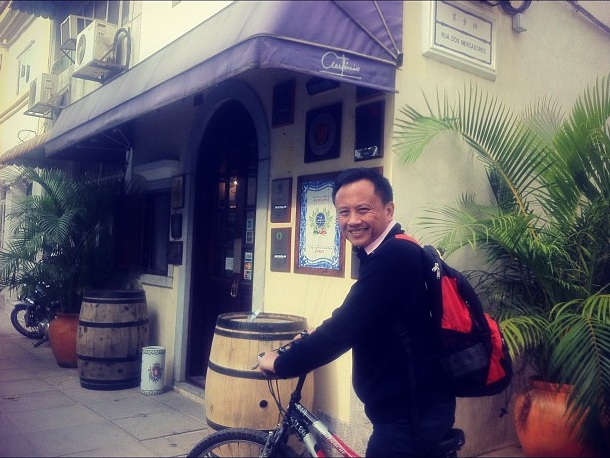 I remember Hong Kong as a liberating place for an adolescent, a time when I had just read "Catcher in the Rye" and imagined myself as that angst-ridden teen wandering around a big strange city. Then Hong Kong changed. It got more expensive and even mean, the natural crankiness of vendors and sales staff bordering on bullying. I could identify with my gentle artist-friend Dante Perez who told me once that he would end up buying something there just to pacify sales staff who didn’t take too kindly to visits to a store without buying anything. Macau was barely on my radar then, not being a natural destination of shopaholic Pinoys. But I had always assumed it would just be an extension of Hong Kong and its unfriendly vibe. The only time I had uttered its name was to chant “lutong Macau” along with an arena full of pissed-off basketball fans. When I finally got to visit as an adult, to shoot a documentary several years ago about Macau’s car-racing tradition, I found Hong Kong’s opposite, a much smaller, gentler Chinese city. It had long been known as a glitzy gamblers’ mecca, but much more so in recent years when it could boast of having grander casinos than even Las Vegas. But I found that the quaint mixes easily with the crass in Macau. And I began to associate “lutong Macau” not with game-fixing or rigged roulettes, but the charmingly decrepit café in the city’s “old town” section by the sea, where I had its signature “sauna shrimp,” live hipon cooked in its juices in a pot directly on covered glowing coals. The biggest difference from Hong Kong, it seemed, was the slower speed of everything in Macau, except perhaps for the traffic.
 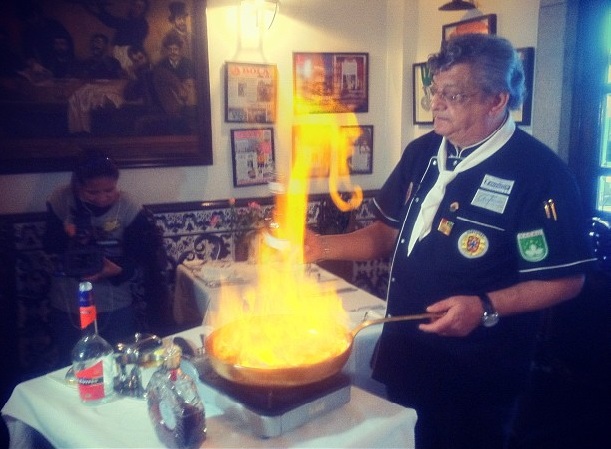 It’s where a world-famous Portuguese chef (Antonio Coelho) will take the time to entertain his guests with a fire show disguised as crepe-making and the Napoleonic technique of popping open a champagne bottle with a sword. Shopping here was not only cheaper than in Hong Kong, at least for the street-stall stuff I tend to buy, but it did not feel like war, even if English is less commonly spoken. No bullying or glaring by vendors if you just want to window shop. No place in Macau gave me a sense of time standing still more than an old corner teahouse called Long Wa, where grizzled goateed men would bring their canaries and other singing birds in their ornate cages. The men would spend hours gathered at tables chatting away and sipping tea – the original thing with floating crushed leaves, no teabags please – while their birds had their own chirpy chit-chat. Not a laptop or iPad in sight, despite the ultra-fast wifi around the city. In a corner, an attractive young woman sold live grasshoppers to feed the birds. That idyllic scene of animated friends speaking in gurgly Cantonese as their birds sang above the din echoed in my memories of Macau. So when I got the chance to return to Macau last December, via Hong Kong through which I transited as quickly as I could, one of the must places on my itinerary was Long Wa. That familiar corner building with the peeling paint and missing letters in the sign was a comforting sight, a timeless image in a city that had since built the largest casinos in the world. Going up the narrow stairs to the teahouse on the second floor, I was struck by the midmorning quiet at a usually bustling time. Inside were the usual pockets of animated men sipping their tea. But the birds in their cages were missing. There was not a single birdsong in the air. I asked the familiar man behind the cash register, the son of the owner: what happened to the birds that made this place so bewitching and unique? In halting English, he explained that they had to comply with new sanitation rules that banned pet birds from eating places, prompted by the recent threat of avian flu. It had struck nearby Hong Kong, and Macau authorities took pre-emptive action. I had my morning dimsum and sipped some tea with floating leaves, but the charm had been sapped out of the room. As I exited, I noticed a single ornate cage hanging from the ceiling near the stairs. It was empty. -- YA, GMA News

