

 GMA Brandtalk
 Tracking
 Archives

ADVERTISEMENT
Filtered By: Lifestyle
Lifestyle
Seoul: The city of many charms
+
Make this your preferred source to get more updates from this publisher on Google.
Sixty years ago, South Korea was devastated—not unlike the Philippines after WW2. The Korean War, waged between South and Kim Il-sung's North, left close to a million South Koreans dead, infrastructure wrecked, and the economy severely weakened. Needless to say, tourism was dead as well.
Fast forward to today, and you will see that South Korea is not only one of the world’s top economies, but is a popular tourist destination for its food, culture and shopping centers. Its capital, Seoul, is at the center of this vibrant society; it’s a place I’ve been to twice, and to which I plan to return.
‘A long history’
I first came to South Korea as a student in 2011. Korea Educational Broadcasting System, a local network, had organized a study tour for Filipino students to commemorate the 60th anniversary of the Korean War.

In Goyang City (north from Seoul), there is a monument to honor Filipino veterans of the Korean War, visited by these Pinay students in 2011. Cristina Tantengco
It was only then that my friends and I learned the Philippines was one of the first to send aid and soldiers during the war: former President Fidel V. Ramos earned his Medal of Valor there, while the back of our P500 bill shows Ninoy Aquino as a young journalist stationed in South Korea.
Seoul has never forgotten. The War Memorial of Korea, located in the Yongsan-dong part of the city, features plaques with the names of each foreign soldier sent to fight for the South; the sprawling grounds appear to have been a massive parking lot for old tanks and battleships.
History buffs have much to enjoy in Seoul. One need not pay anything to enter the National Museum, a six-floor complex with royal relics and a ten-level pagoda inside; English audiotapes and tour guides are available. Meanwhile, entrance to Gyeongbokgung, the largest of Seoul’s preserved palace grounds, costs W3000—the equivalent of P120.
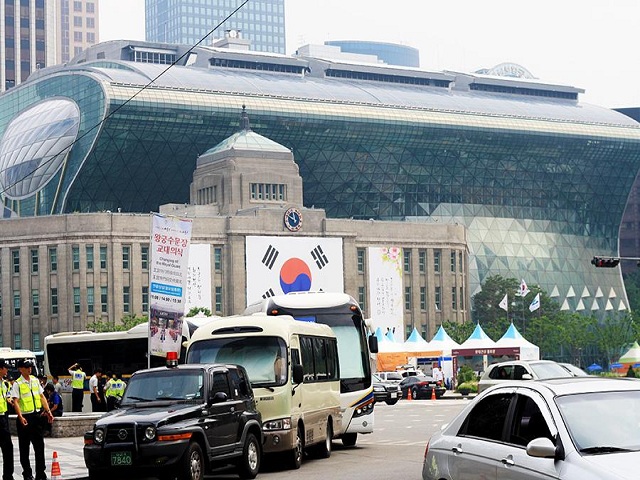
A curved glass-and-metal exterior looks like it came from a science fiction novel. Inside, vertical gardens provide clean air for the visitors.Cristina Tantengco
While entrance is free, there isn’t much to do at the city hall. In the basement, a glass floor covers the foundations of old structures found during the excavation to build the new city hall. “Seoul: A long history,” it reads.
Across the room, symbols of modernity abound: a fair trade shop, a gaming center for families, and tiles decorated with couples’ love notes. At a walking distance from the city hall is Cheonggyecheon, an underground stream and public park that was once—wait for it—a highway.

Across the room, symbols of modernity abound: a fair trade shop, a gaming center for families, and tiles decorated with couples' love notes. Cristina Tantengco
A culture of cuteness

Namsan: There, couples write their names on padlocks, attach these to the fence at Namsan, and throw away the key, hoping they'll last forever. Cristina Tantengco
I imagine this is why I always have a good time in Seoul: it’s a good place to feel kilig. There, couples write their names on padlocks, attach these to the fence at Namsan, and throw away the key, hoping they’ll last forever.
But this is not a foolproof ward against love lost—a Korean student I met in 2011 told me, "Yeah, I need to take down some locks."
Still, can anyone say this isn’t cute?
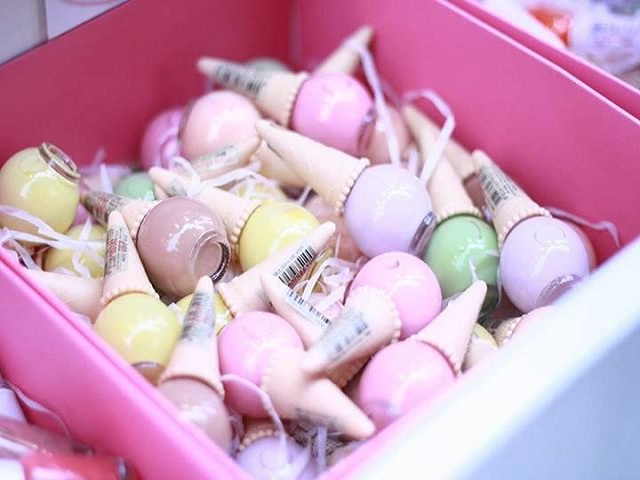
Ice cream-shaped bottles of nail polish, Myeongdong. Cristina Tantengco
Seoul youths use apps like Kakao Talk and Naver Line to chat with their friends, boyfriends, and girlfriends, which offer to send cute, cartoon-like stickers instead of words and phrases. Why spell out "I miss you" when you can send a picture of a colorful robot with a bouquet of flowers to your beloved?
Quiet times and good food
Despite the hustle and bustle of downtown Seoul, quiet moments are easy to find. One of my favorite meals from this recent trip was dinner with my friend Jinny. Her house was in the suburbs of Mia-dong, north of the busy city center.
We grilled samgyupsal (pork belly) and vegetables in her front yard, with her whole family. Her father taught us to eat raw, green peppers; her brother wore the Ateneo de Manila University shirt that we Filipino students gave Jinny as a present.
Dining in Seoul can be expensive, but we found that hole-in-the-wall joints were both cheaper and designed to make you feel at home. There was rabokki at Samcheong-dong’s Meokshidonna: rice cake, mussels, noodles, dumplings, and cheese all bubbling in a metal pot.

Myeongdong Kyoja, just off the main shopping road of shops, served a bowl of soft noodles topped with savory beef dumplings. Cristina Tantengco
We also tried one of Myeongdong’s many grill restaurants located just above cosmetics or clothing stores. For W20,000, or P720, my friend and I shared a plate of prime beef, a plate of samgyupsal, more than enough lettuce to wrap the meat in, and five kinds of side dishes.
Korea’s food is just one of the reasons why I plan to keep returning to Seoul. If you’re into Asian history, all-day shopping, a culture of sweetness and cuteness, there’s a good chance you’ll love Seoul, too. – VC/CM/HS, GMA News

