

 GMA Brandtalk
 Tracking
 Archives

ADVERTISEMENT
Filtered By: Lifestyle
Lifestyle
Sydney's Opera House: The lady turns forty
+
Make this your preferred source to get more updates from this publisher on Google.
Sydney, Australia
My husband Alex and I were in Sydney just in time for the 40th anniversary of its famous landmark, the Sydney Opera House, this month. We lived for a while in this vibrant Australian capital so many years ago, and have been in awe of the diversity and openness of its people. Almost every Sunday we used to come to Circular Quay, a wide area with a picturesque cove just off the central business district. We would simply walk around, and watch the world go by. The water of the harbor was usually calm, and many watercraft plied their routes across it.
The most well-known landmark in this beautiful cove is the Sydney Opera House. The land where it stood, called Bennelong Point, used to be along the city's tram lines. In 1957, a Dane named Jørn Utzon won an international competition to build an opera house for the city. His plan showed a building with white sail-like sculptures on the roof, seemingly flying through the windy skies. It was quite avant-garde at that time, the roof consisting of tiny, cream and white mosaic tiles that sometimes changed color with the sunlight’s direction.
Because the funds came from the government, the construction of the opera house was mired for several years in wrangling, ego-tripping, and grandstanding. Some local architects wanted to change the design, disgruntled that a foreigner was chosen to build their opera house. Utzon later resigned in disgust, because he refused to give in to pressure to change his original design. The whole edifice was finally finished in 1973, at several times the original cost, but Jørn Utzon never set foot on Sydney again; he died in 2008. However, his son Jan came to attend the ceremonies for the opera house’s 40th anniversary.
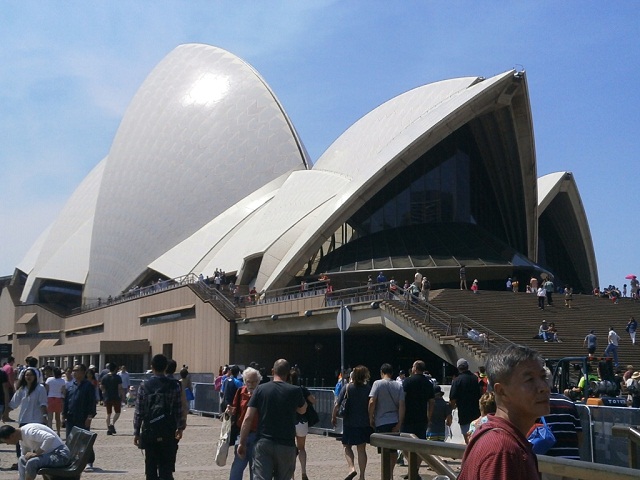
Alex and I used to visit the Sydney Opera House and would exclaim at how the roof tiles seemed to move and fly like a ship’s sails, as it changed colors at different times of the day. Indeed it had become a distinctive, world-wide icon, spelling “Sydney!” at one glance.
The building contains several important venues: The main Concert Hall, which has more than 2,500 seats; the Joan Sutherland Theatre, with 1,500 seats; and the smaller but equally important The Drama Theatre, the Playhouse, the Studio, and the Utzon Room. The foreground, made of wide concrete steps, is often the venue for open-air concerts. Other facilities include a recording studio, cafes, restaurants, bars, and retail outlets.
We felt singularly fortunate to be able to join the crowd in fêting this opera house on her 40th anniversary. Alex and I flew in that morning and were able to reach the area after lunch. Everybody had converged at the foreground of the Opera House, singing a rousing “Happy Birthday” before a birthday cake was sliced.
The sun was shining brightly as we mingled with the many well-wishers. Every space, it seemed, around Circular Quay was occupied. Children and their parents were sprawled on the grass, having their late lunch. Aboriginal musicians played the didgeridoo—a long, heavy native flute—while buskers regaled audiences with their magic, some painting on the ground using spray cans and chalk.
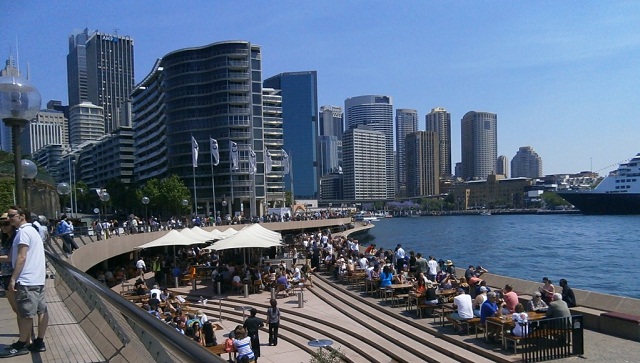 Just below the Opera House, restaurants have sprung up, and they were as international as the customers: Japanese, Chinese, Greek, Spanish. We took the stairs for the underground area, where things were really swinging – people seemed not to tire of eating, drinking, and laughing their cares away.
There was a good view here of the Harbour Bridge, another iconic symbol of Sydney. Locals affectionately call the huge steel structure “The Coat hanger” because it does look like one, from afar! The bridge connects the central business district to the North Shore areas, allowing trains, cars, bicycles, and pedestrians to pass through in a busy traffic of commuters.
We used to have a heavy, colored book about the bridge, and it told us so many interesting stories about its construction, down to the finest details of the hand-driven Australian-made rivets, all six million of them, to keep the bridge together! On March 19, 1932, the bridge was formally opened to the public.
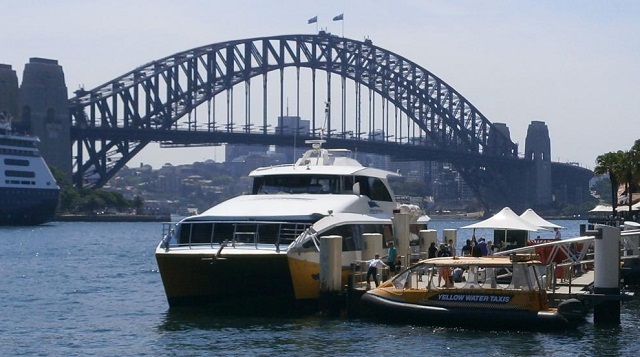
One of the more interesting activities that started here in 1998 was the Bridge Climb: you get outfitted with protective clothing and fastened to the bridge by cable wires, and then guided to walk on top of the arch from its eastern to the western side. The Sydney Harbour Bridge too, is usually the site of the New Year’s Eve fireworks display, one of the most awaited events not only in the city but in the world.
And what's Circular Quay without the Rocks? Once the site of early settlements in Sydney, it's now marked by old sandstone houses, interesting pubs and shops.
On weekends, there were flea markets. Alex and I usually sought them out, not only in the Sydney area, but also in nearby suburbs like Glebe and Gordon, where one found treasures: a Tibetan patchwork cloth “wallet,” perfect for putting in cash and passports, then hung from the neck for safekeeping during travels abroad. Or a jade bracelet, perhaps a little chipped, but still as enchanting.
We took the bus from the imposing Queen Victoria Building, a glass-domed building with high-end shops that sometimes sold one-of-a-kind items. We got down Loungeville Road, and slowly walked back to our friend Maria’s house in Lane Cove, North Shore, where we stayed. We got acquainted again with the fresh, eucalyptus resin smell of the cold air, the sudden cry of the kookaburra bird, sounding like an old woman’s cackle, and the colorful array of blooms in the gardens along the way. Spring was indeed here. – YA, GMA News
My husband Alex and I were in Sydney just in time for the 40th anniversary of its famous landmark, the Sydney Opera House, this month. We lived for a while in this vibrant Australian capital so many years ago, and have been in awe of the diversity and openness of its people. Almost every Sunday we used to come to Circular Quay, a wide area with a picturesque cove just off the central business district. We would simply walk around, and watch the world go by. The water of the harbor was usually calm, and many watercraft plied their routes across it.
The most well-known landmark in this beautiful cove is the Sydney Opera House. The land where it stood, called Bennelong Point, used to be along the city's tram lines. In 1957, a Dane named Jørn Utzon won an international competition to build an opera house for the city. His plan showed a building with white sail-like sculptures on the roof, seemingly flying through the windy skies. It was quite avant-garde at that time, the roof consisting of tiny, cream and white mosaic tiles that sometimes changed color with the sunlight’s direction.
Because the funds came from the government, the construction of the opera house was mired for several years in wrangling, ego-tripping, and grandstanding. Some local architects wanted to change the design, disgruntled that a foreigner was chosen to build their opera house. Utzon later resigned in disgust, because he refused to give in to pressure to change his original design. The whole edifice was finally finished in 1973, at several times the original cost, but Jørn Utzon never set foot on Sydney again; he died in 2008. However, his son Jan came to attend the ceremonies for the opera house’s 40th anniversary.
Alex and I used to visit the Sydney Opera House and would exclaim at how the roof tiles seemed to move and fly like a ship’s sails, as it changed colors at different times of the day. Indeed it had become a distinctive, world-wide icon, spelling “Sydney!” at one glance.
The building contains several important venues: The main Concert Hall, which has more than 2,500 seats; the Joan Sutherland Theatre, with 1,500 seats; and the smaller but equally important The Drama Theatre, the Playhouse, the Studio, and the Utzon Room. The foreground, made of wide concrete steps, is often the venue for open-air concerts. Other facilities include a recording studio, cafes, restaurants, bars, and retail outlets.
We felt singularly fortunate to be able to join the crowd in fêting this opera house on her 40th anniversary. Alex and I flew in that morning and were able to reach the area after lunch. Everybody had converged at the foreground of the Opera House, singing a rousing “Happy Birthday” before a birthday cake was sliced.
The sun was shining brightly as we mingled with the many well-wishers. Every space, it seemed, around Circular Quay was occupied. Children and their parents were sprawled on the grass, having their late lunch. Aboriginal musicians played the didgeridoo—a long, heavy native flute—while buskers regaled audiences with their magic, some painting on the ground using spray cans and chalk.
Just below the Opera House, restaurants have sprung up, and they were as international as the customers: Japanese, Chinese, Greek, Spanish. We took the stairs for the underground area, where things were really swinging – people seemed not to tire of eating, drinking, and laughing their cares away.There was a good view here of the Harbour Bridge, another iconic symbol of Sydney. Locals affectionately call the huge steel structure “The Coat hanger” because it does look like one, from afar! The bridge connects the central business district to the North Shore areas, allowing trains, cars, bicycles, and pedestrians to pass through in a busy traffic of commuters.
We used to have a heavy, colored book about the bridge, and it told us so many interesting stories about its construction, down to the finest details of the hand-driven Australian-made rivets, all six million of them, to keep the bridge together! On March 19, 1932, the bridge was formally opened to the public.
One of the more interesting activities that started here in 1998 was the Bridge Climb: you get outfitted with protective clothing and fastened to the bridge by cable wires, and then guided to walk on top of the arch from its eastern to the western side. The Sydney Harbour Bridge too, is usually the site of the New Year’s Eve fireworks display, one of the most awaited events not only in the city but in the world.
And what's Circular Quay without the Rocks? Once the site of early settlements in Sydney, it's now marked by old sandstone houses, interesting pubs and shops.
On weekends, there were flea markets. Alex and I usually sought them out, not only in the Sydney area, but also in nearby suburbs like Glebe and Gordon, where one found treasures: a Tibetan patchwork cloth “wallet,” perfect for putting in cash and passports, then hung from the neck for safekeeping during travels abroad. Or a jade bracelet, perhaps a little chipped, but still as enchanting.
We took the bus from the imposing Queen Victoria Building, a glass-domed building with high-end shops that sometimes sold one-of-a-kind items. We got down Loungeville Road, and slowly walked back to our friend Maria’s house in Lane Cove, North Shore, where we stayed. We got acquainted again with the fresh, eucalyptus resin smell of the cold air, the sudden cry of the kookaburra bird, sounding like an old woman’s cackle, and the colorful array of blooms in the gardens along the way. Spring was indeed here. – YA, GMA News

