

 GMA Brandtalk
 Tracking
 Archives

ADVERTISEMENT
Filtered By: Lifestyle
Lifestyle
The beauty of Cambodia's temples make kilometer-long walks in between worthwhile
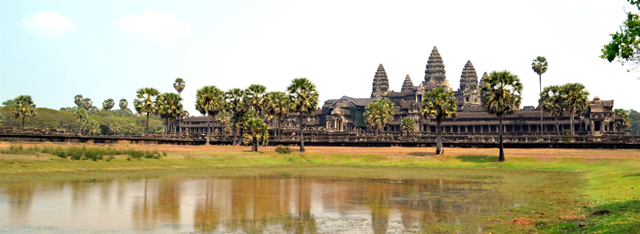
The glorious Angkor Wat.
I have long been raring to go to Cambodia to see the Angkor Wat and other temples. So much so that when I was invited to attend an international conference in the Cambodian city of Siem Reap, I immediately accepted the offer.
Since two friends and I arrived a day before the conference, we decided to go on a day tour to the Angkor temples (US$72). The entrance fee was US$20 per person.
The first temple we visited was the Angkor Thom, which means “the great city” in Khmer. The royal Buddhist city dates back to the 12th century and is especially famed for its grand Bayon Temple. The most distinctive feature of the Bayon is the multitude of serene and massive stone faces on the many towers jutting from the upper terrace and clustering around its central peak.
The Japanese Government Team for the Safeguarding of Angkor has described the temple as “the most striking expression of the baroque style” of Khmer architecture, in comparison to the classical style of Angkor Wat.
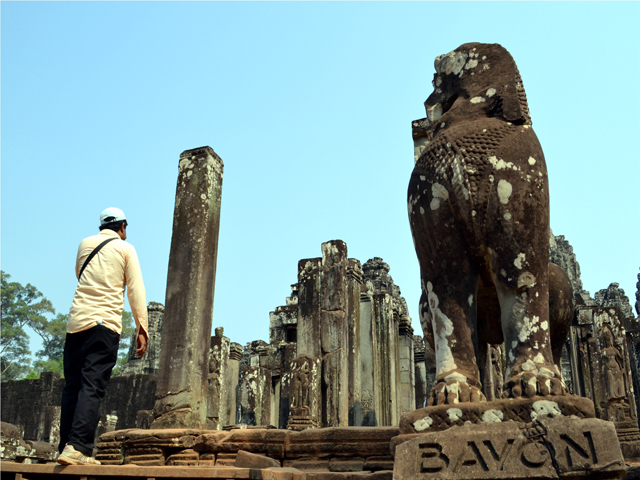
The Bayon Temple.
We hiked for almost a kilometer before we located our vehicle. It was a good thing our driver brought some water.
After few minutes' rest, we were on our way to our second temple: the Ta Prohm, which was the place where Tomb Raider was filmed. The Lonely Planet describes it thus: “It is a series of dark galleries and pillars held hostage under the iron clasp of gigantic roots. The walls are decorated with carvings of sensuous celestial nymphs with smaller roots crawling across them like a rash.”
It was almost lunch time when we finished marveling at the temples of Ta Prohm.
“It’s time for us to walk a long distance again,” our guide told us.
“You mean another hike?” I inquired.
He nodded.
“Can we have lunch first?” I answered. “I think we are running out of energy.”
One of my friends said, “We can rest at the restaurant while waiting for our food.”
And that was what we did—for almost an hour.
“I think we need to go now,” our guide said after a while. “Angkor Wat is not crowded right now. In fact, there may not be people around so we can see the temple in its glory.”
Although we were tired, we agreed.
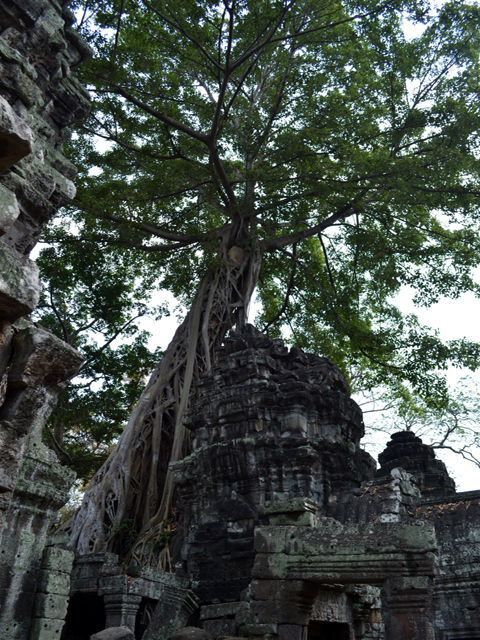
The tree overshadowing the temple of Ta Phrom.
Our guide said that the Angkor Wat was first a Hindu temple, and then subsequently Buddhist. Today, it is the largest religious monument in the world. So famous is this landmark that it has become a symbol of Cambodia, even appearing on its national flag.
It is no wonder that foreigners flock to see the Angkor Wat (which means “Temple City” or “City of Temples” in Khmer).
“Most of our visitors are Koreans,” our guide said. “Chinese is next, then Japanese, and finally Europeans—in that order.”
Portuguese explorer Antonio da Madalena, one of the first of Angkor Wat's Western visitors, described the temple thus: “(Angkor Wat) is of such extraordinary construction that it is not possible to describe it with a pen, particularly since it is like no other building in the world. It has towers and decoration and all the refinements which the human genius can conceive of.”
Henri Mouhot, the French naturalist and explorer who helped cement the Angkor Wat's popularity in the West via his published travel notes, wrote: “One of these temples—a rival to that of (King) Solomon, and erected by some ancient Michelangelo—might take an honorable place beside our most beautiful buildings. It is grander than anything left to us by Greece or Rome, and presents a sad contrast to the state of barbarism in which the nation is now plunged.”
The tourism office of Cambodia describes Angkor Wat in these words: “… In its beauty and state of preservation, (Angkor Wat) is unrivaled. Its mightiness and magnificence bespeak a pomp and a luxury surpassing that of a Pharaoh or a Shah Jahan, an impressiveness greater than that of the Pyramids, an artistic distinctiveness as fine as that of the Taj Mahal.”
At 2:30 p.m., we ended our tour. “Don’t you want to see the sunset?” our guide asked. We wanted to, but we decided to forego the sunset (which a friend told me was magnificent). What a shame. — VC/RF, GMA News

