

 GMA Brandtalk
 Tracking
 Archives

Nothing set in stone on Mt. Manalmon
Past rivers, past rocks. The trail to the peak of Mt. Manalmon in San Miguel, Bulacan was an easy one.
We reached the base camp at around 7 a.m. It was Sunday and the morning sun had just opened its eyes. A small group of kids were swimming in Madlum River.
Some stalls were already open by the time we got there. "Unli lugaw dito," a lady told us as she served a large pot of hot rice broth to some Manileños. "Akala n'yo sa Maynila lang may 'unli'? Dito rin meron!" "Mamaya," I told myself as we started our trek.
We followed the path of the Madlum River. At that hour, the water was relatively calm so we managed to walk on the rocks to cross the river. But that is not always the case, one of our guides said.
He said that the river swells when rainwater travels downstream. The image of the BSU students who drowned here in 2014, holding each other as river water raged around them, came to mind. Our guide said that they had to close their operations for a year after that. And when they opened again, they were operating under stricter guidelines. "Pinahigpit na po para mas maging ligtas," he said.
He even told me the story of how the tragedy happened. "Nagselfie muna sila kaya hindi agad nakatawid. Eh ang bilis tumaas ng tubig dito," he added.
The Madlum River was only inches deep when we crossed it. Beside it were these huge white boulders, whiter than asphalt. Our guide said that even with their immensity, the boulders can still be transported by the river, like a kid playing with his toy car. Which is why the terrain never remains the same.
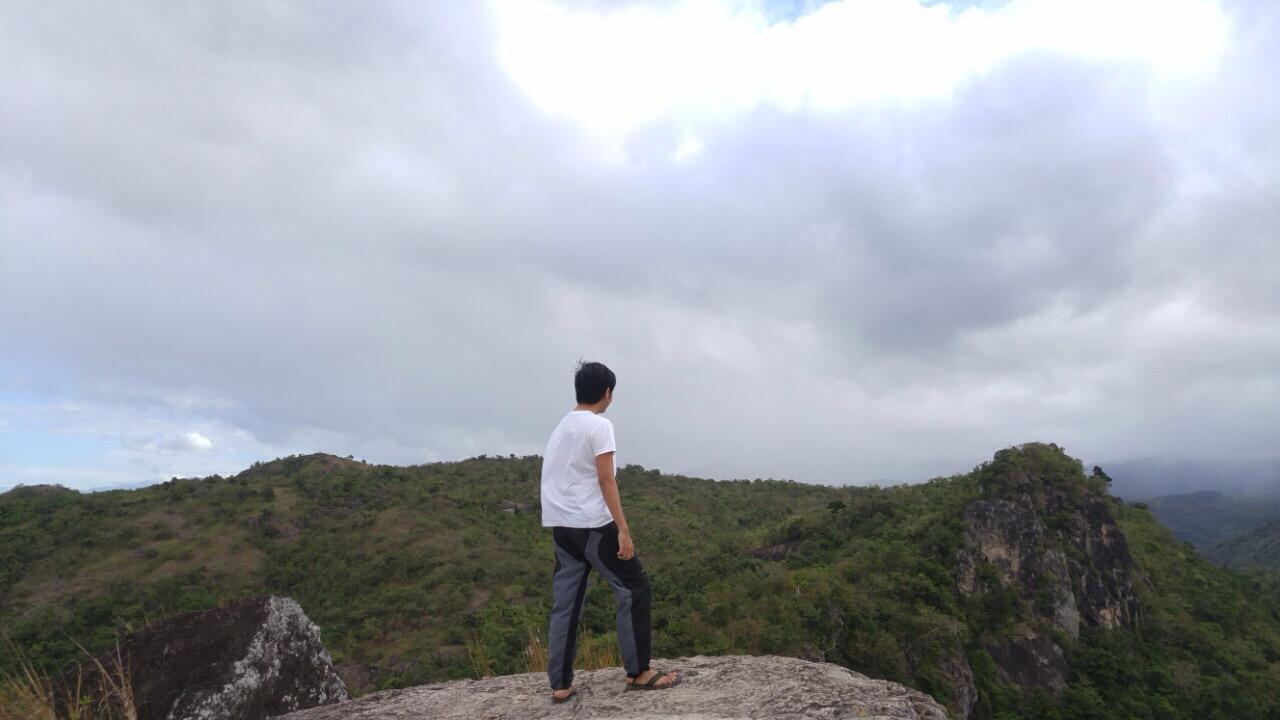
After about 45 minutes or so, we reached the top of the mountain. On our right, its brother, Mount Gola. Farther left, Mount Arayat in Pampanga. Farther south, rain replenished the vast greenery. The wind was so strong that it carried raindrops from the heavens to our spot on the summit. We did not stay long. We just posed for photos before making our descent.
When hikers climb Mount Manalmon, they also make their way to Mount Gola. Both hikes are said to be easy climbs, each lasting less than an hour. That is one itinerary. But for our trek, instead of climbing Mount Gola, we explored the famed Bayukbok Cave.
Part of the Biak Na Bato National Park, the cave was used as a hideout by the Katipuneros during Spanish times. Its cramped, dark passages made it a good place for hiding and plotting rebellion against colonial rule. (For those interested in conquering Bayukbok Cave, expect rappelling, swinging on vines, squeezing through passages and climbing a wooden ladder.)
The cave has historical importance. But one also cannot help but wonder at its natural beauty. Bayukbok Cave consists of a vast network of tunnels, rooms and rock formations that could have only been formed by millions of years of geological movement.
As humans climb on to ever greater heights or explore even greater depths, we do so only for a short amount of time. But in the span of earth's life, rocks will meet and separate. An inch in our eyes, but a rumble in history.
And as we move on from one tectonic change in society to another, the earth also moves in its own rhythm, sometimes as fast as the rising tides, other times as slow as two pillars of rocks meeting for an embrace.
We went our way back to the base camp by lunchtime. The Madlum River had swelled high enough for the visitors to enjoy an afternoon swim. We ate our lunch (I decided on some processed instant noodles instead of lugaw) then headed to the river for a swim.
By that time, the monkey bridge was opened for travelers to cross, with a steel wire connecting two rock formations on either side of the river.
But it will not always be there.
As the centuries pass, the rocks will move farther from each other as the river erodes more sediments downstream. The base camp will keep changing as locals live, age, and die. And eventually, only books will remember the story of the Katipuneros who rebelled against the Spaniards or the students taken by the god of the river.
It only took us 45 minutes to reach the top of Mount Manalmon. Maybe more. But time is fickle. The gods measure time not with numbers but with movement: the ebb and flow of things temporary. And between the changing epochs, we exist as a species aware of our own existence and eventual end. So every minute we have, we count with the steps we take. — BM, GMA News

