

 GMA Brandtalk
 Tracking
 Archives

ADVERTISEMENT
Filtered By: Money
Money
RP software piracy stays at same levels but dollar losses increase
+
Make this your preferred source to get more updates from this publisher on Google.
 MANILA, Philippines - Dollar losses from Philippine software piracy surged by double-digits last year as faster internet access increased “infringing activities," the Business Software Alliance (BSA) said. Software piracy levels remained at 69 percent in 2008 – just about the same rate posted the previous year – but losses rose 37.42 percent to $202 million last year from $147 million in 2007, data from the 6th Annual BSA-International Data Corp. (IDC) Global Software Piracy Study said. “Piracy is growing because Internet connection is increasing while broadband increases. As speed increases, you see more infringing activities of software," Business Software Alliance (BSA) vice president Jeffrey Hardee said in a teleconference with reporters on Tuesday. While piracy went up two percentage points in Asia Pacific at 61 percent, the region does not hold the highest piracy rate, which is currently held by held by Eastern Europe at 66 percent. World piracy rate grew at 41 percent from 38 percent. However, Asia Pacific posted highest piracy losses at $15.26 million, up 8.3 percent from $14.09 million. “The global economic downturn added two additional inputs to the piracy rate dynamics: changing exchange rates and decreased consumer and business spending power," the study read. The economic crisis pushed some changes in buying patterns of consumers and businesses as spending power weakened and software prices went up. In 2009, the study noted economic crisis will have a bigger effect on software piracy. “Since consumers are more likely to hold on to their PCs longer, this may result in increased software piracy because older computers are more likely to have unlicensed software," it read. However, the global recession is expected to have a mixed impact on software piracy, Victor Lim, vice president for Asia Pacific consulting operations at IDC, said. “Pocketbook pressures are spurring sales of inexpensive ‘netbooks’ which tend to come with legitimate pre-loaded software and spurring businesses to implement software assets management programs to increase efficiencies and lower IT costs," he said. However, it cited other “crisis-driven" dynamics that could curb piracy. These included higher sales of cheaper notebooks with pre-installed software, lower prices from vendors to spur demand, and higher deployment of software asset management program that can lower overall IT costs. Next: Stronger laws, improved prosecution to complement anti-piracy efforts
 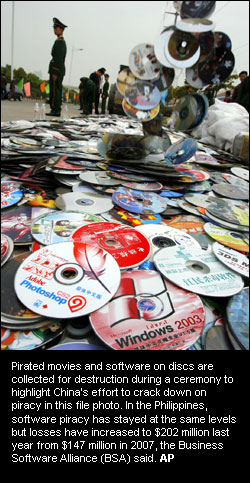 Stronger laws, improved prosecution to complement anti-piracy efforts Marquez said anti-piracy laws should be strengthened while prosecution should be improved to complement the all-out enforcement operations conducted by the Pilipinas Anti-Piracy Team, a government-led initiative to fight software piracy composed of the National Bureau of Investigation, Philipine National Police, and Optical Media Board. In a statement, OMB Chairman Eduardo Manzano said the “urgency in fighting software piracy to protect and boost the local IT sector is even more pronounced now that we are experiencing fallout from the global economic crisis." Buying a pirated copy of a software application or when a business chooses to use more copies of software than it had bought licenses for “results in stealing intellectual property of software developers," Marquez said. Piracy can be done through sale of pirated software on a retail level, illegal manufacture and distribution of software, and loading of illegal copies of software onto the hard disk of computers by computer sellers. Businesses and organizations can be guilty of piracy if they use unlicensed software in the office. Internet piracy is done through unauthorized uploading or downloading of software from Internet sites offering infringing software. Losses in the software industry due to piracy hurts the Philippine economy, Bienvenido A. Marquez III, BSA consultant for the Philippines, said. “They are also causing many of our countrymen to lose job opportunities as a result of lost revenues in the industry," he added. Reducing piracy by 10 points over four years could generate 600,000 new jobs and more than $100 billion in new revenues worldwide, Hardee said. Benefits from piracy reduction will “accrue to locally-based resellers, software services and channel firms," Hardee added. “Benefits remain within a country. IT sector in countries with lower piracy rates contribute a larger proportion to the gross domestic product. - GMANews.TV
