

 GMA Brandtalk
 Tracking
 Archives

ADVERTISEMENT
Filtered By: Money
Money
Nature and Malacañang jolted mining industry in 2012
+
Make this your preferred source to get more updates from this publisher on Google.
Two earth-shaking developments that occurred less than a month apart jolted the mining industry this year: Executive Order 79 and the Padcal Mine tailings disaster.
Because mining involves the extraction of mineral deposits —a phrase that also reads as exploitation of natural resources— the process involves an array of of national and local government permits as well as environmental clearances and mineral production sharing agreements also at the national and local levels. And these are but the most salient points of mining and bureaucracy.
New Mining Law
On July 9, President Benigno Aquino III signed Executive Order 79 or the new Mining Law that intends to amend the Mining Act of 1995 and make the business of mineral exploitation more equitable among the government, mining companies, communities hosting the mine, and indigenous people who hold patrimony to the land and its natural resources as guaranteed by the ancestral domain agreement.
EO 79 and its implementing rules and regulations, signed by Environment and Natural Resources Secretary Ramon Paje on Sept. 11, set the new policy tone for the industry and address the issues of environmental degradation, climate change, protection of indigenous peoples, and equity in the distribution of wealth – including increasing socioeconomic development support for local governments and communities.
In the eyes of big mining companies, under the aegis of the Chamber of Mines of the Philippines, EO 79 spelled disaster.
Losses from mining moratorium
During the 2012 Mining Conference at the Sofitel Plaza in Pasay City, Mines Chamber president Benjamin Philip Romualdez ranted about the losses the industry would suffer as a consequence of the moratorium on new mining projects until a new revenue-sharing measure is in place – one of the major problems the new policy on mining is supposed to address.
"The $2 billion in mining investments we are expecting this year will not happen,” Romualdez said in his speech on the first day of the conference.
“The $2 billion in mining investments we are expecting next year will not happen... The $16 billion in mining investments we are expecting in this administration will not happen," he said.
This seemed to have become the boilerplate argument of big mining companies: Don't or else the country will lose investments. Undermining the Chamber's claims
It was the same argument – with an added twist – heralded by the Mines Chamber when it asked Malacañang early this year to suspend the revised guidelines on Free and Prior Informed Consent that the National Commission on Indigenous Peoples has implemented. The group argued the new guidelines would weaken investor confidence in the Philippines and in the process lose $3.76 billion in investments in the gold, copper and nickel tenements.
In May, the Palace turned down that request.
The Bureau of Mines and Geosciences, however, debunked the numbers Romualdez ticked off during the Mining Conference. “We are rejecting the claims of Romualdez – in fact – with a statement from Secretary Paje...” Director Leo Jasareno told GMA News Online.
In the statement, Environment Secretary Ramon Paje emphasized that only once the existing profit-sharing scheme between government and mining companies has been raised to a more equitable ratio but more in favor of the government, the environment, and the Filipinos, then the government would start to issue new mining permits.
Paje called the profit-sharing scheme currently in place a “measly” 2 percent of gross sales. Environmental protection premise
 Premised on environmental protection, the proposed Mining Act also specified areas closed to mining, including protected areas under the National Integrated Protected Areas System or NIPAS, prime agriculture lands, and tourism development areas.
 It also called for the establishment of Mineral Reservations in areas with known strategic mineral reserves and resources, for the purpose of developing strategic industries identified in the Philippine Development Plan and National Industrialization Plan.
To improve transparency, accountability and governance in the mining industry, a central database of all mining-related information and government support and participation will be set up with the Extractive Industries Transparency Initiative or EITI and a one-stop shop for all mining applications will serve as conduit to EITI.
“There was no problem on the EO itself,” said Mines Bureau assistant director Elmer Billedo “It was only when the IRR (implementing rules and regulations) was released that questions on the viability of the measures cited surfaced.” Contentious profit-sharing, tax measures
The most contentious issue remain centered on profit-sharing and tax measures drew a barrage of criticisms from large scale miners.
In November, the Mining Industry Coordinating Council (MICC) said that the technical working group on economics which was tasked to fix the dilemma on taxation has come up with several models that may adopt a relatively “simple tax” structure that can either split profits into a 50-50 or 60-40 scheme between the government and large scale miners.
The entire exercise of creating a legislative measure on taxation and a whole-new fiscal regime may be outpaced by international developments, according to the Mines Bureau.
“There... the Philippines maybe left behind by other mining countries if prices of precious and base metals shoot up further in 2013, said Billedo., citing the Philippine predicament. “We cannot do anything unless the mining taxation bill is approved.”
The concern revolves around the tax measure that may languish in Congress until 2014
No new mining investments yet
 The Philippine government is trying to stay positive that the Mining Law will help attract more investors, but that point of view was tempered by the reality that no new mining investments are coming in or will not be processed until the country is opens itself up for new ventures.
 Tempering its own optimism was the government's revised investments target for 2012 to $509.24 million from $2.1 billion and down actual investments of $624.82 million in 2011.
In its latest assessment of the industry, the mines bureau noted that investments in the next four years may go down by 218.5 percent to $3.08 billion due to delayed investments. The low base formed in 2010 would impact and weigh on and slow down the succeeding years. At the start of 2012, its figures reflected a rosy and optimistic $9.81 billion.
Investments in 2013 is now estimated at $718.47 million from $2.06 billion, and $851.75 million in 2014 from an earlier estimate of $2.47 billion.
For 2015, the investment figures were pared down to $757.6 million from $2.99 billion and for 2016 to $619.5 million from $2.35 billion.
The Padcal disaster

But the real disaster happened in August when, at the height of enhanced monsoon rains, the tailings pond of Philex Mining's Padcal Mine caved in and spilled more than 20.6 million metric tons of mine waste into the environment until it was plugged in mid-September.
On midnight of August 1, Philex decided to shut down its Padcal operations in Itogon, Benguet and reported the incident to the government, its stockholders and the Philippine Stock Exchange as a publicly listed company.
The Mines Bureau also ordered the mining site to stop any mining related operations in Padcal. Philex refuses to pay
Philex Mining was fined more than P1 billion for the disaster, with the government arguing that while the company's personnel were not responsible for the disaster the company should have made provisions to ensure that its tailings pond was in a condition to withstand typhoons and monsoon rains each year.
Using the same argument – that its people were not responsible for the broken tailings pond but was a result of force majeure – Philex to this day has refused to pay. In a text message to GMA News Online, Philex Mining senior vice president Mike Toledo declined to comment on the company's latest position regarding the fine, simply saying that he is out of the country.
Biggest mining disaster in Philippine history
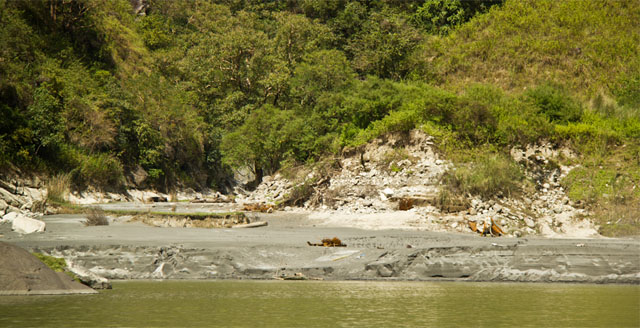
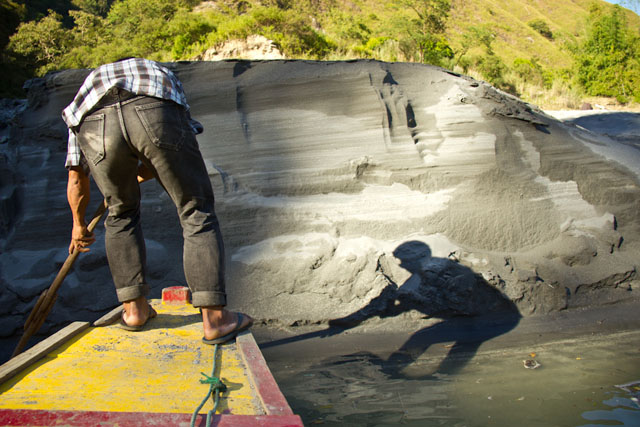
Balog Creek, the waterway that links the Padcal tailings pond and Agno River – the fifth largest river system in the country – is now a biological corpse that choked on an enormous amount of mine waste spilled by Padcal Mine, according a an investigative mission staged by a group of environmentalists, church groups, and reporters.
At 20.6 million MT, it was the biggest mining disaster in Philippine history in terms of the volume of waste materials discharged, said Jasareno.
For Philex Mining to reopen, it is imperative for the company to pay the fine and show a convincing result of the environmental clean-up and rehabilitation efforts so that the suspension order on its environmental clearance certificate would be lifted, said Paje.
“We would want it restored the way it was but we know that is near impossible, but close to what the affected areas have been will be good enough,” he said.
The fine against Philex Mining is based on a density factor of 1.531 tons per cubic meter of solid fractions of tailings, multiplied by P50 per metric ton, which boils down to P1.034 billion in pollution charges, according to Mines Bureau data. Philex speaks up on penalty
In the most recent development on the payments issue, Philex Mining said it will pay the fine only if the government will allow the company to use the money for the ongoing clean up and rehabilitation works.
“Contrary to what has been circulating, it is not the general sentiment that Philex should be allowed a reprieve," said Billedo.
“Many mining companies agree that Philex should pay the penalty as enforced by law. They said they are for responsible mining. If that is their battle cry, then they should follow the law. And I believe that the MGB and the DENR are still within the ambit of law in this case,” Billedo added.
On top of the penalty, Philex is also required to conduct a massive rehabilitation of the affected sites and water sources that may cost the company another P1 billion.
Rehabilitation efforts will continue well until April 2013, parallel to the construction of an open spillway to replace the broken penstock for water management of the tailings bond that gave in to its heavy load of rain water and mine waste. — TJD/HS, GMA News

