

 GMA Brandtalk
 Tracking
 Archives


ASEAN ministers sign landmark region-wide digital economy agreement
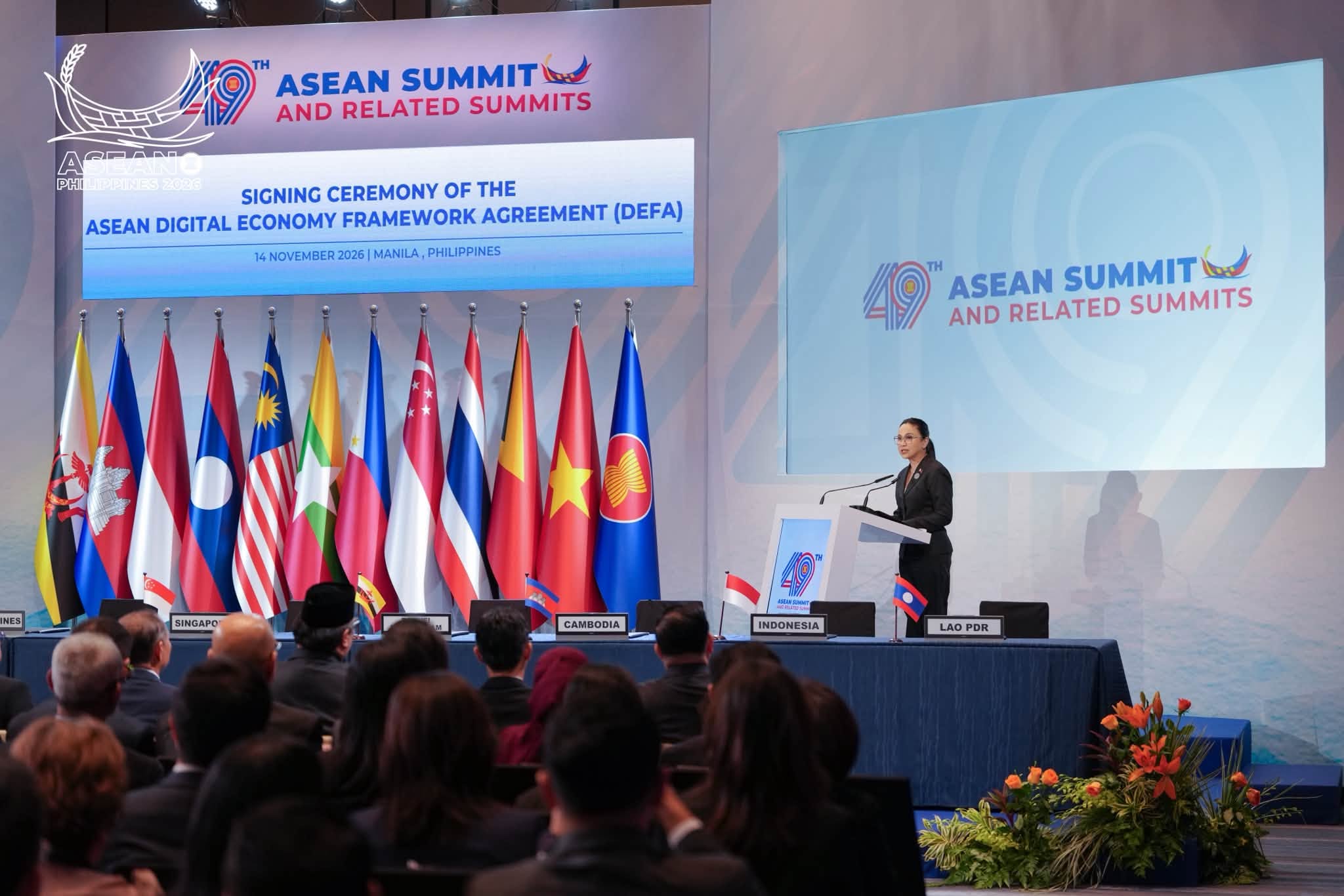
Trade, investment, and economic leaders of the Association of Southeast Asian Nations (ASEAN) on Saturday signed a landmark pact establishing a region-wide framework for cross-border digital trade and e-commerce, the first agreement of its kind in the world.
The ASEAN Digital Economy Framework Agreement (DEFA) was signed by Philippine Trade Secretary Cristina Roque along with Cambodia Minister of Commerce Cham Nimul; Brunei Darussalam Minister of Economy, Trade, and Industry Dato Seri Setia Dr. Haji Abdul Manaf Bin Haji; Indonesian Coordinating Minister for Economic Affairs Airlagga Hartarto; Lao PDR Vice Minister of Industry and Commerce Manothong Vongsay, Malaysian Minister of Investment, Trade and Industry Datuk Seri Johari Abdul Ghani; Myanmar Union Minister for National Planning, Investment, and Foreign Economic Relations Aug Kyaw Hoe; Singapore Deputy Prime Minister and Minister of Trade and Industry Gan Kim Yong, Thailand Deputy Prime Minister and Minister of Commerce Suphajee Sthumpun; Timor-Lester Vice Prime Minister, Coordinating Minister for Economic Affairs and Minister of Tourim and Environment Francisco Kalbuadi Lay; and Viet-Nam Deputy Minister of Industry and Trade Luong Hoang Thai.
The ASEAN DEFA aims to reduce barriers to cross-border digital trade, data transfers, and electronic payments. For foreign businesses, it could simplify regional transactions and reduce duplicated compliance requirements.
In her remarks, Roque said that the signing of the ASEAN Digital Economy Framework Agreement, or DEFA, “marks a defining moment in ASEAN's economic integration and in our collective ambition to shape the future of the digital economy.”
“After years of negotiations, consultations, and hard work, we are here to turn that ambition into a shared regional commitment. DEFA opens a new chapter in ASEAN cooperation, one that brings our economies closer together, extends the benefits of trade beyond physical borders, and positions our region to compete in an increasingly digital world,” she said.
She said that, through the DEFA, “we are building a more integrated digital economy for nearly 680 million people."
ASEAN’s digital economy is also poised to double its value from an estimated $1 trillion to $2 trillion by 2030.
“DEFA is a landmark achievement, not only for ASEAN, but for the global digital economy. As the world's first region-wide digital economy agreement of its kind, it places ASEAN at the forefront of efforts to build a more connected, trusted, and inclusive digital future,” Roque said.
The Philippine Trade chief noted that the DEFA provides a common framework for a more seamless, secure, and interconnected ASEAN digital marketplace. It brings together key areas of cooperation, including:
• Digital trade and cross-border e-commerce, to make it easier for businesses to offer goods and services across ASEAN markets;
• Electronic payments and digital identity, to facilitate more seamless, efficient, and trusted digital transactions;
• Cross-border data flows and data protection, to support the responsible movement of information while strengthening trust and safeguards;
• Cybersecurity and online consumer protection, to strengthen regional cooperation against cyber threats, online scams, and digital risks; and
• Emerging technologies, including artificial intelligence, to encourage innovation and prepare our economies for the opportunities and challenges ahead.
“These are interconnected building blocks of a regional digital economy where businesses can transact more easily, consumers can participate with greater confidence, and innovation can move more freely across borders,” Roque said.
“For our MSMEs, this means greater opportunities to reach customers across ASEAN, access digital platforms, and participate in regional value chains. For consumers, it means safer online transactions and stronger protection of personal information. For our workers, it means new opportunities in e-commerce, IT-BPM, digital services, and the creative industries, alongside the skills needed to succeed in these growing sectors,” she added. —VBL, GMA News

