

 GMA Brandtalk
 Tracking
 Archives

Tobacco lobby keeps PHL cigarettes among cheapest in Asia
The global movement to regulate and heavily tax the tobacco industry has made headway in many countries. But in the Philippines, cigarettes remain relatively cheap and lightly taxed, thanks in part to a powerful tobacco lobby that has so far blocked efforts to increase so-called "sin taxes." The World Health Organization recently said that at an average of only $0.50 per pack of the most popular brands, Philippine cigarettes are among the cheapest in Asia. The WHO is advising at least a 70 percent excise tax on the retail price of cigarettes; it is currently only 22 percent in the Philippines. Increasing revenues to augment state resources for the nation’s ever-growing development and social needs is the foremost objective of the Aquino administration in pushing Congress to approve the “sin tax” reform bill. That goal should not be too difficult to support. However, owing to the sharp division of opinions on its potential impact on the local tobacco-farming industry and on competition in the cigarette market, the proposed policy measure has ignited a noisy and divisive debate. Already dragged into the fray is an assortment of politicians, business executives both local and foreign, public officials both incumbent and retired, economists, academics and nongovernment organizations. Few issues like sin taxes—so called because they are imposed on tobacco and alcohol, highly profitable products that feed vices and are blamed for a variety of diseases in their consumers—can spark such an impassioned clash. 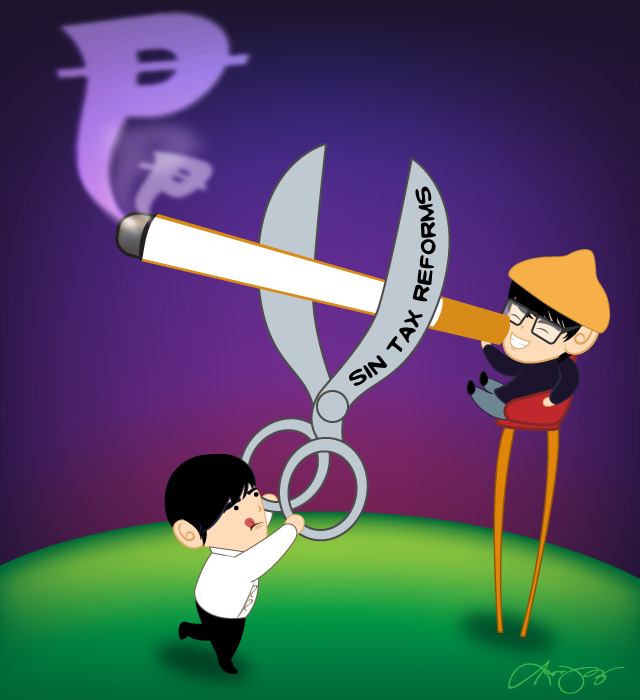 At the center of this skirmish is the huge cigarette market that is now dominated by one manufacturer, Philip Morris Fortune Tobacco Inc. (PMFT), as well as the local tobacco-growing industry on which fewer than 150,000 people, mostly in northern Luzon, depend for a living. Improving the tax system covering this industry will lead to increased collections, thereby raising the country’s tax effort that for decades has remained below Asian standards, as the proponents of the reform measure contend. They also say that this scheme will not only help propel economic growth, it will also support government programs on health care and livelihood for the tobacco farmers. Critics argue, on the other hand, that while the reform may indeed be able to level the playing field for cigarette manufacturers, the move could hurt some industry players more than others and a feared softening in consumption could dislocate tobacco growers. Even as President Benigno Aquino has thrown his support behind the bill, the political opposition is fiercely attempting to either block or weaken the measure which was introduced in the House of Representatives as early as August last year. Groups opposing the bill are said to also have the backing of the dominant cigarette company. Unitary tax The government continues to push for the approval of House Bill 5727, also called the “Sin Tax Reform Initiative,” which prescribes a new, unitary excise tax system for all tobacco products, replacing the current four-level excise tax structure. This single tax rate is to be adjusted in the future in step with inflation to preserve its share in the country’s overall economic growth. Various studies show that Philippine tax rates on cigarettes are the lowest in Southeast Asia, depressing state revenues from this source. Because the tax rates are low, manufacturers are able to also make cigarettes affordable, effectively encouraging smoking that is now known to be a common cause of deaths and disease. Economists say that cigarette prices are “inelastic,” meaning that consumption tends to remain steady even with steep price increases. Normally, price hikes soften demand for most consumer goods. Under the current system, cigarette brands that had been introduced in 1996 and earlier are categorized in a specific tax tier regardless of changes in their prices. On the other hand, brands that entered the market after 1996 are covered by a separate tax rate that is based on their prevailing retail prices. According to analysts, this tax structure favors the industry leader PMFT, which was created in 2010 after Philip Morris acquired Fortune Tobacco. PMFT now has a market share said to be around 97 percent. The bill calls for a uniform tax of P30 per 20-stick pack that retails for P10 or more, with brands priced at less than P10 per pack to be slapped an initial tax rate of P14 per pack for the first year of the reform measure, rising to P22 per pack in the second year, and to P30 in the third year. On the other hand, the reform measure intends to shift taxation of alcoholic drinks from the present system that is based on types of raw materials to one that takes into account alcohol content levels, with the varying tax rates to be unified at one rate for all products over a period of three years. If the proposed system is adopted, the specific tax on distilled spirits will go up, in the case of products with less than 45 percent alcohol, from P42.00 per proof liter in the first year to P159.14 per proof liter by the fifth year, according to computations made by reform policy advocacy group Action for Economic Reforms (AER). For fermented liquor, the AER calculations further indicate, the tax rate for all brands, regardless of price, will unify at P25.00 per liter in the first year, to be increased every year to reach P28.14 per liter by the fifth year. “All told, the total cumulative revenues to be generated from the sin tax reform will amount to more than P530 billion pesos in six years,” AER said in a position paper supporting the bill. Target beneficiaries Rep. Joseph Emilio A. Abaya (Cavite, First District), the main author of the House of Representatives version of the bill, has said that the measure is expected to generate during its first year of implementation over P60 billion worth of tax collections. A substantial portion of these projected tax collections is planned to be channeled to public health services, particularly for the poor, Abaya said. Furthermore, over the first five years of the measure’s implementation, according to projections by the Department of Finance, “around P225 billion of the incremental revenues from the sin tax reforms will be devoted to furnishing alternative livelihoods for any affected farmers.” Expressing support for the bill, Speaker Feliciano Belmonte Jr. has argued for a sin tax that is simple—not the present multi-tiered rates—and which is adjusted to inflation. “It is high time that we restructured our tobacco and alcohol excise taxes,” he said in a recent statement. “The prevailing multi-tax rate classification of cigarette and alcohol products and the pegging of sin taxes to 1996 price levels have convoluted the tax system and shrunk the tax base, dampening the government’s revenue efforts and essentially depriving the public of resources, which could have been used to fund the most basic of services,” Belmonte said. Last week, a group led by former top finance and health officials expressed agreement with the measure, saying that the bill, apart from seeking to “fix” the current excise tax structure, will “protect health, save lives, and raise much needed revenue for tobacco farmers and health services for all.” The group, which also released a “manifesto of support” for the tax reform measure, included former Finance secretaries Margarito Teves, Ramon del Rosario, Jesus Estanislao, Ernest Leung; former Health secretaries Alberto Romualdez, Juan Flavier, Jaime Galvez Tan, Esperanza Cabral, Juan Flavier and Alfredo Bengzon; former Finance undersecretaries Romeo Bernardo and Milwida Guevara, and former National Treasurer Leonor Briones. The manifesto’s release coincided with an international tobacco fair in Manila that was limited to industry-only private meetings and closed to the media and the public. The trade fair, according to its organizers, was aimed at providing “opportunities for tobacco and cigarette producers to meet suppliers of raw materials such as leaf, paper, filters and manufacturing equipment.” Declining revenue yield In a recent study, economists at the World Bank’s Manila office noted that the real revenue yield from excises on tobacco and alcohol in the Philippines declined significantly in the 12 years to 2009. From a level of 1.2 percent of the Philippines’ overall gross domestic product (or GDP, the value of all goods and services produced in the country) in 1997, excise collection fell steadily to just 0.6 percent in 2009. This decline, said the World Bank’s “Philippines Quarterly Update” of December 2011, was due mainly to low tax rates, specific rates that have not been updated regularly, and the use of 1996 prices to determine the tax rate for old products. The report pointed out “quite alarmingly” that these tobacco excise tax rates—the lowest in Southeast Asia—have resulted in a consumer base for cigarettes in the Philippines that is the largest among Southeast Asian countries and the 15th worldwide. The low tax on tobacco is one of the reasons why prices for cigarettes in the Philippines are “among the cheapest among low to medium income countries,” leading to the current situation where almost a fifth of Filipinos begin smoking before the age of 10 and prevalence is increasing, the report said. Increasing excise taxes on cigarettes, said the report, will “induce proportionately more poor consumers to quit smoking than richer ones.” Opposition to reforms The former finance and health officials who last week publicly declared support for the sin tax reforms also said that lobby groups against the initiative have the support of the Lucio Tan group, which controls dominant cigarette maker PMFT. They said that the same lobby group had effectively served as a “major hurdle” for tougher reforms during the administration of former presidents Fidel Ramos and Gloria Macapagal-Arroyo. In the House, a “close fight” is seen between bill’s supporters and the representatives from the tobacco-producing provinces in northern Luzon. The bill is still being dissected in the House Ways and Means Committee, whose 96 members include critics of the bill. One of the oft-repeated warnings of groups resisting the tax reform bill is that the big increases in cigarette prices that are expected to result from the high tax rates will encourage smuggling—which they say could erode tax collections. How the government proposes to mitigate smuggling remains to be seen. Thus far, the response from the bill’s advocates has been in the form of statements pointing to recent moves to beef up capabilities of the Bureau of Customs. Still, the bill’s advocates cite other countries’ experiences in increasing tax revenues overall even with leakages resulting from corruption and smuggling. Closer to home, smuggling remained a major problem during the past administration even after big cuts in tariffs on a number of imported commodities, the advocates say. The tax reform proponents in Congress are now in a race against time. The legislature is due to take a break starting next week, return in May and adjourn session early the following month. Even if the House succeeds in passing the bill in the coming weeks, it will still have to be deliberated on in the Senate. Challenges to the measure are not seen to be any easier in that chamber, according to some observers. Meanwhile, another global tobacco giant, British American Tobacco (BAT), is keenly awaiting the outcome of the reform initiative. It has bared plans to return to the Philippines—it pulled out of the local market four years ago after the multi-tiered tax structure hit its sales—with new investments worth $200 million. The proposed unitary tax system, BAT Philippines general manager James Michael Lafferty said last week, would level the playing field. The current tax system, he said, has worked against the entry of new brands into the market. - HS, GMA News

