

 GMA Brandtalk
 Tracking
 Archives

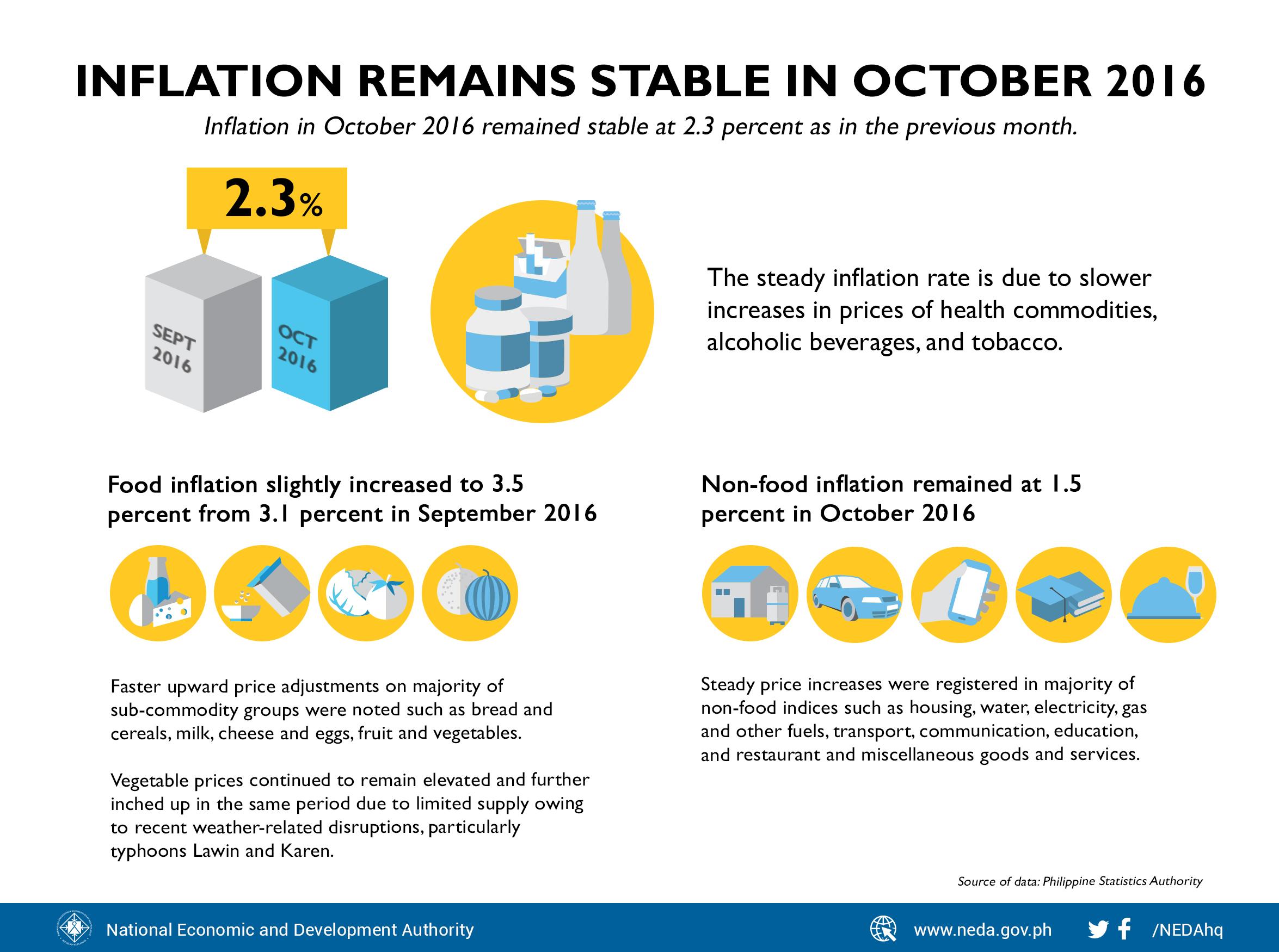
October inflation quickens 5.75 times at 2.3% y-o-y
Headline inflation settled at 2.3 percent in October, unchanged from September but nearly six times faster from 0.4 percent in October 2015, data released by the Philippine Statistics Authority (PSA) showed.
"This can be attributed to the mixed movements of the annual growths among the commodity groups," according to the statistics office.
It noted higher annual mark-ups the prices of food and non-alcoholic beverages, as well as clothing and footwear. Also registering increases were the prices of furnishing, household equipment and routine maintenance of house, and recreation and culture.
"Those for the rest of the commodity groups were either slower or remained at their last month’s rate," the PSA said.
Still, at 2.3 percent, inflation treaded closer to the government's inflation target of 2.5 percent for the month.
Base effect
Alvin Ang, economics professor at the Ateneo de Manila University, attributed the faster inflation year-on-year to "base effect ... as it was "too low last year."
"Base effect is the consequence of abnormally high or low levels of inflation in a previous month distorting headline inflation numbers for the most recent month," according to Investopedia.
Finance Undersecretary Gil Beltran earlier said the same thing – that the apparent surge in inflation rate last month was the result of base effect.
Buying power
"Generally, if inflation goes up, the consumers' buying power goes down," Guian Angelo Dumalagan, market economist at the Land Bank of the Philippines, said in a phone interview.
Dumalagan noted, however, the impact of inflation on buying power was not significant as consumer prices actually increased at a much slower pace.
"At the current level of 2.3 percent, inflation remains generally benign, supporting views that the impact on consumers' overall purchasing power might just be minimal," he said.
Domestic demand
While domestic demand is expected to remain robust, the supply conditions – particularly of food – are expected to improve, National Economic and Development Authority Director-General Ernesto Pernia said.
“This should help keep commodity prices steady. Rice prices will be kept stable by the timely arrival of rice imports under the government-to-government procurement scheme,” Pernia noted in an emailed statement.
In January to October 2016, inflation leveled at 1.6 percent or well below the official target of 2 percent to 4 percent this year, the Cabinet official said.
"We expect inflation for the whole of 2016 to settle below the target range, but upside risks remain,” Pernia said.
Such risks include a possible oil price rally and a sharp depreciation of the peso, tropical cyclones and petitions for higher electricity rates.
“Given the larger possibility of more frequent and stronger rains, the agriculture sector needs to implement adaptation measures to protect the income of farmers and keep food price inflation at bay,” said Pernia.
'Within forecast'
For his part, Bangko Sentral ng Pilipinas (BSP) Governor Amando Tetangco Jr. said the October inflation was within the central bank's forecast range of 1.9 percent to 2.6 percent.
"The turnout is in line with our view that inflation will be manageable over the policy horizon and slowly rise to within target in 2017-18," Tetangco said in a text message to reporters.
Nevertheless, the BSP chief said, "We will continue to monitor a pending petition for higher utility rates, among others, on the domestic front and global economic activity on the external front as well as risk factors to the outlook." — VDS, GMA News

