

 GMA Brandtalk
 Tracking
 Archives

How much have PH minimum wages increased since 1989?

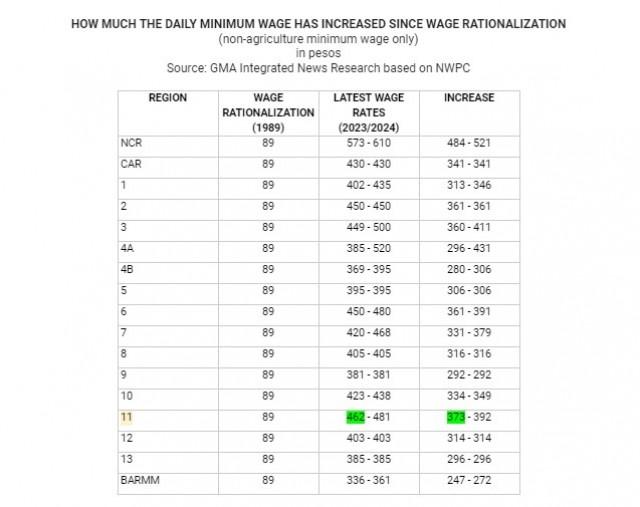
Daily minimum wage increases in the regions have ranged from P247 to P521 over almost 35 years, since the government implemented wage rationalization in the country in 1989, wage statistics indicated.
Republic Act 6727 or the Wage Rationalization Act increased the minimum wage rates of all workers in the private sector by P25 when the law took effect in July 1989. For workers in non-agriculture establishments, this meant a minimum wage of P89, uniformly fixed across all regions.
Subsequent wage orders issued by Regional Tripartite Wages and Productivity Boards over the years led to what minimum wage earners now make. For those working in non-agriculture establishments, that’s anywhere from P336 to P610, with the amounts varying per region.
Today’s rates are based on wage orders issued between June 2023 and earlier this month, although Davao Region’s rates have yet to take effect: Region XI RTWPB Wage Order No. 22, issued on February 13, will be implemented on March 6.
The National Capital Region has the biggest cumulative minimum wage increase among the regions at P484 to P521. In fact, it is the only region where the cumulative wage increase went over P500. It went from P89 in 1989 to between P573 and P610 since NCR RTWPB Wage Order No. 24 took effect on July 16, 2023.
The Bangsamoro Autonomous Region in Muslim Mindanao, which only recently implemented its latest minimum wage rates of P336 to P361, lies on the other end of the spectrum as the region with the lowest cumulative wage hike since 1989. Its wages increased by only P247 to P272 in over three decades.
Incidentally, NCR and BARMM are also on the opposite ends of the scale in terms of poverty incidence. Based on the Philippine Statistics Authority’s data as of the first semester of 2023, NCR is the least poor among the country’s regions, with only 3.3% of its families living below the poverty line. BARMM, with 34.8% of its families not earning enough to meet basic needs, is the country’s poorest region.
The biggest increase granted in one go on the basis of a single wage order was P110 in Region 6 or the Western Visayas. This was set in May 2022 by virtue of RTWPB-VI Wage Order 26, which set the minimum wage of workers in non-agriculture establishments employing 10 workers or less at P420. The wage order was issued two and a half years after the previous wage order: the minimum wage for the same type of workers in the region was previously fixed at P310 in October 2019.
Based on GMA Integrated News Research's calculations, regional minimum wages increased by 278% to 585% since wage rationalization in 1989.
In context, the country’s inflation based on the July 1989 and January 2024 consumer price indices is at 564%.
Wage hikes per administration
GMA Integrated News Research reviewed National Wages and Productivity Commission data on past regional wage orders amid ongoing congressional deliberations on wage hike proposals. It considered in its analysis the rates for workers in non-agriculture establishments with 10 or more workers, and set the P89 wage rationalization rate as its baseline. It used the wage orders’ issuance dates to determine which wage increases were set by regional wage boards within the term of each administration.
Orders for wage hikes were issued nearly every year in one or more regions across all administrations from the time of President Cory Aquino up to the incumbent administration of President Bongbong Marcos. There were a few exceptions: not a single order for non-agri wage hikes was issued in 2009 and in 2021.
During the Cory Aquino administration (1986-1992), most of the regions got further hikes post-wage rationalization in 1989. Region 10 or Northern Mindanao got the biggest cumulative increase at P32.10. The Cordillera Administrative Region (CAR) and what was then the Autonomous Region in Muslim Mindanao (ARMM) were just newly formed in 1989; the P89 wage rationalization rate applied to them, but these two regions would only get their first wage hikes during the succeeding administration.
All regions except for the newly formed Region 13 or CARAGA got wage hikes during the Fidel Ramos administration (1992-1998). Region 4 or Southern Tagalog, which has yet to be partitioned as CALABARZON and MIMAROPA, got the highest cumulative increase at P87 within that period.
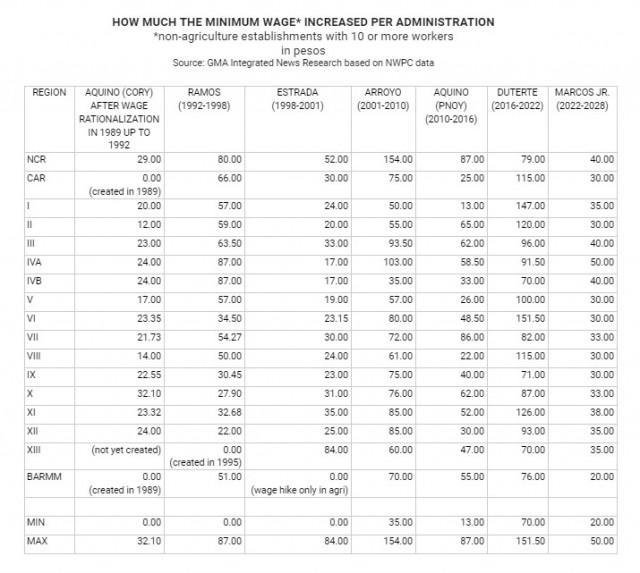
Wage increases during the Gloria Arroyo administration (2001-2010) went up to as much as over P100, although these were incrementally spread out across nine years rather than granted in one go. This was the case in NCR (P154 cumulative increase) and Region 4A (P103 cumulative increase). Region 4B’s P35 increase was the smallest during this period.
The cumulative wage increases during the Benigno Aquino III administration (2010-2016) ranged from P13 to P87, in Region 1 or the Ilocos Region and NCR respectively..
Total wage hikes during the Duterte administration (2016-2022) also reached over P100 in a number of regions, particularly in CAR, Regions 1, 2, 5, 6, 8, and 11. For workers in non-agriculture establishments employing more than 10 people, these were incremental increases that added up to over P100. The smallest wage increase during this period was P70 in Region 4B and 13.
The regional wage boards under the Ferdinand Marcos Jr. administration have so far ordered wage increases ranging from P20 to P50.
The House of Representatives is currently deliberating on bills proposing wage hikes ranging from P150 to P750. —NB, GMA Integrated News

