

 GMA Brandtalk
 Tracking
 Archives

Unemployed Filipinos down to 1.94M in February 2025
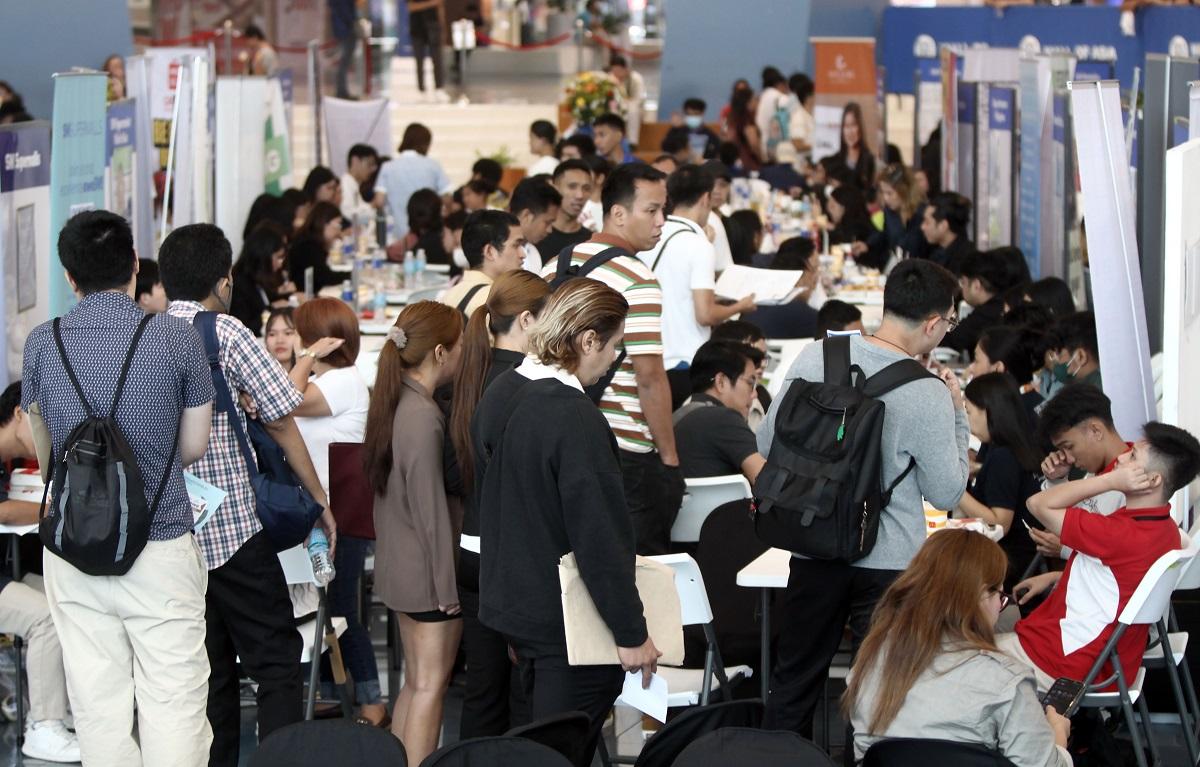
The number of Filipinos without jobs or livelihoods saw a decline in February 2025, amid an induced seasonality due to election-related demand for labor and hot dry season-driven activities, according to the results of the Philippine Statistics Authority’s (PSA) latest Labor Force Survey.
National Statistician and PSA chief Claire Dennis Mapa reported that unemployed persons, ages 15 and above, declined to 1.94 million in the second month of 2024.
This was lower by 228,000 compared to the 2.16 million jobless individuals in January 2025.
As a percentage of 51.09 million participants in the labor force, who are actively looking for labor opportunities during the period, the number of jobless persons translated to an unemployment rate of 3.8%, down from 4.3% month-on-month.
To illustrate, an unemployment rate of 3.8% meant that 38 out of 1,000 individuals do not have jobs or livelihoods in February 2025.
The country’s unemployment rate remains at par with its Asian peers, including Malaysia (3.1%) and Vietnam (2.2%), and lower than China (5.4%) and India (6.4%).
The number of employed persons in the second month of 2025, on the other hand, rose by 668,000 to 49.15 million from 48.49 million month-on-month.
This was equivalent to an employment rate 96.2%, up from 95.7% in January 2025.
Mapa attributed the positive labor market data to the year-on-year rise in employed persons in the accommodation and food service activities which saw an increase of about 377,000.
“This could be an effect of [seasonality] going towards the summer holidays,” the PSA chief said.
The Statistics agency also saw that election-related activities had driven an increase in employment.
“In February, we saw a pickup in those employed by political organizations at about 41,000… we are seeing this, most probably, will continue until May and that in a way induced seasonality,” Mapa said.
Meanwhile, results of the Labor Force Survey found that the services sector continued to dominate the labor market, accounting for 61.6% of the total employed persons in February 2022.
The agriculture and industry sectors followed with a share of 20.1% and 18.3%, respectively, of the total.
The top five sub-sectors with the largest increase in employed persons month-on-month were the following:
- Wholesale and retail trade; repair of motor vehicles and motorcycles - 620,000
- Construction - 434,000
- Manufacturing - 225,000
- Public administration and defense; compulsory social security - 191,000
- Fishing and aquaculture - 147,000
Meanwhile, the top five sub-sectors with the highest month-on-month decline in employed individuals were the following:
- Agriculture and forestry - 520,000
- Administrative and support service activities - 308,000
- Transportation and storage - 176,000
- Professional, scientific and technical activities - 90,000
- Information and communication - 89,000
Moreover, the PSA’s latest survey revealed that wage and salary workers continued to account for the largest share of employed persons at 63.2%.
This was followed by self-employed persons without any paid employee at 28.2% and unpaid family workers at 6.6%.
Employers in own family-operated farm or business had the lowest share of 2%.
The PSA reported that those employed in private establishments remained to have the highest share at 77.3% of the wage and salary workers or 48.8% of the total number of employed persons.
Those employed in government or government-controlled corporations followed with a share of 14.7% of the wage and salary workers or 9.3% of the total number of employed persons during the period.
Underemployed
Amid the increase in employment and decline in unemployment, the quality of jobs also improved as the number of underemployed persons subsided during the period.
The underemployed individuals —those who expressed the desire to have additional hours of work in their present job or to have an additional job, or to have a new job with longer hours of work— decreased to 4.96 million in February 2025 from 6.47 million in January 2025.
As a percentage of the 49.15 million employed Filipinos, the underemployment rate stood at 10.1%, down from 13.3% month-on-month.
In a separate statement, National Economic and Development Authority (NEDA) Secretary Arsenio Balisacan said the government vowed to continue improving the quality of job opportunities available amid the decrease in underemployment.
Balisacan added that “the quality of employment continued to improve year-on-year, with more workers engaged in full-time employment (+1.7 million), middle- and high-skilled occupations (+1.1 million), and remunerative wage and salaried work (+151,000).”
“We are equally encouraged by the increase in the number of employed persons witnessed in both our agriculture and industry sectors. This balanced growth across key economic pillars strengthens the resilience and diversity of our employment and livelihood landscape,” the Department of Labor and Employment (DOLE) said in a statement.
DOLE said that they are working on more projects to further boost employment rates, such as Labor Day Job Fairs and special employment programs.
“DOLE is actively engaged in continuous capacity-building initiatives nationwide to strengthen the implementation of these youth employability programs through our Public Employment Service Offices and program implementers. Our young jobseekers deserve the best possible guidance and support as they embark on their careers, and we are committed to facilitating their seamless transition from school to work,” the statement read.
“The success of our recent orientations underscores this unwavering commitment to enhancing youth employability through targeted skills development and effective employment facilitation strategies.''
They also said that they are looking into prioritizing adaptation of digital transformations and upskilling for future programs.
Projects to generate jobs
Balisacan said that the government aims to swiftly pursue initiatives and fast-track the implementation of projects generating high-quality jobs.
“We will build on our momentum and intensify our efforts to secure strategic job-generating investments, promote a dynamic and innovative business environment, and diversify growth drivers. The continued rollout and implementation of high-impact infrastructure flagship projects, particularly in energy, transport, and digital connectivity, will boost domestic employment and business activity,” Balisacan said.
To support Filipino workers amid a constantly changing labor market landscape, developing the Lifelong Learning Development Framework will be crucial for fostering continuous learning, enabling individuals to develop their skills, pursue higher studies, or acquire micro-credentials while working, according to the NEDA chief.
The socioeconomic planning secretary said the government’s partnerships with the private sector will be expanded to ensure that training programs are tailored to industry requirements, enhancing worker’s skills and productivity, as supported under the Enterprise-Based Education and Training (EBET) Framework.
The Technical Education and Skills Development Authority and the Department of Labor and Employment finalized the Implementing Rules and Regulations of the EBET Framework Act in February 2025.
Balisacan said the government is also set to launch the Trabaho Para Sa Bayan (TPB) Plan 2025-2034.
“The TPB plan will highlight the government’s key employment strategies, including programs to improve the competitiveness of the Filipino workforce; encourage innovation and promote technology adoption among enterprises, especially MSMEs; and enhance labor market governance, including social protection programs,” the NEDA chief said.—with Jiselle Anne Casucian/AOL/VBL, GMA Integrated News

