

 GMA Brandtalk
 Tracking
 Archives

PH, US agree to take concrete steps to address trade, tariff issues
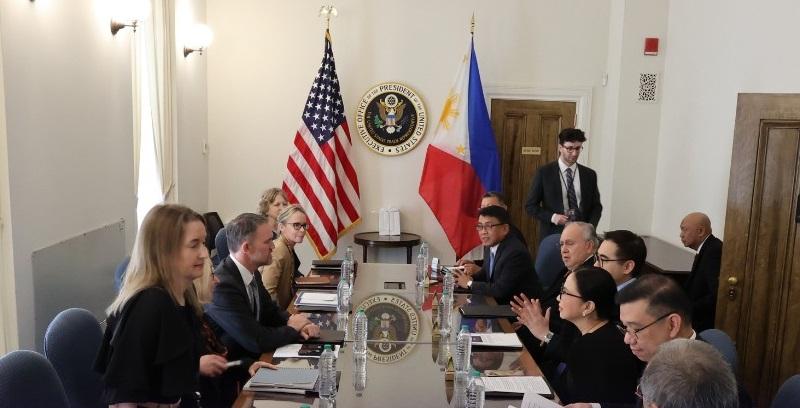
Top Philippine and US officials agreed to take “concrete steps” to address lingering concerns on their bilateral trade following the Trump administration’s imposition of new tariffs on Manila, a key regional ally, and other global trading partners.
Trade and economic officials from the Philippines, led by President Ferdinand "Bongbong" Marcos Jr.’s Investment and Economic Affairs adviser Frederick Go; Department of Trade and Industry Secretary Cristina Aldeguer-Roque; and Philippine Ambassador to the United States Jose Manuel Romualdez met with US Trade Representative (USTR) Jamieson Greer on May 2 in Washington D.C., where they tackled “mutually beneficial ways to strengthen the bilateral relations” amid the 17% tariff rate imposed by the US on Manila.
“We made sure to put the welfare of Philippine local industries at the center of our negotiations. We are hopeful that these discussions mark the beginning of a process toward arrangements from both sides that will not only strengthen US-Philippine trade ties but also help diversify our country’s export markets,” Go said in a statement.
“Our goal for this meeting is a partnership that benefits both sides and supports the growth of our industries at home,” he added.
Go did not disclose if the two countries agreed on lowering tariffs.
The Philippine Embassy in Washington did not provide specific details on what were the key issues they specifically agreed on, but said “both sides expressed optimism on the future of PH-US trade and investment relations especially in the context of economic security and fair, balanced, and reciprocal trade.”
“We came out of the meeting with a positive feeling,” Romualdez told GMA News Online in a separate text message.
“We were able to clearly convey to the USTR our local industries’ asks and concerns and we are hopeful this will yield to our desired results,” Roque also said.
The US last month announced a sweeping enforcement of reciprocal duties on its trading partners, with the Philippines facing a 17% tariff on its imports to America. Although it is the lowest in Southeast Asia, it has triggered concerns within the Philippine government, prompting it to send a delegation to Washington to seek consultations with US officials.
But in a surprise move, President Donald Trump announced a pause of his new tariff policy, with the exception of China, under a 90-day reprieve that ends early July.
The Philippine embassy said the Filipino officials and Greer welcomed the “positive outcome of the discussions” and “underscored the importance of an economically and strategically strong partnership between the Philippines and the United States.”
“Both countries agreed to undertake concrete steps in recognition of the complementary nature of our economies and the strategic value of our alliance,” the embassy said.
The Department of Economy, Planning, and Development (DEPDev)—previously the National Economic and Development Authority (NEDA)—earlier said the latest iteration of the tariffs could still mean a net positive for the Philippines, but this will only be very minimal. — with Jon Viktor D. Cabuenas/BM, GMA Integrated News

