

 GMA Brandtalk
 Tracking
 Archives

Inflation slows down further to 1.4% in April — PSA
The Philippines’ inflation rate continued its deceleration streak for the third straight month, remaining below 2% in April, on the back of slower movements of food and transport costs, the Philippine Statistics Authority (PSA) reported on Tuesday.
At a press briefing, PSA chief and National Statistician Claire Dennis Mapa reported that last month’s inflation print —which measures the rate of increase in the prices of consumer goods and services— cooled down further to 1.4% from 1.8% in March.
This was the slowest since November 2019, when inflation clocked in at 1.2%.
April’s inflation rate brought the year-to-date rate to 2%, well within the government’s ceiling of 2% to 4% for the entire 2025.
“Ang pangunahing dahilan ng mas mababang antas ng inflation nitong Abril 2025 kaysa noong Marso 2025 ay ang mas mabagal na pagtaas ng presyo ng Food and Non-Alcoholic Beverages sa antas na 0.9% [from 2.2% in March],” Mapa said.
(The main contributor to the lower inflation rate in April 2025 versus March 2025 was the slower increase in the prices of Food and Non-Alcoholic Beverages with a rate of 0.9%.)
“Ito ay may 82.3% share sa pagbaba ng pangkalahatang inflation sa bansa,” he added.
(This accounted for 82.3% of the decrease in the country’s overall inflation rate.)
The decline in Food and Non-Alcoholic Beverages index was brought by the stronger contraction in cereals, such as rice, to -7.4% from -5.2%.
Also contributing to the overall inflation downtrend was the faster contraction in Transport index at -2.1% from -1.1% month-on-month, accounting for 15.2% to the decline.
The deflation in the Transport index was on the back of faster contraction in gasoline costs at -12.4% from -7.5% as well diesel at -8.3% from -5%.
Food inflation
In a separate statement, the Department of Economy, Planning, and Development (DEPDev) noted that the “key driver of the decline was food inflation.”
Food inflation, which tracks the price movements of food items in a "basket" commonly purchased by households, dropped to 0.7% from 2.3% in March.
The easing of food inflation in April was mainly driven by the faster deflation of rice at -10.9% from -7.7% in the prior month.
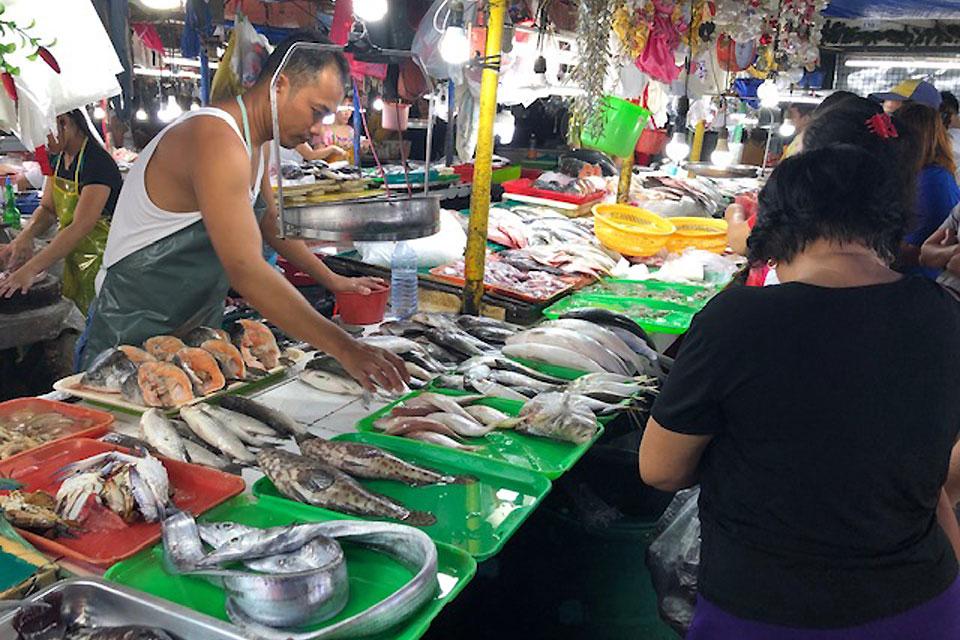
This was followed by the slower inflation rates of vegetables, tubers, plantains, cooking bananas and pulses at 2.3% from 6.9% rate in March; and fish and other seafood at 4.3% from 5.5% month-on-month.
“The sustained slowdown in inflation, driven largely by the significant decline in food prices, is a positive sign that our policy interventions are working. We will continue to implement strategies to vigilantly monitor price shocks and proactively temper inflationary pressures,” said DEPDev Undersecretary for Planning and Policy Group Rosemarie Edillon.
“We must continue to push for decisive coordination to ensure price stability, especially for essential commodities. Our goal is not only to reduce inflation but to ensure that its benefits are felt by every Filipino household—through lower food costs and improved access to basic goods,” added Edillon. — AOL/RSJ, GMA Integrated News

