

 GMA Brandtalk
 Tracking
 Archives

Employed Filipinos decline by 1.13M year-on-year in March
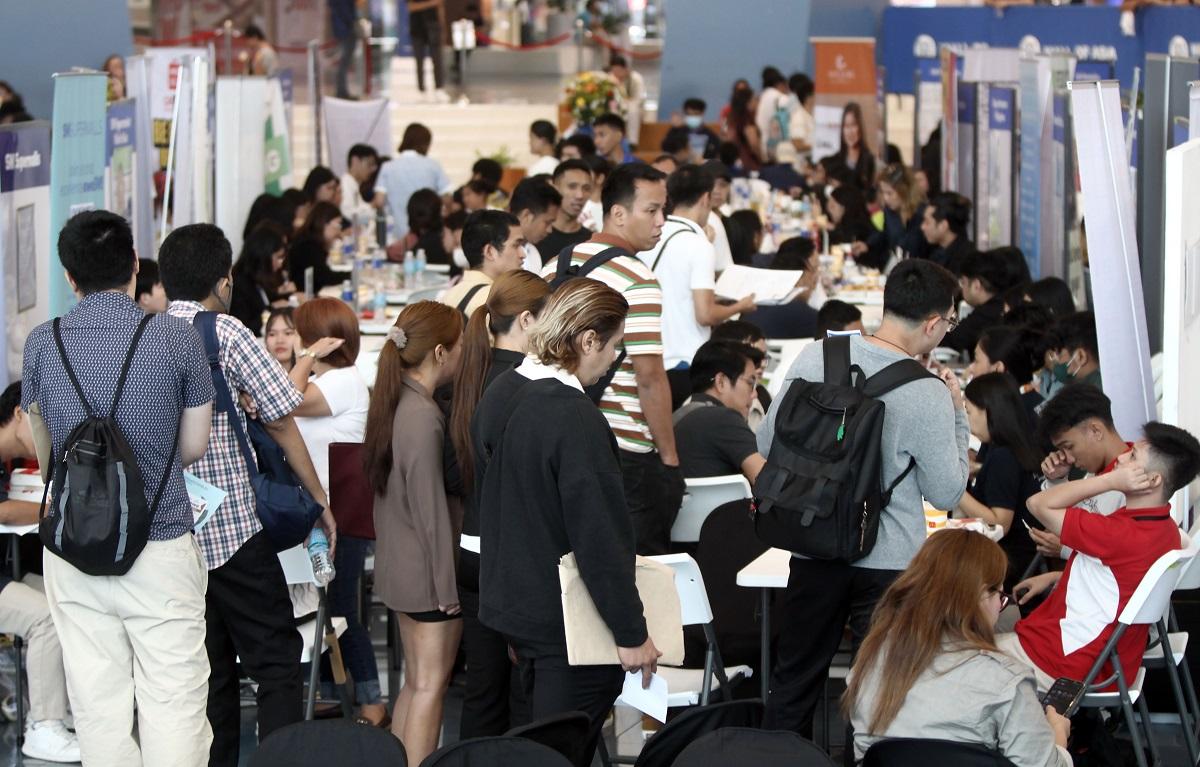
The number of Filipinos with jobs or livelihoods posted an over a million year-on-year decline in March 2025 due to continued decrease in those working in the agriculture sector as well as the election-related ban on hiring in government offices, according to the results of the Statistics Authority’s (PSA) latest Labor Force Survey.
National Statistician and PSA chief Claire Dennis Mapa reported that employed persons, ages 15 and above, plunged by around 1.13 million to 48.02 million from 49.15 million in the third month of 2024.
Month-on-month, those with jobs and livelihoods also declined by about 1.13 million from 49.15 million in February 2025.
Mapa said the top two contributors to the decline in employed persons were the agriculture and forestry and public administration and defense, compulsory social security sectors.
In particular, the agriculture and forestry sector saw a decline of 609,000 workers while the public administration and defense, compulsory social security sector posted a decrease of 394,000.
“For public administration and defense, compulsory social security… these are employees in government [so] we feel this was affected by the election ban,” Mapa said.
During the election period, the hiring and promotions of workers in the government are suspended from March 28 to May 11, 2025.
The other top sectors which posted the highest annual decrease in employed persons are as follows:
- Manufacturing - 281,000
- Wholesale and retail trade; repair of motor vehicles and motorcycles - 175,000
- Professional, scientific and technical activities - 100,000
A significant month-on-month drop of 473,000 employed people was also seen in the construction sector.
Mapa said the drop could be attributed to a possible stoppage in the construction of buildings.
As a percentage of 49.96 million participants in the labor force — who are actively looking for labor opportunities during the period — the number of employed persons translated to an employment rate of 96.1%, the same level year-on-year but slightly lower than the 96.2% rate in February.
Unemployed
Meanwhile, the number of unemployed persons was flat at 1.93 million in March from 1.94 million in February.
Year-on-year, it grew marginally by about 69,000 from two million in March 2024.
As a percentage of 49.96 million labor force participants, the unemployment rate stood at 3.9%, the same rate seen in March last year and slightly above the 3.8% in February 2025.
The decline in both employment and unemployment numbers was correlated to the 1.20-million year-on-year decrease in labor force participation from 51.15 million in March 2024.
The PSA chief said the top reasons cited by those who opted not to actively seek jobs and livelihoods in March were “return to schooling” and “household and family duties.”
“There were a substantial number of those who decided to return to schooling… it saw 816,000 increase. The second reason was household and family duties with an increase of 784,000,” Mapa said.
PSA data showed that wage and salary workers remained as the top sector accounting for 63.4% of the total number of employed persons in March 2025.
It was followed by self-employed persons at 27.9% and unpaid family workers at 6.6%.
Employers in their own family-operated farm or business had the lowest share of 2.1%.
Among wage and salary workers, those employed in private establishments continued to account for the highest share at 78.1% as well as 49.5% of the total number of employed persons.
Those employed in government or government-controlled corporations followed with a share of 14.7% of the wage and salary workers and 9.3% of the total number of employed persons in March 2025.
Underemployed, TPB Pan
Amid the decline in both employment and unemployment, the quality of jobs was affected also as the number of underemployed persons grew during the period.
Underemployed individuals —those who expressed the desire to have additional hours of work in their present job or to have an additional job, or to have a new job with longer hours of work— rose to by 1.05 million to 6.44 million in March 2025 from 5.39 million in March 2024.
Month-on-month, it grew by 1.48 million from 4.96 million in February.
As a percentage of the 48.02 million employed Filipinos, the underemployment rate climbed to 13.4%, from 11% year-on-year and from 10.1% month-on-month.
In a statement, the Department of Economy, Planning, and Development (DEPDev) said the launch of the Trabaho Para sa Bayan (TPB) Plan “comes at a critical time, as the PSA reported that the country's underemployment rate rose to 13.4% in March 2025.”
“The launch of the Trabaho Para sa Bayan Plan is both timely and essential. The latest employment figures highlight the need for a comprehensive set of interventions to increase investments, encourage technology adoption, improve job satisfaction and employment quality. The TPB Plan will serve as our strategic roadmap toward building resilient employment, fostering competitive enterprises, and preparing a future-ready workforce,” said DEPDev Undersecretary for Policy and Planning Rosemarie Edillon.
Launched on Monday, May 5, the TPB Plan is the country’s first 10-year Labor Market Development Plan.
It provides a long-term strategic framework for job creation, labor market transformation, and inclusive workforce development.
Among its key components are the promotion of lifelong learning and the implementation of accelerated learning pathways, such as micro-credentials, to address underemployment and skills mismatches.
“In response to the rapidly growing demand for specialized skills, the government—through the TPB Plan—is expanding access to upskilling and reskilling opportunities for Filipino workers. These initiatives are crucial to addressing skills shortages and aligning the Philippine labor market with global workforce standards,” said Edillon.
“Our collective task now is to translate this Plan into concrete action—guided by data, informed by social dialogue, and driven by a shared purpose. Through our unified effort, we aim to create an inclusive, efficient, and dynamic labor market where Filipinos can access meaningful, quality employment that supports a matatag, maginhawa, at panatag na buhay,” added the DEPDev official. — RSJ, GMA Integrated News

