

 GMA Brandtalk
 Tracking
 Archives

Inflation eased to 0.9% in July 2025 —PSA
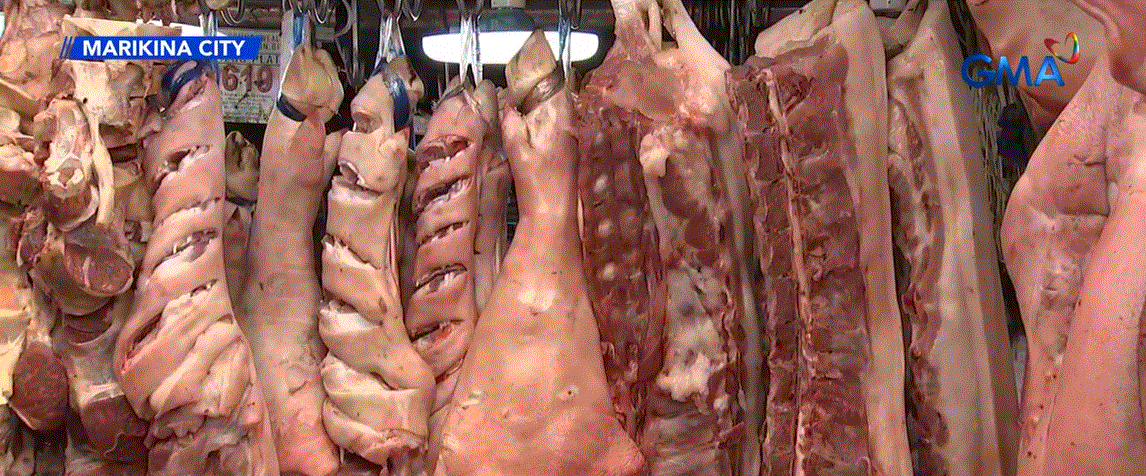
The country’s inflation rate decelerated to its lowest level in nearly six years in July due to the slower increase in utilities costs and the decrease in food commodities’ prices during the period, the Philippine Statistics Authority (PSA) said Tuesday.
At a press conference, National Statistician and PSA chief Claire Dennis Mapa reported that last month’s inflation print —which measures the rate of growth in the prices of consumer goods and services— slowed down to 0.9% from 1.4% in June.
This was the lowest inflation print recorded since October 2019, when it clocked in at 0.6%.
Last month's inflation rate was also slower than the 4.4% rate in July 2024.
July’s inflation rate brought the year-to-date national average rate to 1.7%, still below the government’s comfortable inflation rate ceiling of 2% to 4% for 2025.
“Ang pangunahing dahilan ng mas mababang antas ng inflation nitong Hulyo 2025 kaysa noong Hunyo 2025 ay ang mas mabagal na pagtaas ng presyo ng Housing, Water, Electricity, Gas and Other Fuels na may 2.1% inflation rate [from 3.2% in June],” Mapa said.
(The main contributor to the slower inflation rate in July 2025 versus June 2025 was the slow down in the increase in the prices of Housing, Water, Electricity, Gas and Other Fuels with an inflation rate of 2.1%.)
“Ito ay may 45.1% share sa pagbaba ng pangkalahatang inflation sa bansa,” the PSA chief said.
(This accounted for 45.1% of the overall decline in the country’s inflation.)
This was due to the slower increase in the cost of electricity with a rate of 1.3% from 7.4% month-on-month and the decrease in liquefied petroleum gas (LPG) from 1.5% to 0.7%.
Also contributing to the July inflation rate’s deceleration was the contraction in the inflation rate of Food and Non-Alcoholic Beverages to -0.2% from 0.4% in the prior month.
The Food and Non-Alcoholic Beverages contributed 43.4% to the overall inflation decline.
The index contracted amid the further deflation in cereals (which includes rice) to -11.5% from -10.3% as well the contraction in vegetables’ costs to -4.7% from -2.8%.
Meanwhile, fruits and nuts saw a slowdown to 8% from 9.7%.
The third contributor to the overall inflation decline was the Transport index, accounting for 6.9%, which contracted further to -2.0% from -1.6% on the back of the easing in transport by sea costs to 5.2% from 24.8%, bigger contractions in gasoline to -10% from -8.9%% and airfares to -11.8% from -1.9%.
Food inflation
Consistent with the overall inflation’s downtrend, food inflation —which tracks the price movements of food items in a "basket" commonly purchased by households— decreased to 0.5% from 0.1% month-on-month.
This was still due to the continued deflation in rice at -15.9% from -14.3% in June.
Corn also saw a faster contraction of 15.9% from 14.5% in the prior month.
Lower inflation rates in July were also seen in the following food items:
- Meat and other parts of slaughtered land animals at 8.8% from 9.1%
- Milk, other dairy products and eggs at 5% from 5.1%
- Ready-made food and other food products at 2% from 2.2%
Bottom 30%
Inflation felt by the bottom 30% income households in the country reversed to -0.8% from 5.8% in June.
This is primarily driven by the Food and Non-Alcoholic Beverages index, which contracted faster to -3% from -2.2% month-on-month due to decline in rice to -17.8% from -16%, corn to -17.7% from -16%, and vegetables to -1.9% from 0.1%.
“While we expect the overall inflation for 2025 to remain favorable and supportive of domestic demand, we remain vigilant against external risks, including global policy shifts and geopolitical tensions,” said Department of Economy, Planning, and Development (DEPDev) Secretary Arsenio Balisacan.
The country’s chief economist noted that despite recent weather disturbances, the Philippine Atmospheric, Geophysical, and Astronomical Services Administration (PAGASA) “forecasts a relatively favorable climate outlook” with nine to 17 tropical cyclones expected between August 2025 and January 2026.
“But the prevailing ENSO (El Niño-Southern Oscillation)-neutral condition is likely to support stable agricultural production,” said Balisacan.
To facilitate recovery in areas affected by tropical storms Crising, Dante, and Emong, and the southwest monsoon, the Department of Agriculture (DA) has allocated P495.4 million worth of agricultural inputs, including rice, corn, and vegetable seeds, for distribution nationwide.
The DA is also prepared to activate its Quick Response Fund and offer interest-free loans of up to P25,000 through the Survival and Recovery (SURE) Loan Program, with a three-year repayment period. Additionally, the Philippine Crop Insurance Corporation is expediting indemnity payments to affected farmers and fisherfolk.
In addition, the DA expects the arrival of 150,000 additional AVAC live vaccine doses for African Swine Fever (ASF) from Vietnam this month.
The initial batch has already been distributed nationwide, and strengthened border controls have helped reduce ASF-affected barangays to 28 as of July 11, down from 534 at the peak of the outbreak in October 2024.
Targeted beneficiaries of the Department of Social Welfare and Development’s (DSWD) Walang Gutom Program (WGP) can also purchase rice at P20 per kilo through the Kadiwa ng Pangulo initiative.
“Statistical improvements are meaningful only when they translate into better lives for ordinary Filipinos. Thus, we are committed to sustaining this positive momentum and ensuring that protecting the purchasing power of Filipinos remains our top priority as we move to the second half of this administration,” said Balisacan. —AOL/KG, GMA Integrated News

