

 GMA Brandtalk
 Tracking
 Archives

Jobless Pinoys decline to 1.95M in June 2025
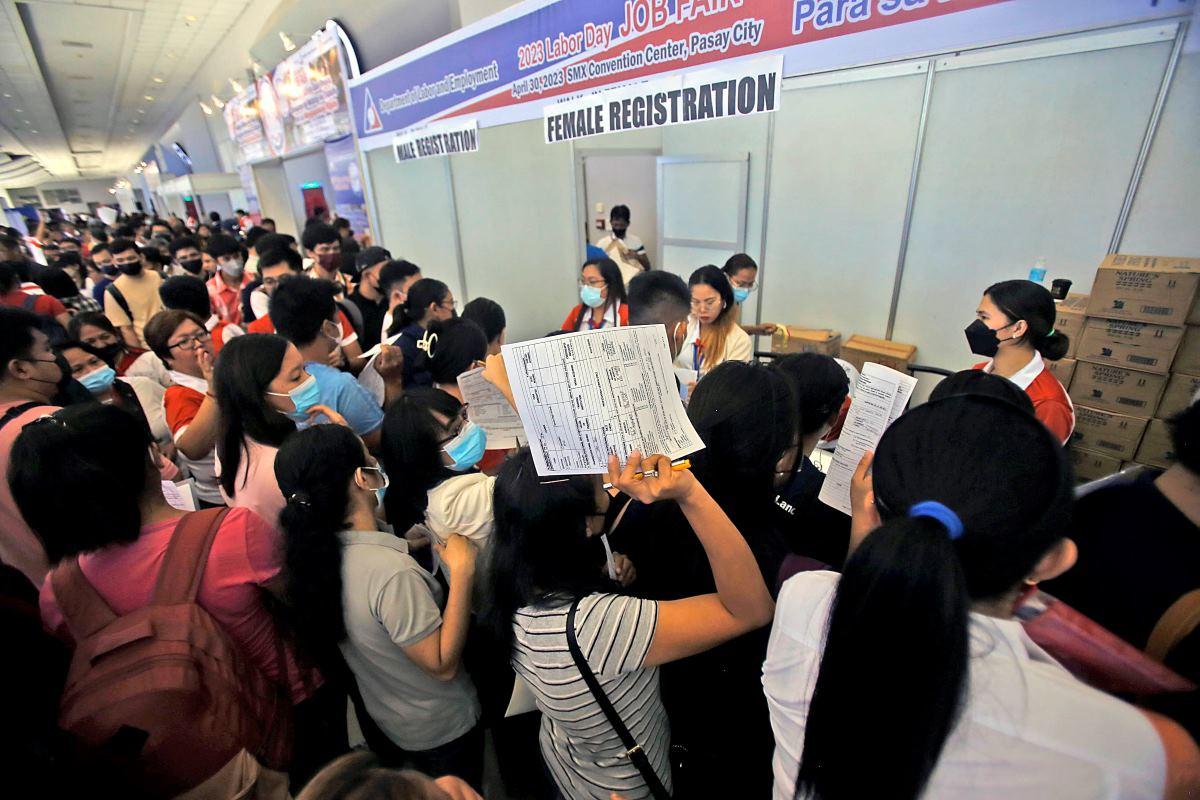
The number of Filipinos without jobs or livelihoods decreased for the second straight month in June 2025, receding below two million, according to the results of the Philippine Statistics Authority’s (PSA) latest Labor Force Survey.
At a press briefing on Wednesday, PSA Deputy National Statistician Divina Gracia del Prado reported that unemployed persons, ages 15 and above, declined to 1.95 million from 2.03 million in May 2025.
Year-on-year, jobless individuals grew from 1.62 million in June 2024.
As a percentage of 52.42 million participants in the labor force who are actively looking for labor opportunities during the period, the number of jobless persons translated to an unemployment rate of 3.7%, down from 3.9% month-on-month.
This means 37 in 1,000 individuals do not have jobs or livelihoods during the period.
Meanwhile, employed persons in June 2025 grew to 50.47 million from 50.29 million in May 2025 and 50.28 million in June 2024.
As a percentage of labor force participants, the employment rate stood at 96.3% higher than the 96.1% seen in the prior month but slightly lower compared to 96.9% in the same month last year.
The Services sector accounted for the highest share in the total of employed individuals in June 2025 at 61.4%, followed by Agriculture and Industry at 20.9% and 17.7%, respectively.
In terms of month-on-month increase in employed persons in June versus May 2025, the top five sub-sectors were the following:
- Wholesale and retail trade; repair of motor vehicles and motorcycles — 908,000
- Fishing and aquaculture — 428,000
- Construction — 292,000
- Financial and insurance activities — 248,000
- Human health and social work activities — 164,000
The top five sub-sectors with the largest drop in employed persons in June versus the prior month were as follows:
- Accommodation and food service activities — 562,000
- Agriculture and forestry — 480,000
- Public administration and defense; compulsory social security — 261,000
- Education — 255,000
- Arts, entertainment and recreation — 214,000
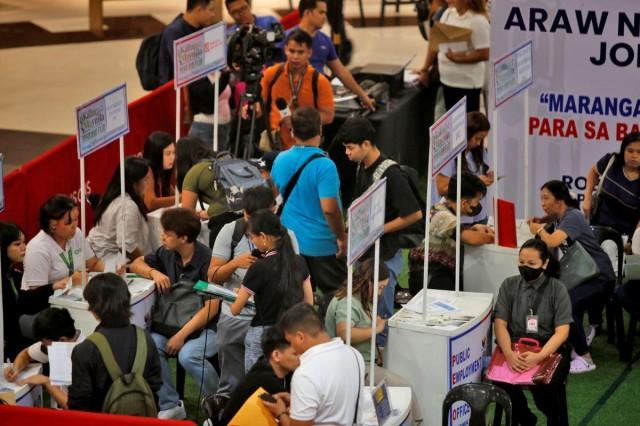
Wage and salary workers
The PSA also reported that wage and salary workers accounted for 63% of the total employed persons in June 2025, followed by self-employed without any paid employee at 27.1%, unpaid family workers at 8%, and employers in their own family-operated farm or business at 1.9%.
Among wage and salary workers, the share of those employed in private establishments was the highest at 78.6% and 49.5% of the total employed individuals during the month.
This was followed by those employed in government or government-controlled corporations with a share of 13.5% of the wage and salary workers or 8.5% of the total number of employed persons during the period.
Underemployed individuals —those who expressed the desire to have additional hours of work in their present job or to have an additional job, or to have a new job with longer hours of work— stood at 5.76 million or 11.4% of the 50.47 million employed persons in June.
The underemployment rate declined from 13.1% in May 2025 and 12.1% in June 2024.
The PSA said the decrease in underemployment was largely driven by the drop in the invisibly underemployed or those who worked less than 40 hours a week in the manufacturing and wholesale & retail trade sub-sectors.
In a statement, Economic Planning Secretary Arsenio Balisacan said the government is leveraging policy reforms aimed at strengthening workforce development.
These include the following:
- Enterprise-Based Education and Training (EBET) Framework Act
- Expanded Tertiary Education Equivalency and Accreditation Program (ETEEAP)
- Proposed Lifelong Learning Development Framework Bill
Balisacan said the reform initiatives would enable a culture of continuous learning among Filipinos, promote industry-driven learning, and recognize prior learning experiences, helping Filipinos adapt to evolving labor market demands.

Strategy
The Marcos Administration is likewise advancing key programs and initiatives of the Department of Labor and Employment to boost youth employment, such as the Special Program for the Employment of Students, the Government Internship Program, the JobStart Philippines Program, as well as strengthened coordination with LGU-based Public Employment Service Offices (PESOs) and school-based Job Placement Offices.
The Department of Trade and Industry’s implementation of the Tatak Pinoy Strategy will also guide efforts to strengthen local enterprises, attract investments, and elevate the country’s position in the global value chain.
Balisacan underscored the importance of aligning workforce competencies with emerging industry demands, particularly in high-value sectors such as Global Capability Centers (GCCs) and digital services.
He also cited the forthcoming release of guidelines on the “Future Workforce in an AI Workplace,” which aim to support AI integration across government, industry, and education, while safeguarding job security through stronger digital literacy and AI-related skills.
“These strategic efforts are part of the Trabaho Para sa Bayan Plan, our long-term blueprint for generating inclusive and high-quality employment. Through a nationwide roadshow, we are working closely with local governments, industry partners, and training institutions to ensure the effective implementation of key reforms,” he added.
To generate more high-quality jobs, the government is also working to strengthen the country’s position as a global leader in the semiconductor industry. This effort will be supported by the Philippine Semiconductor and Electronics Industry Roadmap, which is currently being developed to outline key investment priorities, innovation goals, and talent development strategies. By accelerating growth in this sector, the government aims to create more employment opportunities for skilled Filipino workers and enhance the country’s competitiveness in advanced manufacturing.
Complementing these initiatives, the government is accelerating the implementation of Infrastructure Flagship Projects (IFPs) to attract job-generating investments and address infrastructure bottlenecks. Improving public spending efficiency and prioritizing investments in education, healthcare, food security, and connectivity infrastructure will further support inclusive and sustainable growth.
“The numbers show that our efforts are bearing fruit, but more work lies ahead. We must accelerate structural reforms to make our labor market more inclusive, competitive, and resilient. Through sustained collaboration and innovation, we aim not just to create more jobs, but to sustain improvements in the lives of all Filipinos,” Balisacan said. —VAL, GMA Integrated News

