

 GMA Brandtalk
 Tracking
 Archives

Your companies have a home in PH, Recto tells Japanese investors
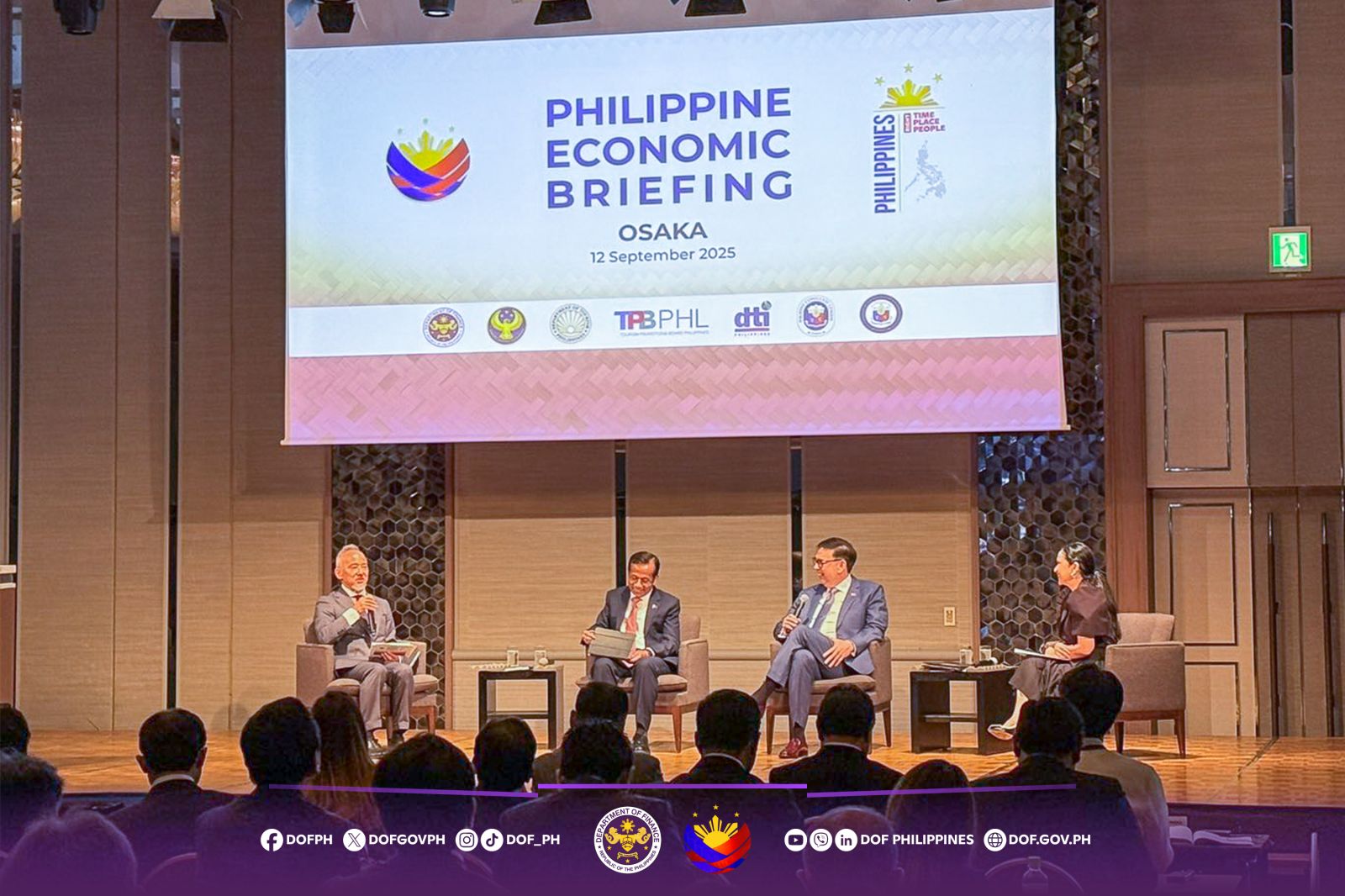
OSAKA, Japan — Finance Secretary Ralph Recto on Friday encouraged Japanese businesses to invest in the Philippines as the country positions itself as a safe, strategic, and rapidly growing hub in Southeast Asia.
Speaking at the Philippine Economic Briefing (PEB) attended by members of the Kansai Economic Federation and the Osaka Chamber of Commerce and Industry, Recto highlighted the Philippines’ robust growth momentum, pro-investment reforms, and demographic advantages.
The Finance chief pointed to emerging opportunities in digital infrastructure, renewable energy, and even space technology.
Recto said the Philippines' booming IT-BPM sector, young workforce, and rapid digital adoption make it a natural partner for Japan in AI, fintech, and data centers.
“This presents a strategic opportunity for our two countries to form a strong demographic partnership,” Recto stressed, contrasting the Philippines’ youthful population with Japan’s aging society.
Department of Economy, Planning, and Development Secretary Arsenio Balisacan said that Japanese entrepreneurs may also explore opportunities in green energy and manufacturing.
Recto touted the Luzon Economic Corridor, which he described as the Philippines’ future “logistics and manufacturing super-hub.” Since its launch, the corridor has already secured over 15 trillion Japanese yen worth of investments, including major projects backed by Japanese firms.
The Philippines is also opening private sector participation in the development of its first-ever Philippine Space Park, envisioned as a regional hub for the global space economy in partnership with the Japan Aerospace Exploration Agency (JAXA).
Despite what he called “two hot wars, a cold war, and a tariff war,” Recto said the Philippines has remained resilient, with the gross domestic product growing by 5.7% in 2024.
The Philippines, he noted, is on track to become the world’s 13th largest consumer market by 2030 and, by 2075, the 14th largest economy worldwide.
Recto framed the Philippines as a “strategic and stable safe haven” for Japanese investors, particularly those eyeing expansion outside Tokyo.
To attract more Japanese capital, Recto cited key reforms and incentives under the CREATE MORE Act, which allow:
- Full foreign ownership in sectors like telecommunications, airports, toll roads, shipping, and renewable energy
- Income tax holidays of up to 7 years, plus extensions for labor-intensive projects
- Special corporate income tax and enhanced deductions for up to 20 years
- Tailored incentives for up to 40 years for large-scale projects
Export-oriented enterprises, he added, are now exempt from VAT—a long-standing concern for Japanese companies operating in the Philippines.
Recto assured Japanese investors that the Philippine government is committed to transparency, good governance, and protecting foreign investments: “You are in the right place, at the right time, with the right partners.”
“Japan has always been more than a partner to us. You are our best friend in the region,” Recto said. “Your companies have a home in the Philippines.”
Balisacan added that the low inflation environment would boost investments in the country.
“Inflation is a significant factor in domestic demand. With the continued decline of inflation in recent months, we should see improvement in the expectations and optimism of the Filipino people. And of course, that will also drive the interest rate,” he said.
Balisacan said that the newly enacted Konektadong Pinoy Act would facilitate the expansion of Japanese companies in the provinces.
"So with greater connectivity, improved connectivity, not just physical but digital, that should encourage location dispersal of industries to other areas of the economy, not just through Manila and neighboring areas, which account for more than half of our economy. So there are a lot more opportunities in other areas in the Visayas, in Mindanao, and in Northern Luzon," he said.
Balisacan also said that the Philippines "can learn a lot" from Japan.
“We can learn a lot from them. They've invested, and they've evolved their economies in ways that are quite resilient. Even if a disaster hit them, they recover quickly and in a way that doesn't hurt their economies and their societies [in the] long term,” Balisacan said.
“So, we have so much to learn from them, and the innovations and technologies they bring into the country through investments will help us move in that direction.”
"When Japanese capital meets Filipino talent, there are no limits to what we can create together," Recto added.
The Philippine delegation also included Department of Trade and Industry (DTI) Secretary Ma. Cristina Roque, Department of Energy (DOE) Secretary Sharon Garin, and Department of Transportation (DOTr) Acting Secretary Giovanni Lopez as well as senior officials from the Department of Budget and Management (DBM), the Department of Public Works and Highways (DPWH), and the Bangko Sentral ng Pilipinas (BSP).
The briefing forms part of the Philippines’ broader engagement in Japan on the sidelines of the World Expo 2025 in Osaka. —with Vince Angelo Ferreras/VBL, GMA Integrated News

