

 GMA Brandtalk
 Tracking
 Archives

France assessing €200M loan to support PH blue economy agenda, climate reforms
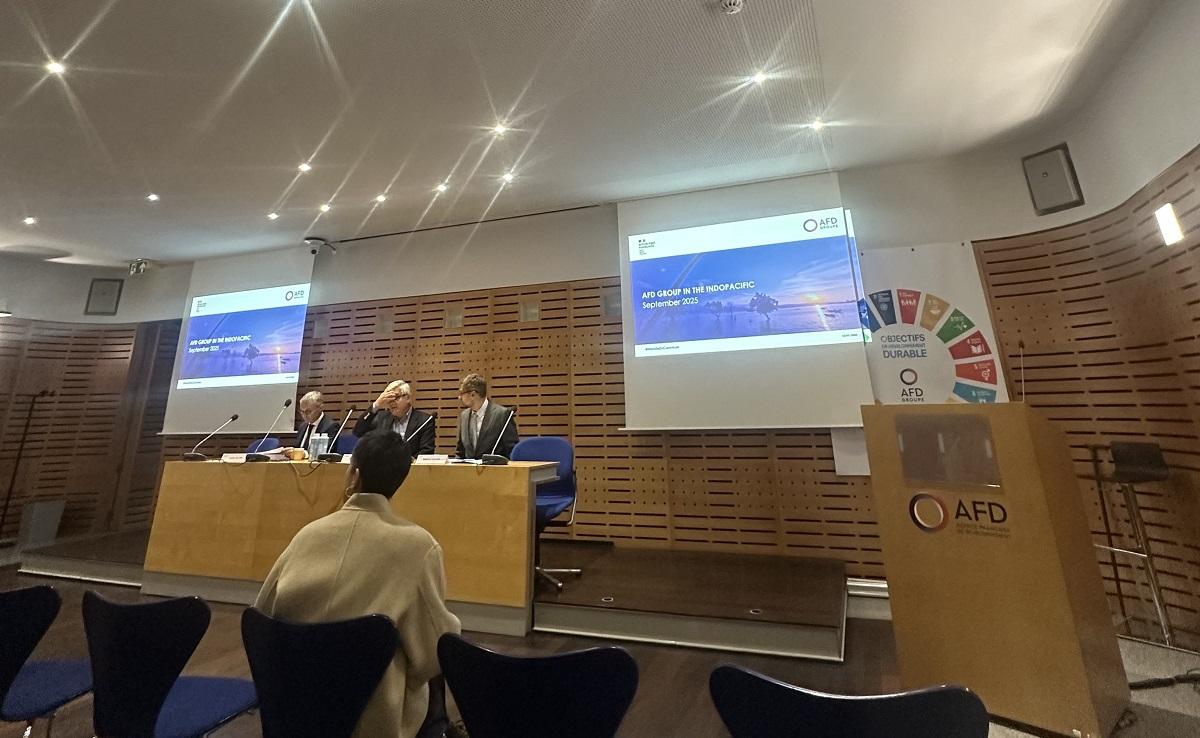
PARIS — France, through the Agence Française de Développement (AFD), is preparing a major support package for the Philippines to boost its fisheries, marine biodiversity, and climate resilience programs.
The proposal includes a €200-million policy-based loan and an additional €500,000 technical assistance grant, with the Department of Environment and Natural Resources and the Bureau of Fisheries and Aquatic Resources as key beneficiaries.
Marie-Cécile Thirion, Deputy Head of the Agriculture, Rural Development, and Biodiversity Division at AFD, explained, “We are looking at the 200 million euro. It's still under discussion. It's a budgetary aid for Philippines. It will be normally co-financed with the Asian Development Bank. And we are discussing with the Ministry of the Philippines on different reforms that we have an impact on the ocean.”
She added that AFD is also working with Philippine authorities on fisheries management, particularly to rehabilitate abandoned aquaculture areas.
“We are discussing with the Philippines management of fisheries to specifically assist coastal resources and especially the aquaculture rehabilitation of old aquaculture areas that… have been left over and that need to be rehabilitated.”
The latest support from AFD—France’s public development agency implementing policies on development and international solidarity—comes at a time when the Philippine government faces scrutiny over alleged irregularities in flood control projects.
Cyrille Bellier, AFD’s Director of Operations in Asia, noted that their engagement in the Philippines goes beyond the fisheries sector: “We are currently working on the Blue Economy project with the Filipino government,” he said. “It's an important year for us. Generally speaking, it would be around new commitments, so it increases the backlog and the volume of projects currently being implemented.”
France’s role in the Philippines’ energy transition
President Ferdinand Marcos Jr. has repeatedly emphasized his administration’s goal of diversifying the country’s energy mix with renewable sources, such as solar, wind, and geothermal, and even exploring nuclear options.
Yet, the Philippines remains one of Southeast Asia’s most coal-dependent nations, with coal still accounting for about 60% of its power generation mix.
Marcos has also pledged to reduce the Philippines’ carbon emissions by 75% by 2030 in line with its commitments under the Paris Agreement.
AFD highlighted that the Philippines, being highly vulnerable to climate change, has set ambitious climate targets.
Since 2021, it has been implementing the Climate Change Action Program, designed to support the country’s Nationally Determined Contributions submitted to the UN Framework Convention on Climate Change.
Philippe Orliange, Executive Director of AFD Operations, emphasized that France is ready to expand its role in helping the Philippines meet its energy transition goals.
“I’m tempted to say that the Philippines is certainly a country in which we'd like to work more in the community. Using the entire toolbox available, from budget support to projects with a strong business, matches the expectations of the Philippine government," he said.
He explained that France’s support would also have a strong financing component.
“Then there is a financial component of it, and here the range of options is quite broad. We can provide a development policy for corporate financing, which is aimed at supporting a policy with a matrix of objectives and indicators, or work directly on projects and clearly on providing financing for public transportation to reduce greenhouse gas emissions," he said.
AFD also noted that local public concerns may accelerate reforms: “One of the drivers of these changes is also air pollution, which is a major problem in the developed cities and which can lead to the public putting pressure on their government to act and move forward, because otherwise it becomes a health issue.”
The new assistance builds on AFD’s earlier initiatives in the Philippines, including the coral reef restoration project launched in 2020 at Shark Fin Bay near Pangatalan Island on Palawan’s northeast coast. —LDF/BM, GMA Integrated News

