

 GMA Brandtalk
 Tracking
 Archives

IMF downgrades Philippines economic growth forecasts for 2025, 2026
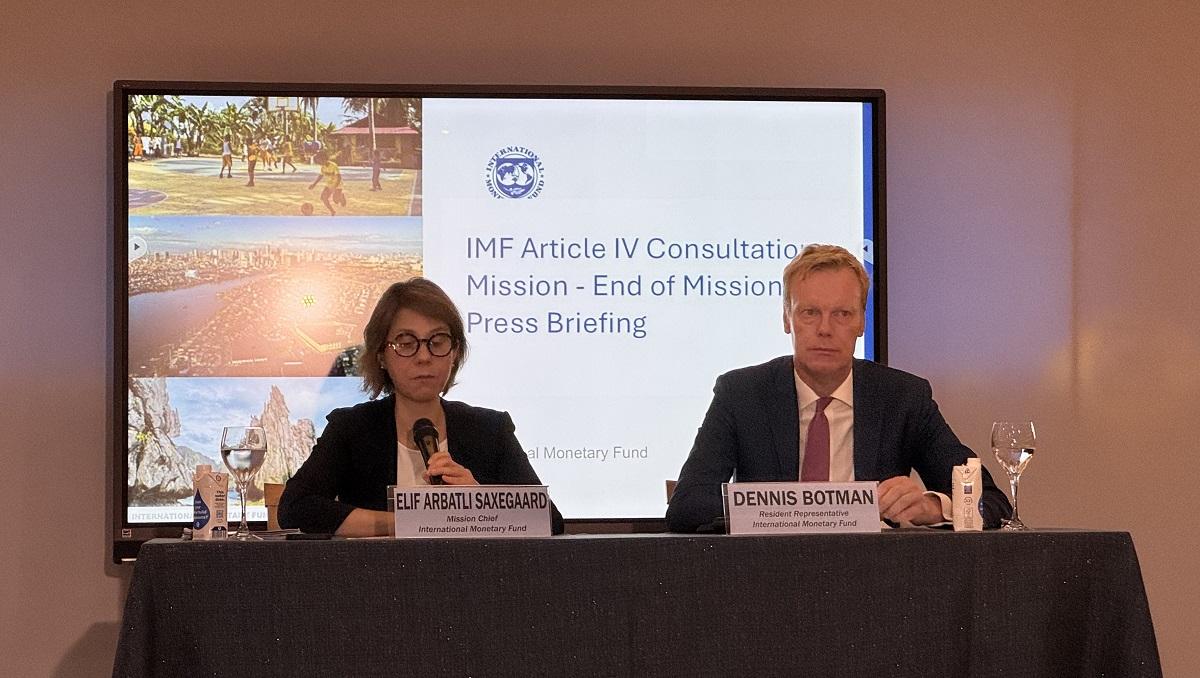
The International Monetary Fund (IMF) on Wednesday downgraded its Philippine economic growth outlook for this year and the next, citing the weaker-than-expected performance in the first half, and external risks such as global trade policy uncertainties.
According to IMF mission chief Elif Arbatli Saxegaard, the IMF now expects the country’s gross domestic product (GDP) growth to average 5.4% this year, lower than its previous forecast of 5.5%. It also downgraded its growth forecast for 2026 to 5.7% from 5.8% previously.
“The revision reflects factors related to the first half performance, which was weaker than expected,” Saxeegard told reporters in a briefing in Manila City.
Economic growth was recorded by 5.4% in the first quarter, and at 5.5% in the second quarter. The government’s economic team has set a target of 5.5% to 6.5% for this year.
“The higher tariffs which are imposed on Philippines exports to US, it will weigh on exports and investment, while the envisioned decline in government expenditure to meet the deficit target is expected to more than offset an increase in private consumption,” Saxegaard said.
US President Donald Trump in July announced a 19% tariff rate for Philippine goods shipped to the United States, down from the previously reported 20%, but still higher than the 17% rate set in April when Trump announced what he called reciprocal tariffs.
“Risks to the growth outlook are tilted to the downside. The main external risks stem from prolonged global trade policy uncertainty, geopolitical tensions, and disruptive financial market corrections,” Saxegaard said.
“On the domestic front, more frequent and intense climate shocks would cause notable macroeconomic losses. On the upside, accelerated implementation of structural and governance reforms would suport investor confidence and the fiscal multiplier and raise potential growth. Risks around inflation are broadly balanced,” she added.
The IMF expects inflation to average at 1.6% this year, within the central bank’s target range of 2.0% to 4.0%, with the pickup seen to be driven by food and transport prices, along with the decline in negative base effects.
“The authorities should consider implementing concrete and durable tax measures to limit the need for restraint in priority spending which tends to have a larger impact on growth and disproportionately impacts the vulnerable,” Saxegaard said.
Among the tax measures she cited are the enhanced use of data analytics and compliance risk management to support revenue mobilization, excise taxes on unhealthy food and sugared beverages, monitoring the costs of tax incentives and evaluating their benefits, along with enhancing the efficiency of the value-added tax (VAT).
Saxeegard also noted that while financial risks remain “moderate” and the country’s banking system has “strong” capital and liquidity buffers, she cited “vulnerabilities” in the real estate sector, given the exposure of the banking system to the sector as vacancy rates remain elevated in some segments. — BM, GMA Integrated News

