

 GMA Brandtalk
 Tracking
 Archives

BSP eases rates for fourth straight meeting, flags infra spending concerns
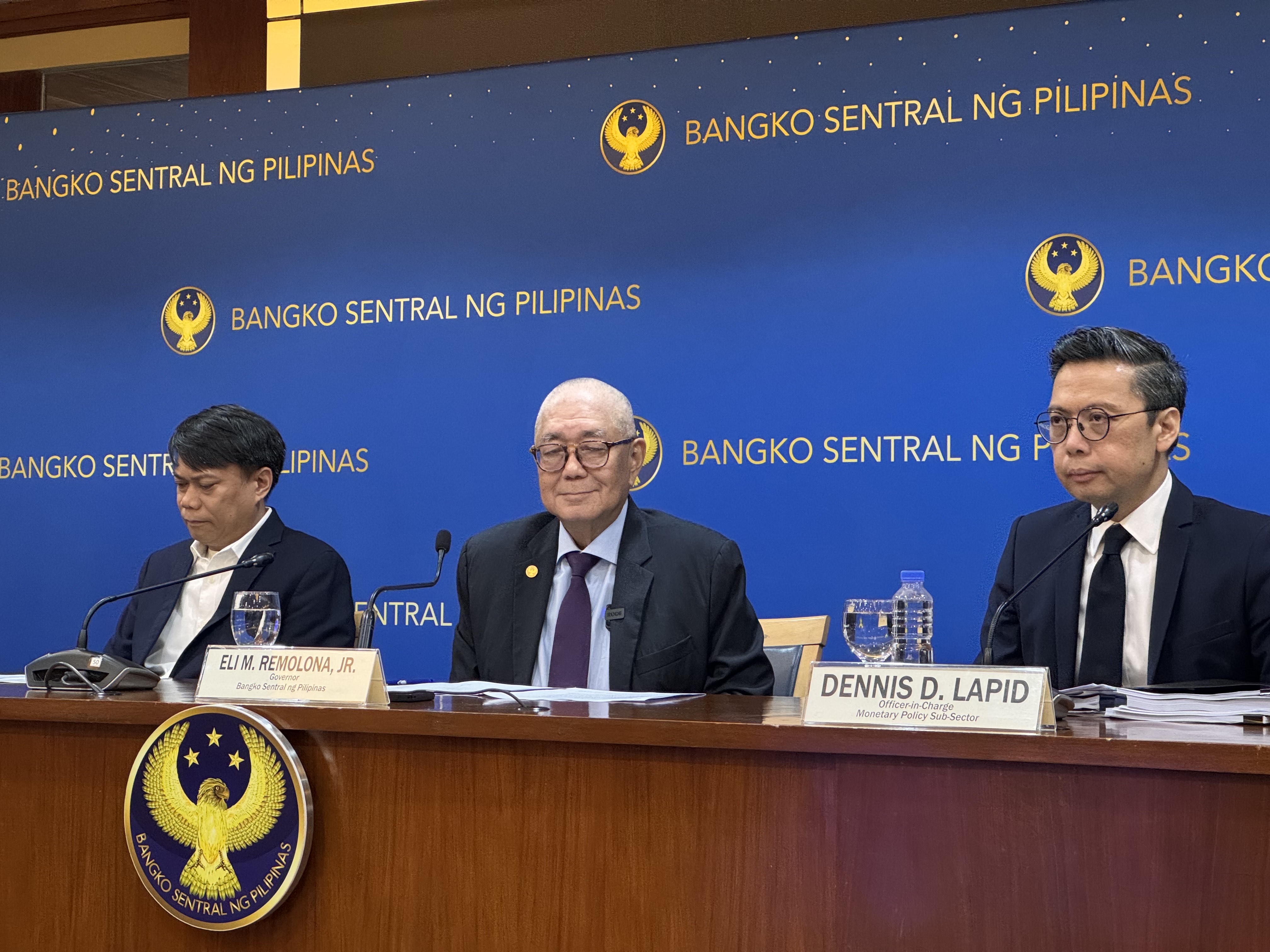
The Monetary Board of the Bangko Sentral ng Pilipinas on Thursday decided to continue its easing cycle for the fourth straight meeting, citing the "benign" inflation outlook, and the weakened economic growth projections amid infrastructure spending concerns.
According to BSP Governor Eli Remolona Jr., the Monetary Board decided to cut policy rates by 25 basis points, bringing the target reverse repurchase rate to 4.75%, the overnight deposit rate to 4.25%, and the overnight lending facility rate to 5.25%.
Policy rates were also reduced by 25 basis points each at the Monetary Board's meetings in August, April, and June.
"This decision reflects our latest reading of economic conditions, as well as judicious adjustments to our model. These adjustments reflect the new importance of business sentiment in light of the issues related to government infrastructure spending," Remolona told reporters in a briefing at the central bank’s headquarters in Manila City.
This comes as business sentiment has been hit by governance issues, with infrastructure spending—specifically flood control projects—being investigated by the Senate and by an independent commission.
President Ferdinand "Bongbong" Marcos Jr. earlier bared that 20% of the total P545-billion budget for such projects went to only 15 contractors, which he described as a "disturbing assessment."
Remolona said such issues are dragging investor sentiment, which would in turn weigh on economic growth, as seen on the local stock market which is widely regarded as an indicator of the country’s investment appetite.
"I think the biggest effect will be on investment, on private sector investment. Investment in services would be the largest, because that’s the largest sector. When it comes to which specific sector is affected the most, I would say it’s kind of spread evenly across sectors," he said.
The PSEi closed Tuesday, October 7, at 6,083.83, up by 1.39% or 83.51 points from the previous close. This compares with the close of 6,149.13 a month before on September 5. The broader All Shares index climbed by 0.8% or 29.27 points to 3,673.22 at the closing bell.
"The outlook for growth has softened in the near term. Governance concerns on infrastructure spending have weighed on business sentiment. The stock market has declined, and there are now fewer companies with expansion plans. Weaker growth means weaker demand, and lower inflation," Remolona said.
The central bank kept its inflation outlook for the year unchanged at 1.7%, while downgrading its projection for 2026 to 3.1% from 3.3% previously, and for 2027 to 2.8% from 3.4% previously.
"The outlook for inflation is benign and well within the target range. Inflation expectations remain well-anchored," Remolona said.
The governor cited the potential electricity rate adjustments and possible increases in tariffs on rice imports could add some upward pressures, but such risks are limited as price pressures are expected to ease.
"This outlook reflects in part the impact on business confidence of governance concerns about public infrastructure spending. Indications of moderating demand also reflect lingering uncertainty from the external environment," he said.
Marcos last month ordered a sweeping review of the proposed budget of the Department of Public Works and Highways (DPWH), the agency tasked to implement the flood control projects, under the National Expenditure Program (NEP).
He also earlier launched a website on flood control, and urged citizens to report any wrongdoings through the platform.
Aside from this, the Marcos administration has also established the Independent Commission for Infrastructure (ICI), in response to public calls for greater transparency and accountability in infrastructure spending. It is tasked to conduct an in-depth investigation into the alleged irregularities and misuse of funds in flood control, and other infrastructure projects.
Moving forward, Remolona said another rate cut is possible in 2025, with only one more Monetary Board meeting scheduled this year, on December 9, 2025. He also hinted at the possibility of further easing in 2026.
"It's possible, one more cut, but it’s also possible that we will have more cuts," he said.
To recall, Remolona during the August policy meeting said the benchmark rate was already close to the "sweet spot," but on Thursday said this has "moved a bit."
"We have also shifted our estimate of our 'Goldilocks Rate.' We believe it could be lower than before, giving us more room to reduce the policy rate," he said. — AOL/ VDV, GMA Integrated News

