

 GMA Brandtalk
 Tracking
 Archives

BSP delivers 5th straight rate cut, nears end of current easing cycle
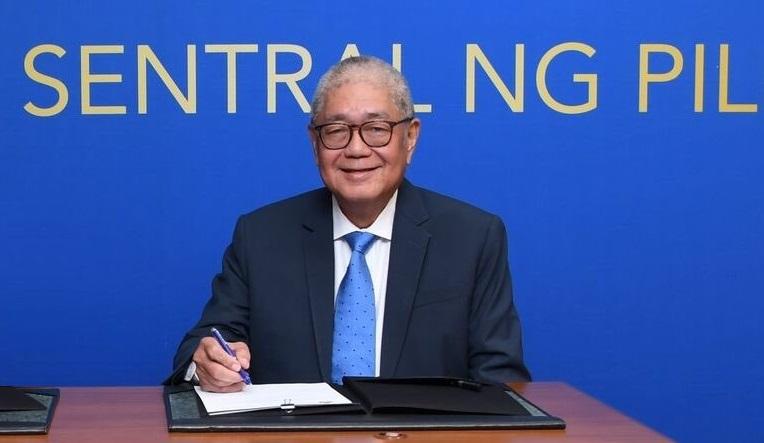
The Monetary Board of the Bangko Sentral ng Pilipinas (BSP) on Thursday decided to continue policy easing for the fifth straight meeting, delivering a 25-basis-point cut that brought rates to the lowest level in three years.
According to BSP governor Eli Remolona Jr., the Monetary Board decided to cut rates anew to bring the target reverse repurchase rate to 4.50%, the overnight deposit rate to 4.00%, and the overnight lending rate to 5.00%, as he hinted at the possibility of the end of the current easing cycle.
This level is the lowest since September 2022 when the overnight reverse repurchase rate was set at 4.25%, the overnight deposit facility rate at 3.75%, and the overnight lending facility rate was at 4.75%.
“On balance, the Monetary Board sees the monetary policy easing cycle nearing its end. Any additional easing will likely be limited and will be guided by incoming data,” he said in a briefing at the central bank headquarters.
“A rate cut is justified if things are worse than we thought—growth, inflation, just as what’s happened in Q3 and Q4. Growth was worse than we thought. If that kind of thing continues, then we’re likely to cut policy rates again,” he added.
Economic growth averaged 5% in the first nine months, after the third-quarter print came in at 4.0%, the slowest in four years since the 3.8% recorded in the first quarter of 2021 when the country implemented strict lockdown measures due to the COVID-19 pandemic.
The BSP has now reduced rates by a cumulative 200 basis points since the current easing cycle started in August 2024, after delivering a 25-basis-point cut each in April, June, August, and October.
“The outlook for inflation continues to be benign and inflation expectations remain firmly anchored,” Remolona said, with the inflation outlook for this year revised to 1.6% from its earlier projection of 1.7%.
It also revised its economic growth target for 2026 to 3.2% from 3.1% previously, and for 2027 to 3.0% from 2.8%.
“The Monetary Board noted that the outlook for domestic economic growth has weakened further. Overall business sentiment has continued to decline on concerns about governance issues and lingering uncertainty over global trade policy,” he added.
Moving forward, Remolona said domestic demand is expected to rebound slowly as the full impact of the current easing cycle works its way through the economy, and the quality of public spending improves.
Philippine lawmakers are now looking into alleged irregularities in public works spending, after President Ferdinand “Bongbong” Marcos Jr. in August disclosed that 20% of the total P545-billion budget for flood control projects went to only 15 contractors, which he described as a “disturbing assessment.”
This has hit government spending on public works and dampened consumer and investor sentiment, leading Department of Economy, Planning, and Development (DepDev) Secretary Arsenio Balisacan to concede that the country is unlikely to achieve its economic growth target for the third straight year in 2025.
“Monetary policy cannot address the corruption cycle directly, but it can compensate for the effects of that. The effects of that are on business sentiment and investor confidence. When those things weaken, they weaken growth and lower policy rates can compensate for that,” Remolona said.
Remolona earlier said economic growth could average 4.0% to 5.0% this year, with a gradual recovery seen to start by the middle of 2026. He now expects a recovery—which he said is “better than now”— in the second half of next year.
“The main factor would still be the governance issue. If investors feel that those issues are addressed, then we should see some recovery,” Remolona said.
Department of Economy, Planning, and Development (DepDev) Secretary Arsenio Balisacan has already conceded that the country is unlikely to achieve its economic growth target for the third straight year in 2025, following the weaker-than-expected third-quarter performance as corruptions concerns dampen consumer and investor sentiment. –NB/BM, GMA Integrated News

