

 GMA Brandtalk
 Tracking
 Archives

Unemployed Filipinos decreased slightly to 2.25M in November 2025 —PSA
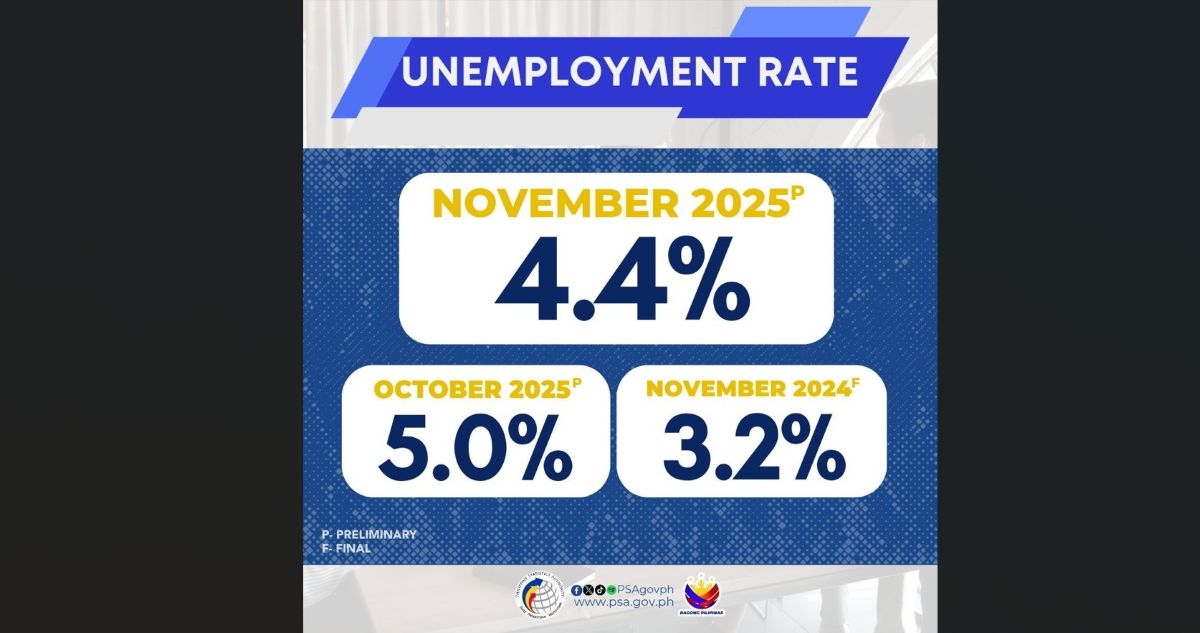
The number of unemployed Filipinos, those without jobs or livelihoods, saw a slight decline in November 2025, according to the results of the Philippine Statistics Authority’s (PSA) latest Labor Force Survey (LFS).
At a press briefing on Wednesday, National Statistician and PSA chief Claire Dennis Mapa reported that jobless individuals, ages 15 and above, decreased to 2.25 million from 2.54 million in October 2025.
This was, however, higher compared to the 1.66 million unemployed posted in November 2024.
As a percentage of 51.52 million participants in the labor force, who are actively looking for labor opportunities during the period, the number of jobless persons translated to an unemployment rate of 4.4%, down from 5% in October 2025.
This means 44 in 1,000 individuals do not have jobs or livelihoods during the period.
The number of employed persons, meanwhile, increased to 49.26 million from 48.62 million in October 2025.
Year-on-year, employed individuals in November 2025 was slightly lower than the 49.54 million seen in November 2024.
As a percentage of labor force participants, the number of employed Filipinos translated to an employment rate of 95.6%, up from 95% month-on-month but down from 96.8% year-on-year.
Mapa attributed the minimal increase month-on-month increase in employment but the higher year-on-year decline to the “strong typhoons that we experienced in the month of November” despite the onset of the holidays season, which brought a seasonal surge in labor demand.
In terms of month-on-month increase in employed persons, the top five sub-sectors with the largest growths were as follows:
- Other service activities - 621,000
- Wholesale and retail trade - 356,000
- Education - 173,000
- Construction - 143,000
- Accommodation and food service activities - 90,000
In terms of year-on-year growths, the following sub-sectors posted the highest increases:
- Public administration and defense - 185,000
- Education - 176,000
- Administrative and support service activities - 99,000
- Construction - 86,000
- Information and communication - 82,000
Meanwhile, the top five sub-sectors with the largest drop in the number of employed persons were the following:
- Agriculture and forestry - 517,000
- Public administration and defense - 121,000
- Fishing and aquaculture - 78,000
- Financial and insurance activities - 73,000
- Manufacturing - 64,000
Year-on-year, the top five sub-sectors with the highest decrease in employment are as follows:
- Accommodation and food service activities - 309,000
- Wholesale and retail trade - 258,000
- Other service activities - 250,000
- Manufacturing - 150,000
- Fishing and aquaculture - 56,000
Wage and salary workers accounted for more than half of the employed persons at 63.4% in November 2025.
This was followed by self-employed without any paid employees at 27.8%, unpaid family workers at 7.2%, and employers in their own family-operated farm or business at 1.6%.
Among wage and salary workers, those employed in private establishments accounted for the lion’s share at 77.8% of the total wage and salary workers and 49.4% of the total number of employed persons.
Those employed in government or government-controlled corporations followed with a share of 14.8% of the wage and salary workers and 9.4% of the total number of employed persons during the period.
Labor force participants slightly grew to 51.52 million from 51.16 million in October 2025 as well as from 51.2 million in November 2024.
In a statement, Department of Economy, Planning, and Development (DEPDev) noted that job losses were high in sub-sector in which severe typhoons during the period disrupted economic activity affecting 873,000 workers, which included accommodation & food service activities, wholesale and retail trade, other service activities, and fishing and aquaculture.
“The government is prioritizing investments in skills development, lifelong learning, and social protection systems to enable workers to transition across sectors and withstand economic shocks. Strengthening workforce competitiveness is one of the key elements to attract investments that generate quality jobs,” said DEPDev Secretary Arsenio Balisacan.
Underemployment rate, an indicator of job quality, declined to 10.4% from 12% in October 2025 and 10.8% in November 2024.
The number of underemployed, those employed persons who desire additional jobs or more hours of work, stood at 5.11 million out of 49.26 million employed individuals during the period.
Balisacan said that to minimize business disruptions and protect workers during severe weather events, the government will actively support establishments in developing and implementing Business Continuity and Resiliency Plans.
The country’s chief economist said the DEPDev is also pushing for the full implementation of the Philippine Innovation Act (Republic Act No. 11293), which fosters an innovation ecosystem, to develop more entrepreneurs and increase labor demand.
The DEPDev chief added that the government is likewise prioritizing the “Tatak Pinoy” strategy —the country’s 10-year national industrial roadmap aimed at boosting local industries, creating jobs, and elevating Filipino products to global standards.
Priority sectors include Information Technology and Business Process Management (IT-BPM) as well as Food and Agro-processing, which offer high potential for value-added production, export growth, and employment generation.
The recently enacted 2026 General Appropriations Act (GAA) supports these priorities through increased investments in quality education and programs for upskilling and reskilling.
“The 2026 National Budget serves as a strategic roadmap for safeguarding economic recovery and sustaining progress toward our long-term development goals. It prioritizes investments in education, health, agriculture, social protection, and job creation—sectors fundamental to building a more inclusive, competitive, and resilient Philippine economy,” Balisacan said.
'Recovery of economic activities'
The Labor Department attributed the slight increase in year-on-year employment to the continued demand for higher- and middle-level skill occupations, including technicians, professionals, and managers.
Labor Secretary Bienvenido Laguesma also said the month-on-month employment gains indicate the "recovery and the normalization of economic activities toward the end of the year, particularly as businesses ramp up operations in anticipation of the holiday season and year-end demand, and more people wanting short-term work engagements."
"The month-on-month gains in employment reflect the resumption of services and trade activities that were temporarily disrupted in the previous month due to reported natural calamities," Laguesma said.
Meanwhile, the DOLE chief noted the improvement in the year-on-year underemployment rate for November 2025, touting the agency's employment programs.
"The DOLE continues to closely monitor labor market developments and strengthen employment facilitation services through the expanded reach of Public Employment Service Offices, which placed more than 2.2 million jobseekers from January to November 2025 with a placement rate of 93%," he said.
"These efforts are complemented by sustained international cooperation underscoring the country’s role in advancing responsive and modern public employment services," Laguesma added.—With Sundy Locus/KG/AOL, GMA Integrated News

