

 GMA Brandtalk
 Tracking
 Archives

DEPDev warns of ‘severe’ scenario of 7.5% inflation amid Middle East conflict

The Department of Economy, Planning and Development (DEPDev) on Tuesday said inflation could accelerate to as much as above 7% should the conflict in the Middle East escalate further and for a longer period.
Discussing the DEPDev’s analysis on the economic impact of the US-Iran-Israel conflict to members of the House Representatives, Socioeconomic Planning Secretary Arsenio Balisacan presented two scenarios.
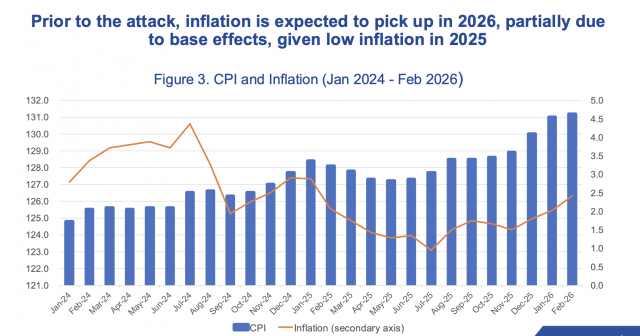
The first scenario is a situation in which crude oil prices average roughly $100 per barrel in March and stay at above $80 per barrel until May.
The second scenario, which he described as a more severe or situation, is that crude oil prices average at $140 per barrel and remain at more than $80 per barrel until September.
Under both scenarios, Balisacan said, inflation could breach the upper band of the government’s comfortable ceiling of 2% to 4% “given the increase in fuel prices, other non-food commodities, and food items.”
For scenario 1, inflation is seen to accelerate at a range of 4.5%% to 5.1% in March before it slows down slightly to 4.5% to 4.8% in April and hit an average of 4% to 4.2% in 2026 and further ease to 3.5% to 3.6% in 2027.
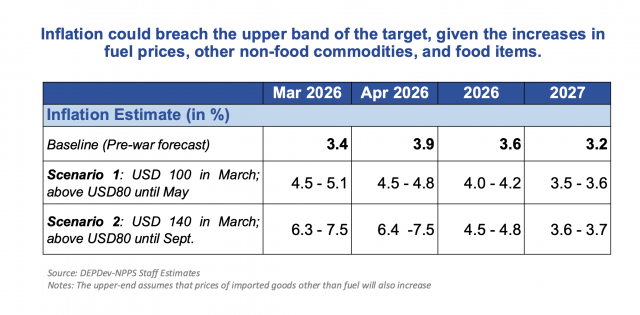
Prior to the Middle East conflict, the DEPDev was expecting inflation to already pick up due to base effects given low inflation environment seen in 2025.
In its baseline or pre-war forecast, the socioeconomic planning agency was expecting inflation to average at 3.6% in 2026 and 3.2% in 2027.
On the conflict’s impact on domestic fuel prices, Balisacan said diesel prices could spike by as much as 62% in March under a “more severe” scenario at P96.76 per liter against a baseline estimate of P59.68 per liter.
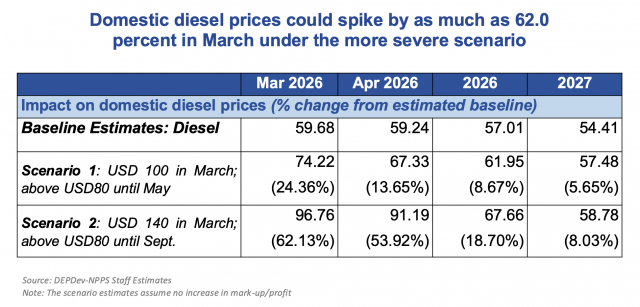
For gasoline, the “more severe” situation could translate to a spike of as much as 52% this month at P88.79 per liter compared to the baseline or pre-war estimate of P58.53 per liter.
This week, retailers are set to increase prices per liter gasoline by P7.00 to P13.00, diesel by P17.50 to P24.25, and kerosene by P32.00 to P38.50.
The big-time adjustment came as the Strait of Hormuz, a key global shipping corridor located between Iran and Oman, has been closed off amid the ongoing conflict among the United States, Israel, and Iran. It is considered the world’s most vital oil export route, connecting the biggest Gulf oil producers with the Gulf of Oman and the Arabian Sea.
OFW deployment, remittances
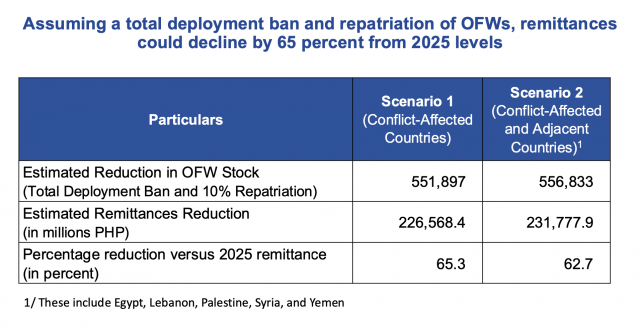
Assuming there would be a total deployment ban and repatriation of OWFs in the Middle East, Balisacan said that remittances could slide by 65% from the 2025 levels.
Under scenario 1, the DEPDev chief said that if there would be a total deployment ban and 10% repatriation from conflict-affected countries, the estimated reduction in OFW stock would be 551,897 with an estimated remittances decline of P226.568 billion.
Under scenario 2, in which the deployment ban and repatriation would be extended to adjacent countries such as Egypt, Lebanon, Palestine, Syria, and Yemen, the OFW stock reduction would be around 556,883 with an estimated remittances contraction of P231.777 billion versus 2025 levels.
The DEPDev chief recommended the easing of transport costs for the public through the suspension of excise tax on fuel, implementing safety net program for the most vulnerable groups, implementing staggered price hikes, expanding the use of low-cost bioethanol to reduce fuel prices, implementing energy conservation programs, and in the long run reducing the country’s dependence on imported fuel by incentivizing renewable energy and harmonizing permits for nuclear power plant projects.
The DEPDev earlier estimated that suspending the excise tax on fuel products could cut oil prices by P6 per liter for diesel and P10 per liter for gasoline. On Tuesday, the House ways and means committee approved an unnumbered substitute bill that would allow the President to suspend or reduce excise taxes on fuel. — BM, GMA Integrated News

