

 GMA Brandtalk
 Tracking
 Archives

Jobless Pinoys rose to 2.96M in January 2026 — PSA
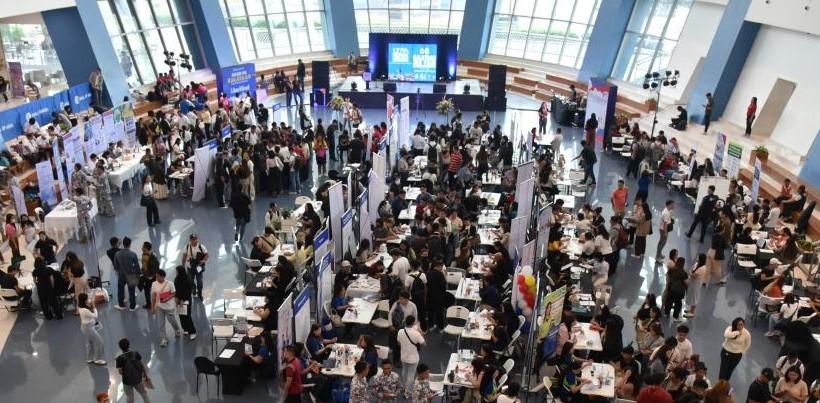
Joblessness among Filipinos increased in January 2026 due to seasonal post-holidays decline in labor demand and economic activity, according to the results of the Philippine Statistics Authority’s (PSA) Labor Force Survey.
At a press briefing on Friday, Deputy National Statistician Divinia Gracia del Prado reported that unemployed individuals, ages 15 and above, swelled to 2.96 million in the first month of the year from 2.26 million in December 2025 and 2.17 million in January 2025.
As a percentage of 50.89 million participants in the labor force, who are actively looking for labor opportunities during the period, the number of jobless persons translated to an unemployment rate of 5.8%, higher than the 4.4% rate seen in December 2025 and 4.3% in January 2026.
This means 58 in 1,000 individuals have no jobs or livelihoods during the period.
Del Prado said this is the highest unemployment rate since June 2022, when it clocked in at 6.0%.
The PSA official said that in January, about 306,000 were looking for employment but failed to secure jobs, while 196,000 were waiting for the results of their job applications.
Del Prado explained that availability of job opportunities usually decline during January, immediately after the increase in labor demand to meet the seasonal growth in economic activities during the “ber” months.
“That’s the common trend after the Christmas season, there is a decline in employment,” she said.
Similarly, the number of employed persons decreased to 47.94 million in January 2026 from 48.49 million in January 2025 and 49.43 million in December 2025.
As a percentage of 50.89 million labor force participants, employment rate stood at 94.2%, lower than the 95.7% seen in January 2025 and 95.6% in December 2025.
PSA data showed the services sector remains as the top sector with the highest employment share of 63.6%. This was followed by industry and agriculture sectors, accounting for 18.3% and 18.1%, respectively.
In terms of sub-sectors, the top three with the highest employment shares were wholesale and retail trade at 19.3%, agriculture and forestry at 15.7%, and construction at 9.6%.
Meanwhile, the top five sub-sectors with the highest year-on-year decrease in employed persons are as follows:
- Agriculture and Forestry - 1.42 million
- Wholesale and retail trade - 729,000
- Fishing and aquaculture - 140,000
- Financial and insurance activities - 15,000
- Real estate activities - 7,000
The top five sub-sectors with the highest increase in the number of employed are the following:
- Administrative and support service activities - 403,000
- Public administration and defense; Compulsory social security - 342,000
- Manufacturing - 326,000
- Transportation and storage - 160,000
- Human health and social work activities - 87,000
Moreover, the PSA reported that wage and salary workers accounted for the majority of the workforce in January 2026 at 68.8%.
This was followed by self-employed without any paid employee at 24.7%, unpaid family workers at 4.2%, and employers in own family-operated farm or business at 2.4%.
Among wage and salary workers, PSA data showed that those employed in private establishments contributed the lion’s share of 78.5% of the total wage and salary workers or 54% of the total number of employed persons.
Those employed in government or government-controlled corporations followed with a share of 14.3% of the wage and salary workers or 9.9% of the total number of employed persons during the period.
Region XII or SOCCSKSARGEN saw the highest employment rate at 96% in January 2026, while Region V or Bicol region posted the lowest employment rate of 91.8%.
Moreover, the eight regions which posted unemployment rate higher than the national average of 5.8% in January 2026 are as follows:
Region V - 8.2%
Region VIII (Eastern Visayas) - 7.7%
Region IX (Zamboanga Peninsula) - 6.7%)
Region XIII (Caraga) - 6.53%
Negros Island Region - 6.50%
Region IV-A (CALABARZON) - 6.4%
Region X (Northern Mindanao) - 6.1%
National Capital Region - 6.0%
Underemployed
On the other hand, underemployed persons —employed persons who express the desire to have additional hours of work in their present job, or to have an additional job, or to have a new job with longer hours of work— stood at 6.35 million of the 47.94 million employed individuals, translating to
underemployment rate of 13.2%, slightly down from 13.3 percent recorded in January 2025.
Of the total underemployed in January 2026, 51.6% worked less than 40 hours in a week or “visibly underemployed,” and 48.4% worked 40 hours or more in a week or “invisibly underemployed.”
Geopolitical tensions
In a statement, Department of Economy, Planning and Development (DEPDev) Secretary Arsenio Balisacan said the Philippine government is stepping up its support for the country’s workforce amid rising global uncertainties.
“Given elevated geopolitical tensions and global uncertainties, strategic policies are needed to bolster labor market resilience. The government continues to pursue a comprehensive response to support affected workers in the short term while fostering a dynamic and robust labor market in the medium and long term,” Balisacan said.
The DEPDev chief said the government is strengthening safety nets to provide immediate relief to affected workers amid the ongoing conflict in the Middle East, which includes targeted fuel subsidies for transport operators, farmers, and fisherfolk, as well as measures to ease commuting costs and maximize existing emergency employment assistance programs such as the “Tulong Panghanapbuhay sa Ating Disadvantaged/Displaced Workers” and other livelihood programs.
Balisacan added the government is likewise leveraging digital technologies to enhance labor market programs, as seen in the Technical Education and Skills Development Authority’s (TESDA) recently launched Skills Passport, which facilitates job-skills matching which can inform the design of skill training programs to equip jobseekers —including repatriated Overseas Filipino Workers (OFWs) with capabilities for higher-value jobs.
The government is also strengthening its reintegration programs for OFWs to help affected workers find gainful employment or entrepreneurial opportunities.
“Our priority is clear: create more and better jobs at home, strengthen industries, equip our workers with the skills needed for higher-value employment, and ensure that those affected by global disruptions, including OFWs, can transition smoothly into productive opportunities here in the Philippines,” the country’s chief economist said. — RSJ, GMA Integrated News

