

 GMA Brandtalk
 Tracking
 Archives

PH econ team to meet Marcos on fuel tax suspension after Holy Week
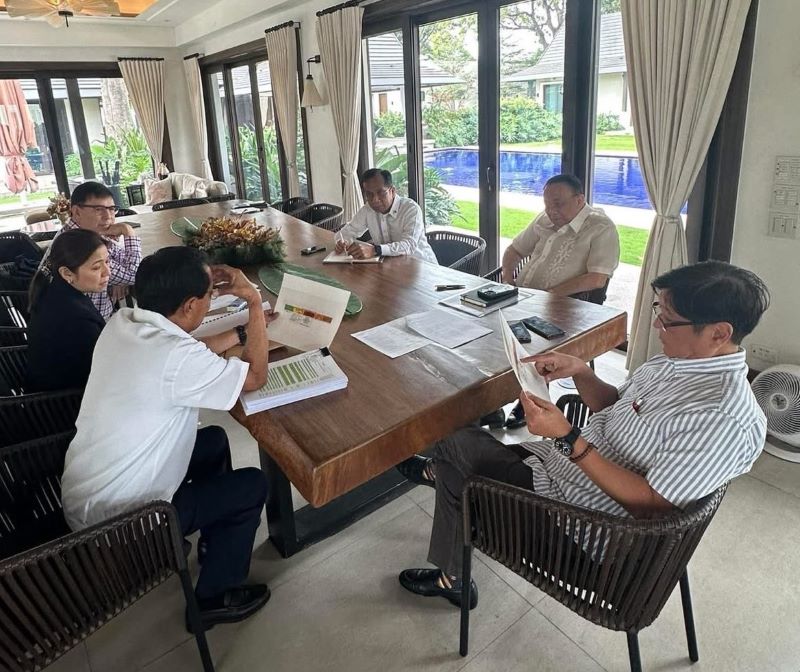
The inter-agency Development Budget Coordination Committee (DBCC) is set to meet with President Ferdinand “Bongbong” Marcos Jr. next week to present its recommendations regarding the possible suspension of excise taxes on fuel products.
According to the Department of Budget and Management (DBM), which chairs the DBCC, the body has already met and a final policy direction is now being determined.
“The Development Budget Coordination Committee (DBCC) has convened its special meeting to assess the implications of rising global oil prices and to evaluate possible policy responses, including measures on fuel excise taxes,” DBM Undersecretary Goddes Hope Libiran said in a mobile message.
“The Committee has since formulated its recommendations, which are currently undergoing internal consolidation. The DBCC Principals are scheduled to meet with the President early next week to present these recommendations for his perusal and consideration,” she added.
Libiran's remarks came on Wednesday, April 1, the last working day of the week. There will be no government work on Thursday, April 2, and Friday, April 3, which were earlier declared regular holidays in commemoration of the Holy Week.
Under Republic Act 12316 signed into law by President Ferdinand “Bongbong” Marcos Jr. on Wednesday, March 25, the President may suspend or reduce excise taxes on fuel upon the recommendation of the DBCC, in coordination with the Department of Energy (DOE) Secretary.
The suspension or reduction, however, can only be done for a maximum of three months when the average Dubai crude oil price based on Mean of Platts Singapore (MOPS) reaches or exceeds $80 per barrel for one month. Brent crude prices have been hovering at $102 per barrel as of writing time.
Finance Undersecretary Karlo Fermin Adriano has since clarified that Marcos may issue the executive order whether to suspend or reduce the excise tax on fuel products by April 12 or April 13, as the law only takes effect 15 days after its publication in the Official Gazette or a newspaper of general circulation.
Should Marcos decide to totally suspend the excise taxes, this would mean a reduction of P10.00 per liter for processed gas, P6.00 per liter for diesel fuel oil, P4 per liter for aviation turbojet fuel and aviation gas, and P3.00 per kilogram for liquefied petroleum gas (LPG).
Locally, fuel retailers on Tuesday implemented another round of pump price hikes, marking the 12th straight week of increases for gasoline, and the 14th for both diesel and kerosene.
Marcos also earlier declared a state of national energy emergency and ordered the adoption of a Unified Package for Livelihoods, Industry, Food, and Transport (UPLIFT), to ensure energy supply stability, and support key sectors such as transport, agriculture, and micro, small, and medium enterprises (MSMEs).
Chaired by the DBM, the DBCC counts as members the Department of Finance (DOF), the Department of Economy, Planning, and Development (DepDev), and the Office of the President.
DepDev Secretary Arsenio Balisacan earlier warned the country’s inflation rate could shoot up to double-digit levels as diesel prices are seen to grow 176% to P162.50 per liter in May should crude hit $200 per barrel, the “most severe scenario.”
“We will provide further updates once a final policy direction has been determined,” Libiran said. —RF, GMA News

