

 GMA Brandtalk
 Tracking
 Archives

2026 is 'right year' for PH-EU free trade agreement, says ambassador
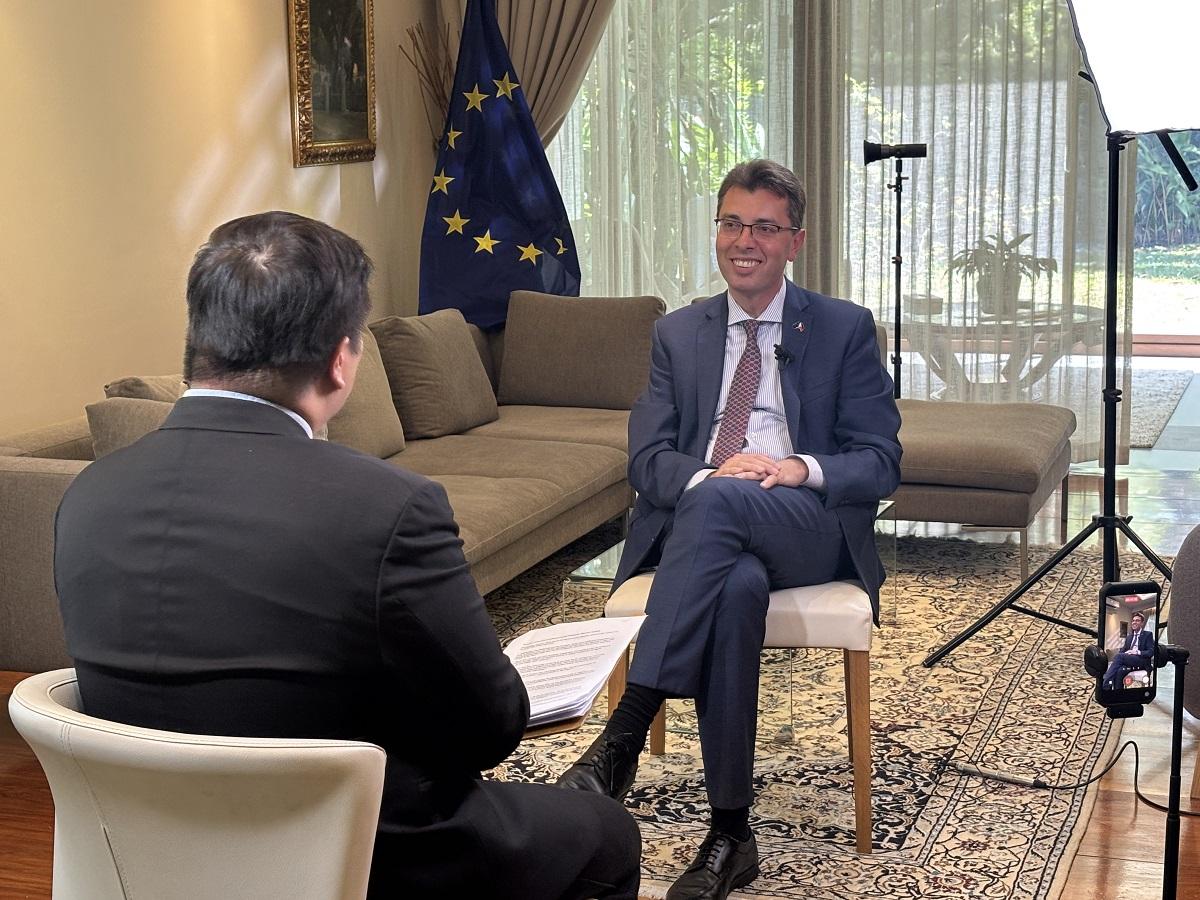
The European Union believes this year is the “right” time to conclude negotiations for a free trade agreement with the Philippines, a deal the bloc said could bring more investments, jobs, and wider market access to both sides.
In an exclusive interview with GMA News, European Union Ambassador to the Philippines Massimo Santoro said he is optimistic that negotiations could be completed within the year.
“I'm confident that this is the right year. I hope it's sooner than later this year. The rest will depend , no pressure on the ability for negotiators to come to an end,” Santoro said.
The EU and the Philippines officially resumed FTA negotiations in March 2024, after talks were put on hold following the second round in 2017. The European Commission has said the final text of any agreement will depend on the outcome of negotiations and will be made public before signature and ratification.
The EU is composed of 27 member states: Austria, Belgium, Bulgaria, Croatia, Cyprus, Czechia, Denmark, Estonia, Finland, France, Germany, Greece, Hungary, Ireland, Italy, Latvia, Lithuania, Luxembourg, Malta, the Netherlands, Poland, Portugal, Romania, Slovakia, Slovenia, Spain, and Sweden.
Santoro said a concluded FTA would give an important push to reciprocal exports of goods and services, and could encourage more European companies to invest in the Philippines.
“For the Philippines, it will also translate into interesting job creation opportunities because clearly when investors from the European Union come to the Philippines, this also implies having more job opportunities for Filipino citizens,” he said.
According to Santoro, an FTA could mean zero or significantly reduced tariffs for Philippine goods and services entering the European market, and vice versa.
The Philippines currently benefits from the EU’s Generalised Scheme of Preferences Plus or GSP+, a trade arrangement that removes import duties for products from selected developing countries. The Philippines is one of the countries listed under the EU’s GSP+ arrangement as of 2025.
EU eyes wider use of satellite data in PH
Santoro also said the EU wants to further expand the Copernicus Capacity Support Action Programme for the Philippines, or CopPhil, a €10-million EU-funded program aimed at helping the country use satellite data for disaster management, climate monitoring, environmental protection, agriculture, and food security.
CopPhil, implemented with the Philippine Space Agency, the European Space Agency, and the Department of Science and Technology, includes the establishment of a Copernicus data center or mirror site in the Philippines, pilot services for earth observation, and training for Filipino technical experts.
Santoro said the program uses satellites “allowing for the observation of Earth from higher than the sky,” which can help authorities check crops, assess the impact of natural disasters, and respond to climate-related risks.
He said the program is not just about giving the Philippines access to satellite data, but also helping Filipino experts read and use the information properly.
Santoro said the EU’s entry point is the Philippine Space Agency, with other agencies such as the Department of Environment and Natural Resources and the DOST also involved.
He added that the Philippines could eventually become a regional hub for Copernicus data in ASEAN, with satellite information stored, read, and interpreted in the country before the program is expanded to other Southeast Asian countries.
EU backs rules-based order in South China Sea
On maritime security, Santoro said the EU and the Philippines have launched a dialogue on security and defense, including cooperation on maritime issues.
He said both sides share a commitment to the international rules-based order, peace, and stability in the South China Sea.
China continues to assert sweeping claims in the South China Sea, including waters within the West Philippine Sea, but the 2016 arbitral ruling found no legal basis for China to claim historic rights to resources within the so-called nine-dash line. The tribunal also found that certain areas are within the Philippines’ exclusive economic zone and that China had violated the Philippines’ sovereign rights. China has rejected the ruling.
Santoro said the EU supports the Philippines, as ASEAN chair, in pushing for a substantive Code of Conduct in the South China Sea.
He also reaffirmed EU support for making the Code of Conduct legally binding.
“The moment it is legally binding, normally we consider that when something is legally binding, then typically you also have specific mechanisms which come into place in the moment that what is legal is not respected,” Santoro said.
He added that a legally binding COC would “trigger… the possibility of using specific mechanisms,” which is why the EU is generally supportive of giving the agreement a binding legal nature.
EU response to Middle East crisis
Santoro said the EU has responded to the Middle East crisis through political, diplomatic, security, humanitarian, and energy-related measures.
He said both the EU and ASEAN immediately called for de-escalation, dialogue, and for parties to stop fighting and return to negotiations.
“The European Union has immediately, like ASEAN, called for de-escalation, has called for dialogues, has called the parties to stop fighting and to sit around a negotiating table,” Santoro said.
Santoro said the crisis has been discussed repeatedly in Brussels at the level of heads of state and government, foreign ministers, and other ministerial formations because of its impact beyond foreign policy.
He said the conflict has also affected the economy and energy security, requiring what he described as a “multifaceted” response.
Santoro also cited the EU’s Operation ASPIDES, a defensive maritime security mission under the EU’s Common Security and Defence Policy. The EU Council said ASPIDES was launched in 2024 in response to threats in the Red Sea and was extended until February 2027 to help safeguard freedom of navigation and maritime security.
Santoro said EU ministers had discussed reinforcing the current mission and the possible extension of its mandate to cover the Strait of Hormuz.
“On the extension, we are not there yet in the political discussion, while on the reinforcement, work is already ongoing to reinforce it according to its current mandate,” he said.
He added that the EU has also intensified contacts with partners in the Middle East, including through bilateral engagements and through the Gulf Cooperation Council.
Santoro said the crisis also highlights the importance of energy diversification, a lesson the EU had already learned from Russia’s aggression against Ukraine.
“Since that moment, we have been, as European Union, diversifying much more than before,” he said.
For the Philippines, Santoro said the situation similarly points to the need for further diversification, especially as global conflicts continue to create pressure on energy supply and prices. — BM, GMA News

