

 GMA Brandtalk
 Tracking
 Archives

ADVERTISEMENT
Filtered By: Money
Money
Peso seen staying strong as foreign funds pour into emerging markets
+
Make this your preferred source to get more updates from this publisher on Google.
(Updated 6:34 p.m.) The peso is seen further strengthening as investors in search for higher yields continue to flock to emerging markets such as the Philippines, analysts said Wednesday.
The peso has so far appreciated by 6.82 percent to P40.85:$1 on Wednesday from P43.84 as of end December 2011.
This is bad news for sectors that earn in dollars, like exporters and overseas Filipinos.
With the government trying to curb the peso's rise, affected sectors may have to continue finding ways to make ends meet, according to officials and analysts. 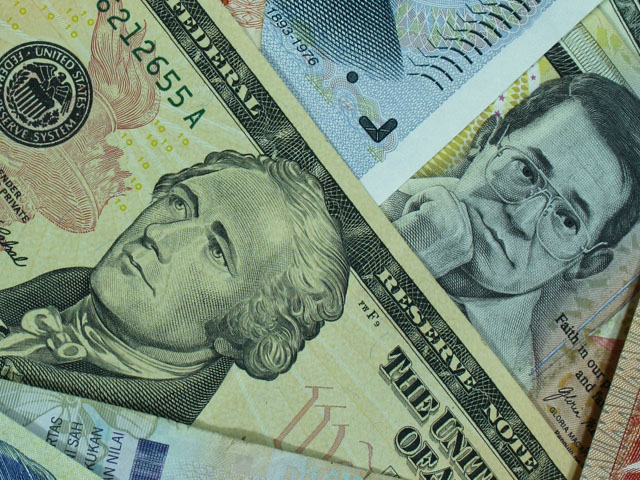
"The peso will remain strong and will still be at the P40-to-a-dollar level in 2013," Marianne Joy Vital, executive director at the UP-based Institute for Development and Econometric Analysis Inc., told GMA News Online.
In a separate interview, Metropolitan Bank & Trust Co. research head Ildemarc Bautista noted that the Philippine unit may even strengthen further to P38 to P39 per dollar.
Both Vital and Bautista said the trend will continue as investors seek for better yields and place their money in emerging markets amid problems in advanced economies.
The peso's strength, analysts said, will particularly hit exporters and overseas Filipinos who are now earning less in peso terms. Exporters also "try to be more efficient to cut down costs. It's easy to tell exporters to do this and do that... It's easy to say that," he added. The peso's appreciation is a "mixed bag... [of] good and bad sides," Bautista noted. "The good side is that imports would be cheaper, so oil and food costs can go down. The bad side is there are sectors that will be hit." — VS, GMA News
Tough times for exporters
Noting that the appreciation has resulted in "small-scale exporters downsizing or even closing shop," Sergio R. Ortiz-Luis, president of Philippine Exporters Confederation Inc. (PhilExport), said the government must continue to help temper the peso's rise.
"We would like the government to protect the exporters and local industries that cannot compete with cheap imports," he said in separate phone interview, pointing to monetary tools that the Bangko Sentral ng Pilipinas can employ.
Bangko Sentral Deputy Governor Diwa Guinigundo noted that policy makers are employing monetary tools in the market. "BSP is doing what it can to help temper peso appreciation," he said in a text message.
The Monetary Board has cut interest rates to record lows of 3.5 percent for overnight borrowing and 5.5 percent for overnight lending, the central bank official said.
The rate cuts were aimed at "reducing foreign exchange flows," he said.
Such a policy tool can discourage investors from placing their money in fixed-yielding instruments that give low returns.
Institute for Development and Econometric's Vital said benign inflation – which settled at 2.8 percent in November – has "created plenty of room for interest rates to go down further."
Guinigundo, however, said exporters should "hedge their FX [foreign exchange] position and shape up to be more competitive."
To lower risks in foreign exchange fluctuations, the Bangko Sentral introduced hedging in 2010 when the peso reached 45:$1. Thus, exporters could hedge their foreign exchange position by setting a fixed rate ahead of the transaction.
"The BSP will do everything in its power but... [exporters] have to do their share," said Guinigundo.
But small-scale exporters does not have the capacity to play hedging game – unlike "exporters with huge shipments" – said PhilExport's Ortiz-Luis.
Boon or bane for overseas Filipinos?
Because of the situation, overseas Filipinos will likely send in more money to fill the gap in the exchange rate as the dollar continues to become cheaper in peso terms, Institute for Development and Econometric's Vital noted.
The World Bank has forecast money transfers from overseas Filipinos to hit a record high of $24 billion this year to cope with the rising peso.
The multilateral lender, however, said migrant workers may not be able to control the urge to send more dollars to meet the needs of their family back home.
In order to cope with a strong peso, Metrobank's Bautista suggested that overseas Filipinos use their money more efficiently. "OFWs [overseas Filipino workers] should cut down on non-essentials and start investing in instruments and not just real estate."
Apart from investing in mutual funds or trust funds, overseas Filipinos can also start a business, said Bautista. "Since, you are earning less in dollars, then start earning in pesos," he added.

